Monday, September 16, 2013
From the Vault: JFK
BLOGGER'S NOTE: I'm re-posting this review, originally written when JFK opened in 1991, as part of The Oliver Stone Blogathon occurring through Oct. 6 at Seetimaar — Diary of a Movie Lover

Seldom has reviewing a film proved as problematic as Oliver Stone's JFK. So much has been written about what is — and isn't — accurate in this film that I went in desperately trying to view solely on a cinematic basis, ignoring the fact that it concerns that fateful November day in Dallas in 1963. That sort of objectivity ends up being impossible because JFK demands evaluation and analysis and obliterates any chance of passive viewing with its strange hybrid of thriller, murder mystery and documentary.
Kevin Costner plays the lead in Stone's story as New Orleans District Attorney Jim Garrison, who launched a full-fledged investigation into the conspiracy he believed left both John F. Kennedy and the country mortally wounded. "Fundamentally, people are suckers for the truth," Donald Sutherland's Deep Throat-type character tells Garrison at one point in the film. While it remains to be seen whether Stone's version contains more truth than the preposterous idea that Lee Harvey Oswald (played well by Gary Oldman, part of the film's gargantuan, excellent ensemble) acted alone, fascination with the assassination keeps this three-hour film compulsively watchable.
Problems plague the film other than the ones that spark so much debate. Despite allegations that the film comes off as homophobic (I see why that charge has been leveled) or exists as nothing more than propaganda (could be), it fares fairly well. Stone keeps the pace speeding along most of the time except for a middle section that lags. His editing and jump-cuts that mix real footage, re-creations and original material triumph, especially in the film's very good opening segments. The movie stumbles the most when it presents scenes of Garrison's domestic life with his wife Liz (a thankless task given to the usually reliable Sissy Spacek, saddled with dialogue along the lines of "I think you care more about John Kennedy than your own family!") It also doesn't help that Garrison's son (played by Stone's own 7-year-old son Sean) never ages though the film covers more than half a decade.

Other demerits include John Williams' score, which nearly overpowers important scenes such as Sutherland's magnetic spinning of key elements of the "conspiracy" so that it makes sense as he's sharing it, and, it should really go without saying, Costner himself. While he manages to be fairly consistent with his Southern accent, he still can't emote effectively. He's a star, not an actor. Much of the popular opinion about the real Garrison refers to him either as someone seeking publicity or a crackpot. Regardless, Costner can't convey his obsession or possibly unstable nature. In his overrated Dances With Wolves, his lack of acting skills presented a similar problem. Both JFK and Dances would have been better served if they'd cast a performer capable of portraying people losing control. Lt. Dunbar tries to commit suicide and then asks to be placed on the frontier, but Costner couldn't pull off that conflict any more convincingly than he pulls off Garrison's drive for the truth.
Thankfully, able supporting performers abound to pick up the slack, even if they appear for a single scene. Actors deserving particular praise include Ed Asner, Kevin Bacon, John Candy, Jack Lemmon, Walter Matthau, Joe Pesci, Sutherland and Tommy Lee Jones, who gives a good performance despite the possible perception of his character as an offensive stereotype. Structurally, the film weakens in its final act by climaxing with Garrison's prosecution of Clay Shaw (Jones). While this conclusion comes naturally to a film focused on Garrison, it seems anticlimactic to the film's real subject — dealing with the demons of the past. Stone's obsession with the Vietnam era equals Garrison's with Kennedy's murder. Methods separate Garrison's obsession from Stone's. Stone uses cinema as his rosary to drag the audience kicking and screaming into his personal confessional. With JFK, that's not altogether inappropriate. Even people born since the assassination grew up with the myths and the facts of Nov. 22, 1963, as part of their lives, though for most of the younger of us, Jim Garrison and his actual prosecution of Clay Shaw was something few of us knew about until Stone's movie.
Growing up though with the history of the Kennedy and Martin Luther King assassinations ingrained in our brains shortened our attention span of shock when John Lennon, Reagan and Pope John Paul II encountered bullets in a period of just a few months. The explosion of the space shuttle Challenger seemed to affect us for only an hour or two instead of the lifelong effect JFK's assassination had on an earlier generation.
Personally, I don't know if I buy the revamped Garrison theory that Stone offers. I don't see how anyone can believe Oswald acted alone or all the shots came from behind — watching the Zapruder film enlarged on the big screen makes the "back and to the left" motion of Kennedy's head unmistakable. However, Stone can't quite pull off the idea that the reason Kennedy was killed was so the Vietnam War could happen.
In that respect, JFK plays like a murder trial where only the prosecution presents its case. I'm certainly no apologist for Oliver Stone and I think most of his films grow weaker on subsequent viewings. Indeed, his tendency to pass off fabrication as fact can be troubling when most viewers can't tell the difference. Reservations aside, JFK holds one's attention firmly and deserves a look.
Tweet
Labels: 90s, Costner, D. Sutherland, John Williams, Kevin Bacon, Lemmon, Matthau, Oldman, Oliver Stone, Pesci, Spacek, Tommy Lee Jones
TO READ ON, CLICK HERE


Tuesday, December 20, 2011
A Riddle Wrapped in a Mystery Inside an Enigma

By Damian Arlyn
While some might be of the opinion that Oliver Stone’s most archetypal movie is Wall Street or Platoon, I happen to think the film which holds that particular distinction is JFK (which celebrates its 20th anniversary today). It is not necessarily his greatest movie, but it is his most significant in a number of ways. In a career littered with provocative, politically charged works, it has proved to be arguably his most controversial. It marked the beginning of a stylistic period in Stone’s filmmaking (a fast, in-your-face approach to storytelling which culminated in Stone’s outrageously anarchic Natural Born Killers). Finally, it was (and still seems to be) one of Stone’s most personal projects: the result of years of research, overwhelming passion and righteous indignation. Indeed, of all Stone’s protagonists, the man at the center of JFK (who is, somewhat ironically, not the titular character) serves as perhaps the best representative of the ideals and opinions of Oliver himself. In reality, the motives and actions of New Orleans District Attorney Jim Garrison (the only prosecutor ever to go to trial in the assassination of President Kennedy) are not entirely clear nor always seem purely honorable, but in the film, Garrison — wonderfully played by Kevin Costner — is a man on a crusade, a courageous hero of the highest intentions and noblest stature crying, “Let the truth be told though the heavens fall!” He is the director's alter ego, a lone wolf fighting the establishment in the name of truth, justice and, yes, the American way.
JFK was my first Oliver Stone picture. My dad took me to see it in the theater when I was a sophomore in high school and I was, as the expression goes, blown away by it. Incidentally, he was (and still is to some degree) a major expert on the Kennedy conspiracy, so he was able to lean over and tell me at various junctures "That's true" or "That's not true" which helped orient me in the somewhat overwhelming
 deluge of faces, names, dates and theories with which I was being bludgeoned. My dad once owned the largest collection of books, magazines, videos and even vintage newspaper articles about that specific event which I have ever seen. After watching the film and concluding that there definitely was a conspiracy and a cover-up, I even read a few of them myself, including the screenplay to the film which contained a footnoted source for every piece of information that Stone wrote into the expository dialogue and/or imagery of the film. It gave me a whole new appreciation for a movie's potential to tell a story which, if not "true" or "historically accurate," is at least "factual." Eventually I became somewhat of an expert myself and years later, after getting married and moving to Dallas, I finally visited the sixth floor museum and Dealey Plaza (the latter of which, I was shocked to discover, is a very small, and intimately contained space). Now, however, having read multiple accounts from different writers arguing for both sides of the conspiracy debate — including this very compelling website run by Dave Reitzes, whose experience with the film is remarkably similar to my own — I have no idea what really happened on that day in Dallas (though I still think there is more to the story than we are being told). However, one thing that has not changed, is that JFK remains a seminal film in my development as a cinephile.
Much can be said about the movie's many stellar qualities, such as the performances from its immense cast (a dizzying collection of such familiar faces as Sissy Spacek, Joe Pesci, Tommy Lee Jones, Kevin Bacon, John Candy, Ed Asner, Jack Lemmon, Walter Matthau, Gary Oldman, Donald Sutherland, etc). In a nice bit of subversive casting, Stone even got the real Jim Garrison to portray Judge Earl Warren of the Warren Commission. Much could also be said about John Williams' suspenseful and emotional Oscar-nominated music score, but the main element of the film which captivated me upon my first viewing (and which I studied very carefully upon numerous subsequent viewings) was its visual aesthetic. In order to make a film which was heavy on talk into an arresting experience, Stone deftly employed various cinematic techniques that until that time had never been employed with such enthusiastic exuberance nor wild abandon in a historical epic.

His approach to shooting and editing the film was considered confusing and indulgent by some and incredibly powerful and innovative by others. I personally fell into the latter camp. Jumping back and forth (sometimes in a seemingly random manner) from authentic to recreated footage, from color to black-and-white and from 35 to 16mm, JFK creates such an apparently chaotic product that people didn't know what to make of it. The more one delves deeper into it though, the more one discovers that there is indeed "method in the madness." Stone's is a stream-of-consciousness approach to examining history, a process that makes no distinction between past and present, between what has happened and what is happening and, perhaps most controversially, between theory and fact. To Stone, history is in the eye of the beholder and he presents so many different perspectives, ideas and judgments that he was essentially, as film critic Roger Ebert proposed, fighting the official establishment myth by "weaving a counter-myth." Not surprisingly, Stone's effort garnered a great deal of criticism from various esteemed news sources. It did not help their case that they were attacking the film well before it had come out and anyone, including them, had even seen it, their zeal and hostility seemingly inspired more by fear of losing their privileged authoritative status than by supposed journalistic integrity and objectivity.
In spite of (or perhaps because of) JFK's notoriety, it was very well-received upon its release in December 1991. The film grossed more than $50 million worldwide, which was impressive considering that the film was more than three hours long, and ended up receiving eight Academy Award nominations, including best picture, best director and best supporting actor for Tommy Lee Jones. It ended up winning two of those awards for the experimental cinematography and editing. It also, much to Stone's delight no doubt, incited a whole media discussion about the Kennedy assassination. Much like the media circus that surrounded the release of Mel Gibson's The Passion of the Christ, all you could see and hear on the news for several months was talk of what actually occurred on Nov. 22, 1963. In point of fact, we probably will never know what occurred. As Pesci's nervous David Ferrie quotes Winston Churchill in the film, "It's a riddle wrapped in a mystery inside an enigma." Still, perhaps whether we ever know the truth (or, to be more precise, know THAT we know the truth since we may already know it) isn't as important as that we never give up looking for it. Maybe the real message behind the film is that the pursuit of truth is more important then the possession of it.

Tweet
Labels: 90s, Costner, D. Sutherland, Ebert, John Williams, Kevin Bacon, Lemmon, Matthau, Mel Gibson, Movie Tributes, Oldman, Oliver Stone, Oscars, Pesci, Spacek, Tommy Lee Jones
TO READ ON, CLICK HERE
Monday, September 26, 2011
All Things Being Equal

By Josh R
It would be comforting, if more than a little naïve, to imagine that we live in truly equitable society. Certain politicians insist that the existence of what is broadly outlined as “The Welfare State” robs people of the initiative to strive and achieve — an assertion that would only make sense if everyone started out at the same place, with identical advantages and without the kind of obstacles that apply only under given sets of circumstances. That’s a nice way of saying that most people’s futures are predetermined by factors completely beyond their control — for all but a select few, the future is less about choice than the choices that have been made for you.
The Help, based on the controversial best-selling novel by Kathryn Stockett, is a film that examines the imbalances created by a society that insists on keeping all its members in their “proper place,” and the toll such casual dispensation of injustice can take on the human soul. Specifically, the film is dealing with racial inequality in the American South in the early 1960s — but the mere existence of this film testifies to another, perhaps even more startling imbalance of the type that Hollywood usually pretends not to notice. It isn’t difficult to reel off a list of films which not only feature predominantly male casts, but feature strong, complex roles for multiple cast members; I can think of at least five or six films released in the past year which gave as many male actors the chance to shine. There are certainly female-driven ensemble films being made — this summer alone, the vastly overrated Bridesmaids has seemingly tapped into a new market by proving that women can do lame-brained, frat-boy type humor just as successfully as men do — but how many films can you name that furnish fully realized, challenging and provocative female roles for all but a few of its members? How many films have ever featured not one, nor even two, but an entire gallery of great female performances? A handful of classics stand out — Stage Door and The Women remain the gold standard, more than 70 years after their initial releases — but for the most part, great female ensemble pieces have been few and far between. While there have been notable recent exceptions — the films of Rodrigo Garcia have showcased several of our best contemporary actresses to terrific effect — The Help may be the first big-budget, mass-market film in many a year that has made full and glorious use of a large, diverse and extremely talented collection of female performers. It is due to their efforts that The Help — a good film, if hardly a great one — transcends whatever limitations the material may have and provides an eminently satisfying, emotionally rewarding filmgoing experience.
The Help of the title are African-American women employed as domestic servants in the households of young, pampered white socialites in Jackson, Miss., at the dawning of the Civil Rights era. The mistresses — who seem mostly to regard things such as marriage and parenting as tiresome, unwelcome distractions from the unending cycle of events on the Junior League social calendar — regard their maids with equal measures of indifference and suspicion. Skeeter Phelan (Emma Stone), a recent college graduate and aspiring journalist, returns to her childhood home in Jackson to work at a local newspaper. Returning to one’s roots inevitably entails reverting to old patterns; her social life is quickly commandeered by a circle of former high school friends, presided over with an iron fist by Hilly Holbrook (Bryce Dallas Howard), an unctuous queen bee who spends the bulk of her time cheerfully campaigning for the installation of separate toilets in households that employ black servants. Uncomfortable with the behaviors and attitudes she encounters, Skeeter decides to write an expose of Jackson society, as told from the point of view of the help. To that end, she persuades two domestic servants — the cautious, reserved Aibileen Clark (Viola Davis) and feisty, indignant Minny Jackson (Octavia Spencer) — to share their experiences working in various households, providing a glimpse into what happens behind closed doors, drawn curtains and the pretense of Southern gentility. Although the women are initially reluctant to participate, they eventually find a sense of purpose in revealing both the casual indignities and more harrowing instances of degradation and cruelty they witness and experience as second-class citizens in a segregated culture. When the book is published, it creates shockwaves felt both far and wide; once the truth has been dragged out in the open, no one is entirely prepared to deal with the repercussions.
The Help is directed by Tate Taylor, who also penned its screenplay. While the film represents a competent effort, it inevitably feels like the work of a novice filmmaker; it’s not particularly interesting from a visual standpoint, the tone is uncertain throughout (not all of its scenes seem to belong in the same film) and the pacing is slightly off, with certain scenes feeling oddly truncated while others seem hyper-extended. Many cast members have been coaxed in the direction of caricature — making it all the more remarkable how successfully they avoid the trap of existing on a one-dimensional level. There are exaggerated aspects to all but a handful of the performances, but the exaggeration doesn’t upset the balance of characterization — even when Spencer (a previously unheralded talent who is a delight from start to finish) is dispensing cantankerous sass in a manner which may bring to mind Hattie McDaniel, it doesn’t come across as stereotypical behavior — there’s still the sense of a real person behind the bulging eyes and grumbling retorts.
The well-meaning, conscientious Skeeter is the kind of role that almost never works; the character’s unvarying decency is like a salve for liberal guilt. Fortunately, Emma Stone is a creative, resourceful actress capable of projecting genuine personality even in less-than-ideal circumstances; she has some of Debra Winger’s off-the-cuff spontaneity, and invests the role with enough in the way of quirky intelligence to make you (mostly) forget how narrowly conceived the character is. On the other side of the spectrum, the vile, epithetic-spewing Hilly is writ so large, and in such a poisonous hand, that the easy choice for Bryce Dallas Howard would have been to render her as a vessel of pure, unadulterated evil — whereas Stone has to whip up something from nothing, Howard has to avoid the temptation to oversimplify matters. Thankfully, she doesn’t fall into that trap — her Hilly is suitably detestable, but not a cardboard villainess with a one-dimensional pathology. The audience has to want this Southern-fried witch, with her steely beauty-pageant smile and propensity for making people suffer, to get what’s coming to her; at the same time, Howard clues you in to where Hilly’s rottenness originates (racists are made, not born), and what it has cost her to preserve it. The hatred and fear that have been instilled in Hilly from birth, and that she carries around with her day after grinding day without reprieve or relief, is so corrosive that it’s eating her alive. The character may be rendered in very broad strokes, but she’s recognizably, pitiably human. The same holds true for the insecure blonde bombshell Celia Foote (Jessica Chastain), a social pariah who forms an unlikely bond with Minny. The ubiquitous Chastain — whose distant, ethereal quality works much more effectively in this context than in the suspense thriller The Debt — has the sweet, slightly dazed manner of Marilyn Monroe in her post-Strasberg years, and delivers a genuinely affecting performance that appeals to the audience’s sympathy without begging for it. Like Howard, she has a fine line to walk — Celia could easily come across as a pathetic dingaling, all curves and nervous giggles — but the performance, while exaggerated, never feels fake or forced.
The efforts of the younger cast members are nicely offset by the contributions of a trio of scene-stealing veterans. The redoubtable Sissy Spacek, who is no stranger to playing Southern eccentrics (but is usually pitch-perfect no matter what she’s doing), delivers a master class in how to play a smallish role for all it’s worth. As Hilly’s dotty mother, she has some choice bits of comic business, and handles the assignment with unflagging aplomb; so well-enshrined is Spacek’s reputation as a dramatic actress, it’s easy to forget how comfortably comedy falls into her wheelhouse. Allison Janney, who is given considerably more screen time, has a qualified success in the role of Skeeter’s evasive, cancer-riddled mother, a woman too image-conscious to act on the courage of her convictions. The performance is a bit more vivid than it needs to be — while all of the actors flirt dangerously with caricature, Janney is the only who takes it past the tipping point — but she handles the quieter moments well, and she and Stone strike up a crackling combative rhythm in their confrontation scenes. Cicely Tyson has a lovely, heart-rending cameo as Skeeter’s beloved childhood nanny, who is nowhere in evidence when her former charge returns to Jackson; her unexplained absence preys on Skeeter’s thoughts even as she trains her gaze on the goings-on in other peoples’ houses.
As strong as the ensemble work is, one performer deserves (at the very least) a paragraph all to herself. As Aibileen, Viola Davis pushes beyond the film’s comfort zone, bringing the hard, cold realities of its subject matter into razor-sharp focus. It isn’t a noisy, flashy performance; you have only to look in Aibileen’s sad, weary eyes to feel the crushing weight of her circumscribed, hardscrabble life of backbreaking labor and heartbreaking compromise, absorbing daily blows to her dignity in soul-killing silence. Without that anchoring presence, The Help would probably exist on the same level as Beaches or Steel Magnolias — a glossy, feel-good product that deals with big emotions in a facile, airbrushed manner, with swelling musical cues to signal when to reach for the Kleenex. The other actresses (all terrific) lend it tartness and sweetness, but Davis is the one who gives it gravity — she delves deep below the surface to unearth a rawness that feels at once both universal and intensely personal; the sense of hurt and suppressed anger she brings to the part cuts right to the bone. It remains to be seen whether Hollywood will afford her the chance to plumb these depths on a consistent basis — as stated previously, it would be foolish to assume that, even in The Age of Obama, the same range of opportunities are available to everyone. On the evidence of The Help, it is clear that Viola Davis is more than willing to go to those places — if she gets more parts like this, the results will be riveting.
On the merits of the performances, there can be little room for doubt; still, it is probably worth questioning whether an African-American author or filmmaker would have placed the character of Skeeter so firmly at the center of the narrative. For the record, The Help is not the story of a courageous, selfless white woman coming to the aid of helpless black people; nor is fair to say that Stockett and Taylor treat their subject matter with any lack of intelligence and sensitivity. Nevertheless, The Help isn’t really as tough-minded as it pretends to be — it cheats on the side of entertainment. I’m not enough of an authority to say whether or not it qualifies as good history; it certainly provides the occasion for some great ensemble acting. The women of The Help are totally invested in their roles, and thoroughly engaged with one another — that, in and of itself, provides cause for celebration.
Tweet
Labels: 10s, Debra Winger, Marilyn, Spacek, Viola Davis
TO READ ON, CLICK HERE
Friday, January 28, 2011
There's life, there's death and there's a middle that's the worst of all

By Edward Copeland
Some of the most satisfying films play as if they started as short stories, telling simple, self-contained tales that capture the viewer with acting and visuals the way good prose does with words. That's the feeling evoked by Get Low, Aaron Schneider's impressive feature directing debut that stars Robert Duvall in another superb performance that begins his sixth decade of superb film performances.
Get Low opens with a shot of a large house engulfed in flames while an unindentified figures flees the blaze. Usually, I'm good at remembering prologues such as this so that they stay in the back of my mind until I see (or figure out) how they play out later in the film. In this case, the rest of Get Low, written by Chris Provenzano and C. Gaby Mitchell from a story by Provenzano and Scott Seeke, so captivated me that I forgot about the opening until the incident comes up again.
This may be Schneider's first feature, but he already has an Oscar to his credit, having won the 2003 Academy Award for live action short for Two Soldiers. Prior to that, Schneider worked as a cinematographer on the film Kiss the Girls and many TV shows such as Murder One , which won him two awards from the American Society of Cinematographers and an Emmy nomination. I imagine this background nurtured the 1930s-era Get Low's gorgeous, burnished look by d.p. David Boyd.
Duvall plays Felix Bush, a small town's aging, eccentric recluse with long, unkempt gray hair covering both his head and face, who gets a visit from a minister, Rev. Gus Horton (Gerald McRaney), informing him that an old acquaintance has died. The man's passing puts an idea in Bush's head so he ventures back to Rev. Horton, telling him that it's time for Bush to "get low" and he wants the reverend to plan a funeral for him — a funeral he plans to attend while he's alive.
The minister declines, thinking it an odd idea he wants no part of, but a man named Buddy (Lucas Black, the young boy in Sling Blade) happens to be in the church with his wife and baby. He works at the town's struggling funeral home owned by Frank Quinn (Bill Murray). Frank can't understand how a business that should survive every economic swing could be in trouble. People seem to be dying everywhere else, but they are defiantly living there. That's when Buddy tells him he might be able to bring him some business.
Buddy and Frank drive out to Bush's place, knowing full well he likes to take shots at trespassers, and Frank sends Buddy to the door (promising commission) and Felix soon explains his plans for a funeral party where everyone in the neighboring counties come to speak about him. Since he's generally disliked, he adds the idea of a raffle for his house and land at $5 a ticket. Frank gleefully embraces the plan as the way of putting his business back in the black.
During a visit to town, Felix runs into a woman he used to date, Mattie Darrow (Sissy Spacek), who almost doesn't recognize him with beneath all that hair. Later, after he's gone to a barber and been groomed, Mattie stops by in one of the film's most beautiful scenes. Lit entirely by the flames from a fireplace, the talk between Felix and Mattie in his dark farmhouse not only provides great writing but displays images pleasurable to gaze upon. Unfortunately, the talk gets cut short when Mattie spots a photo of her late sister and surmises that Felix was involved with her while the woman was married and that's why he stopped courting Mattie.
It's the first clue we get that there might be method to Felix's madness. As he says, he's kept himself in a prison of his own making for 40 years and he needs to purge himself of the secret he's held for all those decades and that's what he wants to do at his funeral for himself. When he finally does, Duvall's delivery will break your heart. He may have just turned 80, but Duvall has been one of our finest film actors for a long time and he still controls the powers of his gift and uses them to fine effect, knowing how to modulate them for comic or dramatic effect.
The supporting cast all do well, especially Spacek, but they really appear just to serve Duvall and none fail. Murray gets most of the humorous parts, though he's tossed a serious moment here and there. It's impressive to see how Black has grown physically and as an actor now that he's an adult. There's also a fine turn by Bill Cobbs, who always adds a nice touch to just about anything in which he appears.
With Get Low, you get an almost perfect package: great acting, great direction and great writing all in a technically fantastic film with glowing photography and intricately detailed production design. It really should have been remembered more in year-end awards across the board.
Duvall tops that list of omissions. Sure, he has won one Oscar for Tender Mercies and been nominated five other times (and he should have won a second for The Apostle nomination), but he deserved that seventh nomination this year. I've seen all the nominated actors except for Javier Bardem in Biutiful, but Duvall's performance in Get Low clearly bests the other four nominees for best actor (and I think those four gave great performances as well — that's how good Duvall is).
Tweet
Labels: 10s, Awards, Bardem, Duvall, Murray, Oscars, Spacek, Television
TO READ ON, CLICK HERE
Wednesday, February 21, 2007
Odienator's Oscar Exchange Program
BLOGGER'S NOTE: Welcome for the first time as a contributor the inimitable Odienator, who many of you may know from his great offerings at The House Next Door.
By Odienator
Since the inception of the Academy Awards, actors and actresses have received nominations for less than stellar work. Occasionally they win. Meanwhile, these same actors and actresses go unnoticed by Oscar for some of their best work. There are plenty of reasons for these omissions, valid and not, but these do not concern
 Odienator's Oscar Exchange Program (OOEP). Like the toys for guns program, we will take your Oscar nominations with no questions asked, and we will exchange them for an Oscar nomination for the better performance of your choice. You can exchange a supporting performance for a lead or vice versa, and if you're as noble as we think Hollywood types are, you can even exchange a nod that resulted in a win, especially if you feel another actor was robbed by that win. Unless you're Jaye Davidson, Dustin Hoffman or Felicity Huffman, you cannot exchange the gender of the nomination. Other than that, come on down and let's make a deal.
 Below, the proprietor of OOEP put together a wish list of some performers we hope to see at our service counter.
SISSY SPACEK
Exchanged: Actress nod for Crimes of the Heart
Received: S. Actress nod for The Straight Story

Comedy nominations are few and far between, but Spacek should turn the one she received for this Southern-fried episode of The View for her simple, understated turn as Richard Farnsworth's mentally challenged daughter. It is perhaps the nicest David Lynch has ever been to a female character, and Ms. Spacek is the recipient of one of the director's most hauntingly beautiful long takes.

PAUL NEWMAN
Exchanged: Actor win for The Color of Money
Received: Actor nod for Somebody Up There Likes Me
Newman should have done a George C. Scott and rejected his Oscar for this dismal performance, a pale shadow of his Fast Eddie performance in The Hustler. Even though the nod put him in the same company as Bing Crosby in terms of being nominated twice for the same character, it is one of Newman's rare botches. Since Newman's received Oscar nods for playing real life characters and/or throwing punches (see The Verdict for the best punch he ever threw onscreen), why not exchange a nod for one of the first movies in which he did both? Plus, he's good too.
KATHARINE HEPBURN
Exchanged: Actress win for Guess Who's Coming to Dinner
Received: Actress nod for Bringing Up Baby
One would think Hepburn should exchange the nod for her hideous turn in Suddenly, Last Summer, but in giving up Dinner, she gives Mrs. Robinson, Bonnie Parker, or that fellow Hepburn, Audrey, the chance to get the award she robbed from them.

AL PACINO
Exchanged: S. Actor nod for Dick Tracy
Received: S. Actor nod for Donnie Brasco
The less said about Dick Tracy, the better, except for the fact that Disney tried selling those banana yellow trench coats at J.C. Penney. Nobody bought them, not even pimps. As one of Tracy's nemeses, Pacino, under a gallon of latex makeup, makes Rod Steiger look restrained. In Donnie Brasco, Pacino's rundown mobster is his take on Ratso Rizzo — a 180 degree turn from his more famous organized crime figure. The quiet resignation of Pacino's last scene is enough to make this a worthwhile exchange.

JESSICA LANGE
Exchanged: Actress win for Blue Sky
Received: Actress nod for Men Don't Leave
In both films, Lange plays lousy mothers, but her redemption in Leave is far more believable than any moment of Blue Sky. Sometimes the Academy gives little gold men to the actor who chewed the most scenery without exploding like Mr. Creosote; Lange flosses her teeth with the scenery in Blue Sky.
In Men Don't Leave, she breaks your heart by turning in a '40s woman's weepie performance that Wyler or Cukor would have been proud to direct.

SIDNEY POITIER
Exchanged: Actor win for Lilies of the Field
Received: Actor nod for A Raisin in the Sun
Lilies of the Field is a nice little movie, but hardly a stretch of Poitier's talent. His take on Walter Lee Younger, the role he played on Broadway in Lorraine Hansberry's classic play, is a journey through a myriad of emotions — anger, joy, regret, resentment and passion — and a testament to Poitier's thespian powers. Rarely did we get to see Poitier drawn this complexly onscreen. History was made with his Lilies win, but if history could be rewritten, he might have won for Raisin instead.
Tomorrow, a look at some overlooked performances that deserved Oscar nominations.
Tweet
Labels: A. Hepburn, Cukor, Disney, George C. Scott, J. Lange, K. Hepburn, Lynch, Newman, Oscars, Pacino, Poitier, Spacek, Wyler
TO READ ON, CLICK HERE
Wednesday, December 20, 2006
Sexual perversity in suburbia
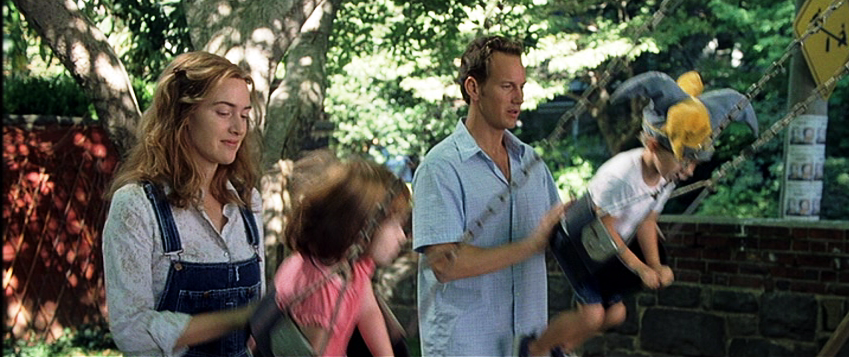
By Edward Copeland
I was a fan of Todd Field's In the Bedroom, especially the performances of Tom Wilkinson and Sissy Spacek, though I understood the criticism some had of it — it was pretty heavy and humorless. I'm glad to say that Little Children raises Field's work as a director another notch and does inject levity into the proceedings.
In fact, for the first hour or so, I was enthralled and thought I might be watching the best 2006 film until I started to fear that various story strands weren't going to come together in a cohesive, satisfying way. I still liked Little Children a great deal, but alas it doesn't tie its story together in a way to really make the whole package work.
Usually, I'm no great fan of voiceover narration, but in Little Children it really works as performed by Will Lyman as an omniscient storyteller, who I assume is lifting passages directly from the novel by Tom Perrotta upon which the film is based (and whose screenplay was co-written by Perrotta and Field). Those passages insert a lot of sardonic humor into the story and serve as elaboration instead of exposition.
Kate Winslet is the ostensible star as a suburban mom with an unhappy marriage to a man with a secret Internet porn habit and a daughter to whom she can't really connect. She spends most days taking the girl to the park where other stay-at-home moms gather to gossip and chatter, especially about the sudden return of "The Prom King" (Patrick Wilson), a rare father who shows up to the park with his child.
Having failed the Bar Exam twice, Wilson seems unsatisfied as he depends upon his wife (Jennifer Connelly), but he and Winslet develop a friendship. On top of these stories hang the community's concern about the arrival of a released sex offender (Jackie Earle Haley, long absent from movie screens but still recognizable from his days in the original Bad News Bears and Breaking Away), especially a former cop (Noah Emmerich) who develops an obsession with the freed man.
For most of the film, I was entranced, not only by the performances and sharp script, but especially by Field's visual style, which has really grown since In the Bedroom. However, as the film moved along, the feeling that there wasn't a clear destination in mind began to gnaw at me, a feeling that unfortunately proved to be true. The Wilson-Winslet plot and the Emmerich-Haley story, though loosely tied through Wilson's character's connection to Emmerich's, almost feel as if they belong in separate films, though Emmerich and Haley's tale does resolve itself more satisfactorily than the Wilson-Winslet one does.
I don't want to sound too harsh about Little Children — even with its flaws, it's one of the better films I've seen this year and I liked it better than In the Bedroom. Winslet, as usual, turns in a great performance, and it's good to see Haley again, even if I think a lot of the praise his performance has generated can be more attributable to his comeback than to his acting itself.
Still, Field as a director really impressed me and I look forward to seeing what he comes up with next.
Tweet
Labels: 00s, Jennifer Connelly, Spacek, Winslet
TO READ ON, CLICK HERE
Thursday, January 12, 2006
Quick takes on Altman works
By Edward Copeland
Granted, I haven't seen every single thing Robert Altman has done, but I have seen quite a few and while he is indisputably one of the greats and one of my favorites, there are a lot of missteps and clunkers on his resume as well. Thought I'd go chronologically and I'm only including the things I've seen.
MASH: 1970
One of the first of what I like to call "perfect but flawed" when referring to a movie, especially Altman's. It beautifully set the template for the later series, but it was harsher and more brutal (and lacked a laughtrack, thank God). The performers are all excellent and it really only goes astray for me in the third act with the football game and whatnot. Still, it's one of Altman's most rewatchable films.
Trivia note: The day after McLean Stevenson who played Col. Henry Blake on TV's M*A*S*H died, Roger Bowen who played Blake in the movie died. It's like he figured that was the only way his obituary would get noticed.
McCabe and Mrs. Miller: 1971
This is a film that has really grown on me over the years. When first exposed to it, I found it rather drab and dull, but on repeated viewings, I've liked it more and more both for Warren Beatty's performance and Julie Christie.
Images: 1972
I just watched this not too long ago on DVD and this is definitely one of Altman's missteps. He seems to be trying to ape Ingmar Bergman here and it's the phase of Bergman I can least stomach. Susannah York does her best as the lead, but it's really an incomprehensible bore.
The Long Goodbye: 1973
This is a really fun outing with Elliot Gould playing Philip Marlowe in a way you'd never expect him to be played. Really, it's a lost treasure that more people should seek out.
Thieves Like Us: 1974
This is a close call. There is a lot to like here, but it still seems familiar with very little new to offer. Like many of his offerings on DVD, the Altman commentary track is more interesting than the film itself.
California Split: 1974
A strong look at gambling that I recently revisited, in the midst of my poker obsession no less. It holds up fairly well. Not one of his masterpieces, but a good diversion.
Nashville: 1975
I'll resist the urge to write pages upon pages about how much I love this film. It's in my Top 10 of all time. I was fortunate enough to see a restored print once at the theater in Lincoln Center in New York, and it was one of the great moviegoing experiences of my life. The cast is impeccable and he juggles the multiple characters with ease and you are never bored (contrast that with the juggling in Syriana). The movie only gets better and better with each passing year. While I like One Flew Over the Cuckoo's Nest, how it beat this, Dog Day Afternoon and Jaws mystifies me.
Buffalo Bill and the Indians: 1976
It probably isn't fair of me to even comment on this one since I saw it in a drive-in when I was in second grade and don't really remember much of it. I'll get to the DVD eventually.
3 Women: 1977
Now here is where Altman is again playing with styles like he did in Images, only this time it works thanks to excellent work of Sissy Spacek and Shelley Duvall. I had the good fortune of speaking to Robert Altman once and he said something that always stuck with me. He said that you should always see a film twice, because the first time you are too worried with plot and what's going to happen next. With a second viewing, you relax and watch the film at work. That's definitely the best way to approach 3 Women.
A Wedding: 1978
I've come to think that I'm one of the few defenders of this one. It boasts a cast twice the size of Nashville, but I loved it. I wish they'd give it a proper DVD so I can see it again and see how it holds up.
H.E.A.L.T.H.: 1979
This was a real misfire, but there are some good performances within it.
Streamers: 1983
Altman's adaptation of David Rabe's play still feels like a play, but it really works thanks to an excellent ensemble cast.
Secret Honor: 1984
Now here is a play adaptation that doesn't work quite as well, though Philip Baker Hall is excellent playing what is an essentially a monologue by a drunken crazed Richard Nixon.
O.C. & Stiggs: 1987
I caught this one by accident late one night on HBO. It's really nothing to write home about, but what caught my attention was the return of Hal Philip Walker, the candidate in Nashville.
Aria segment "Les Boreades": 1987
A better idea than a movie: 10 directors make what are essentially music videos of classic opera pieces. Altman's is a bore. Really, only Franc Roddam's tale set in Las Vegas and featuring a young Bridget Fonda really works.
Tanner '88: 1988
Granted, this isn't a movie, but it was HBO's first great original series with a great script by Doonesbury cartoonist Garry Trudeau. Having rewatched it recently, it still holds up. It's amazing how many real politicos agreed to appear.
Vincent and Theo: 1990
This was actually the first Altman I saw in a theater — and I was bored silly. Tim Roth was great, but the movie left me cold. In fact, it's my contention that there has never been a really good movie made about a real-life artist. So far, no one has shown me something that dissuaded me from this theory.
The Player: 1992
An absolute satiric masterpiece with a strong cast, oodles of cameos and one of the funniest payoffs ever put in a movie. I can still think about its ending and start laughing. Probably the best fictional film ever made about moviemaking.
Short Cuts: 1993
This is another example of one his "perfect but flawed" films. He really just used Raymond Carver's stories as a launching pad, only sticking close to one of the stories, and the one Altman events from wholecloth involving Annie Ross and Lori Singer is the weakest and most conventional of the bunch, but you really need it so you can have those great jazz songs, I suppose. The earthquake might be a bit much at the end, but it works.
Ready to Wear aka Pret a Porter: 1994
Another complete misfire. There are some good performances, but the movie is pretty bad and never goes anywhere.
Kansas City: 1996
Another misfire, despite a good performance by Harry Belafonte. It just never pulled me in.
The Gingerbread Man: 1998
The first film based on an original screen story by John Grisham is a slight diversion. It's fine while you are watching it, but you forget it almost immediately once it's over.
Cookie's Fortune: 1999
I enjoyed the hell out of this movie and it boasts another great cast, including a really good turn by Patricia Neal.
Dr. T and the Women: 2000
A complete misfire from top to bottom, including Altman returning to the earthquake-like Short Cuts well with a tornadic ending that is ludicrous.
Gosford Park: 2001
Again, a strong cast, and while I liked it, it didn't bowl me over like it did a lot of critics.
The Company: 2003
About an hour into this, I realized a plot was never going to develop. It had some interesting stuff, especially Malcolm McDowell, but it is essentially a bore.
Tanner on Tanner: 2004
Altman and Trudeau return to TV for an update on the 1988 presidential candidate, in the form of a documentary made by his daughter (Cynthia Nixon). While it has its moments, it's mostly a wash and doesn't come close to matching the brilliance of the original.
TO READ ON, CLICK HERE
Granted, I haven't seen every single thing Robert Altman has done, but I have seen quite a few and while he is indisputably one of the greats and one of my favorites, there are a lot of missteps and clunkers on his resume as well. Thought I'd go chronologically and I'm only including the things I've seen.
MASH: 1970
One of the first of what I like to call "perfect but flawed" when referring to a movie, especially Altman's. It beautifully set the template for the later series, but it was harsher and more brutal (and lacked a laughtrack, thank God). The performers are all excellent and it really only goes astray for me in the third act with the football game and whatnot. Still, it's one of Altman's most rewatchable films.
Trivia note: The day after McLean Stevenson who played Col. Henry Blake on TV's M*A*S*H died, Roger Bowen who played Blake in the movie died. It's like he figured that was the only way his obituary would get noticed.
McCabe and Mrs. Miller: 1971
This is a film that has really grown on me over the years. When first exposed to it, I found it rather drab and dull, but on repeated viewings, I've liked it more and more both for Warren Beatty's performance and Julie Christie.
Images: 1972
I just watched this not too long ago on DVD and this is definitely one of Altman's missteps. He seems to be trying to ape Ingmar Bergman here and it's the phase of Bergman I can least stomach. Susannah York does her best as the lead, but it's really an incomprehensible bore.
The Long Goodbye: 1973
This is a really fun outing with Elliot Gould playing Philip Marlowe in a way you'd never expect him to be played. Really, it's a lost treasure that more people should seek out.
Thieves Like Us: 1974
This is a close call. There is a lot to like here, but it still seems familiar with very little new to offer. Like many of his offerings on DVD, the Altman commentary track is more interesting than the film itself.
California Split: 1974
A strong look at gambling that I recently revisited, in the midst of my poker obsession no less. It holds up fairly well. Not one of his masterpieces, but a good diversion.
Nashville: 1975
I'll resist the urge to write pages upon pages about how much I love this film. It's in my Top 10 of all time. I was fortunate enough to see a restored print once at the theater in Lincoln Center in New York, and it was one of the great moviegoing experiences of my life. The cast is impeccable and he juggles the multiple characters with ease and you are never bored (contrast that with the juggling in Syriana). The movie only gets better and better with each passing year. While I like One Flew Over the Cuckoo's Nest, how it beat this, Dog Day Afternoon and Jaws mystifies me.
Buffalo Bill and the Indians: 1976
It probably isn't fair of me to even comment on this one since I saw it in a drive-in when I was in second grade and don't really remember much of it. I'll get to the DVD eventually.
3 Women: 1977
Now here is where Altman is again playing with styles like he did in Images, only this time it works thanks to excellent work of Sissy Spacek and Shelley Duvall. I had the good fortune of speaking to Robert Altman once and he said something that always stuck with me. He said that you should always see a film twice, because the first time you are too worried with plot and what's going to happen next. With a second viewing, you relax and watch the film at work. That's definitely the best way to approach 3 Women.
A Wedding: 1978
I've come to think that I'm one of the few defenders of this one. It boasts a cast twice the size of Nashville, but I loved it. I wish they'd give it a proper DVD so I can see it again and see how it holds up.
H.E.A.L.T.H.: 1979
This was a real misfire, but there are some good performances within it.
Streamers: 1983
Altman's adaptation of David Rabe's play still feels like a play, but it really works thanks to an excellent ensemble cast.
Secret Honor: 1984
Now here is a play adaptation that doesn't work quite as well, though Philip Baker Hall is excellent playing what is an essentially a monologue by a drunken crazed Richard Nixon.
O.C. & Stiggs: 1987
I caught this one by accident late one night on HBO. It's really nothing to write home about, but what caught my attention was the return of Hal Philip Walker, the candidate in Nashville.
Aria segment "Les Boreades": 1987
A better idea than a movie: 10 directors make what are essentially music videos of classic opera pieces. Altman's is a bore. Really, only Franc Roddam's tale set in Las Vegas and featuring a young Bridget Fonda really works.
Tanner '88: 1988
Granted, this isn't a movie, but it was HBO's first great original series with a great script by Doonesbury cartoonist Garry Trudeau. Having rewatched it recently, it still holds up. It's amazing how many real politicos agreed to appear.
Vincent and Theo: 1990
This was actually the first Altman I saw in a theater — and I was bored silly. Tim Roth was great, but the movie left me cold. In fact, it's my contention that there has never been a really good movie made about a real-life artist. So far, no one has shown me something that dissuaded me from this theory.
The Player: 1992
An absolute satiric masterpiece with a strong cast, oodles of cameos and one of the funniest payoffs ever put in a movie. I can still think about its ending and start laughing. Probably the best fictional film ever made about moviemaking.
Short Cuts: 1993
This is another example of one his "perfect but flawed" films. He really just used Raymond Carver's stories as a launching pad, only sticking close to one of the stories, and the one Altman events from wholecloth involving Annie Ross and Lori Singer is the weakest and most conventional of the bunch, but you really need it so you can have those great jazz songs, I suppose. The earthquake might be a bit much at the end, but it works.
Ready to Wear aka Pret a Porter: 1994
Another complete misfire. There are some good performances, but the movie is pretty bad and never goes anywhere.
Kansas City: 1996
Another misfire, despite a good performance by Harry Belafonte. It just never pulled me in.
The Gingerbread Man: 1998
The first film based on an original screen story by John Grisham is a slight diversion. It's fine while you are watching it, but you forget it almost immediately once it's over.
Cookie's Fortune: 1999
I enjoyed the hell out of this movie and it boasts another great cast, including a really good turn by Patricia Neal.
Dr. T and the Women: 2000
A complete misfire from top to bottom, including Altman returning to the earthquake-like Short Cuts well with a tornadic ending that is ludicrous.
Gosford Park: 2001
Again, a strong cast, and while I liked it, it didn't bowl me over like it did a lot of critics.
The Company: 2003
About an hour into this, I realized a plot was never going to develop. It had some interesting stuff, especially Malcolm McDowell, but it is essentially a bore.
Tanner on Tanner: 2004
Altman and Trudeau return to TV for an update on the 1988 presidential candidate, in the form of a documentary made by his daughter (Cynthia Nixon). While it has its moments, it's mostly a wash and doesn't come close to matching the brilliance of the original.
Labels: Altman, Belafonte, Cynthia Nixon, Fiction, HBO, Julie Christie, Malcolm McDowell, Patricia Neal, Spacek, Television, W. Beatty
TO READ ON, CLICK HERE


