Tuesday, February 14, 2012
Truth be told, you two are both dragging me down

By Edward Copeland
By the time I finally found myself in a position to watch Shame, my expectations rested on two separate planes. The first, for the film itself, had settled on not anticipating being wowed, based not only on what I'd heard but also because (I must admit) I never managed to make it all the way through director Steve McQueen's first film, Hunger. The other plane existed on a much higher level, formed solely on what I'd witnessed of Michael Fassbender in 2011, giving great performances in movies that couldn't be more different — X-Men: First Class and Jane Eyre. I haven't even had a chance to catch him as Carl Jung in David Cronenberg's A Dangerous Method. However, I've witnessed many an actor or actress rise above mediocre material and I expected that if Shame turned out to be a subpar film, Fassbender still could deliver a superb performance. Unfortunately, thespians can do only so much with scripts as aimless, pointless and devoid of meaning as Shame. While Fassbender lets it all hang out in service to this lackluster screenplay, Carey Mulligan delivers the film's best performance, far better than Shame deserves, as Fassbender's character's sister.
Fassbender plays Brandon Sullivan, an Irish transplant to the U.S. who works as an executive in Manhattan. For what kind of business, it's never clearly stated, but it allows Brandon enough free time to leave the office for hours during the day to go to a hotel and have vigorous sex with multiple women. Now, sometimes Brandon does have to stay in the office. You might not be able to smoke inside public buildings in New York anymore, but masturbation breaks seem to be OK. At night, Brandon occasionally carouses with his married boss, David Fisher (James Badger Dale), who doesn't even try to hide his adultery from his employees. However, when loads of particularly nasty paid porn sites turn up on the hard drive of Brandon's work computer, Fisher immediately assumes that someone has hacked into Brandon's account or been using his computer when Brandon isn't there.
Based on the portrait painted in Shame, it seems that nearly all currently living in New York — including the women — carry attitudes toward sex that's more likely to be found in 14-year-old boys, only real 14-year-olds aren't getting laid at this high a percentage and the teens probably display more maturity and hold fewer fears of long-lasting relationships. Yes, I understand that Brandon is a sex addict, but the screenplay by director McQueen and Abi Morgan may depict the life of a sex addict but it never deals with the subject of sex addiction. Imagine a film about a heroin addict and the entire movie consists of the addict shooting up or snorting the drug, showing little in the way of consequence and no discussion of the addiction before the film finishes. That's almost what Shame amounts to as a film. Hell, the TV sitcom Cheers treated sex addiction more seriously and with laughs when in a later season Sam sought treatment for it.

The film's complication, i.e. Brandon's complication, stems from the arrival of his estranged younger sister, Sissy (Mulligan), who crashes at Brandon's apartment because she and her boyfriend are on the outs. Her arrival, according to the production notes and a couple of dialogue scenes inserted to break up the monotony of Brandon's boffing, throws his world into "chaos." As near as I can tell from the movie, chaos for Brandon (as well as McQueen and Morgan) equals having Sissy living in his apartment meaning he must go elsewhere to fuck. Poor baby. What also upsets Brandon is that Sissy gets a booking to sing at a New York club, which Brandon's boss David hears about, forcing Brandon to reluctantly accompany Fisher to see her show. The scene actually ends up being one of the film's few highlights as Mulligan performs the most downbeat version of Kander & Ebb's "New York, New York" you'll ever hear. It's reminiscent of the scene in Georgia when Jennifer Jason Leigh performs Elvis Costello's "Almost Blue." It certainly bears no resemblance to Liza Minnelli's version in Martin Scorsese's film of the same name that introduced the song or Sinatra's recording that immortalized it. Rubbing salt in Brandon's wound about Sissy interfering in his nightlife and his apartment, she and David end up going back to Brandon's place and having loud, boisterous sex, forcing a pissy Brandon to leave.
While visually, cinematographer Sean Bobbitt provides a cool blue tint that comes across as wholly appropriate to the film, Shame suffers from being overscored — not just by the original music composed by Harry Escott but the misuse of lots of Bach, mostly taken from Glenn Gould's recording of "The Goldberg Variations," alongside John Coltrane's instrumental cover of Rodgers & Hammerstein's "My Favorite Things" from The Sound of Music, Chet Baker's "Let's Get Lost" and Blondie's "Rapture" — all of which get played at near deafening levels at times to compensate for the largely dialogue-free sections. In a way, Shame sounds as if it's trying to be one of those late-night Skin-emax movies, only employing a classier soundtrack to play over the continuous coitus.
When Shame finally comes to a stopping place, they do allow Brandon and Sissy to have a conversation (more like a fight) to pretend that a point might have been hiding all along. Brandon has had it not being able to screw strangers in his own bed so he orders his sister out, telling Sissy that he's not responsible for her. He didn't give birth to her. "I'm trying to help you," Sissy tells him. "How are you helping me,
 huh? How are you helping me? How are you helping me? Huh? Look at me. You come in here and you're a weight on me. Do you understand me? You're a burden. You're just dragging me down. How are you helping me? You can't even clean up after yourself. Stop playing the victim," Brandon responds bitterly. I have to agree with Brandon there. The film hasn't given any indication that Sissy has arrived to stage some sort of intervention. Hell, aside for her stumbling upon some live sex chat woman calling out for Brandon on his laptop and walking in on him beating off once, nothing indicates that Sissy has clued in on her brother's lifestyle. Then again, I don't notice much of a mess. "I'm not playing the victim. If I left, I would never hear from you again. Don't you think that's sad? Don't you think that's sad? You're my brother," Sissy declares. No, what's truly sad about this situation is watching talented actors such as Michael Fassbender and Carey Mulligan attempt to squeeze some sort of emotional truth from a movie that contained nothing but artifice up until that point. Fassbender tries his best, but he's burdened with the heavy lifting since he's in every scene and the shallow script leaves him rudderless. Carey Mulligan comes off looking so much better because her part takes up less time on screen so it's easier to give Sissy life even if the screenplay doesn't provide her any more depth than it does Brandon.
That scene between the siblings toward the end of the movie reinforces what we got a slight glimpse of in an earlier scene where Brandon takes a co-worker named Marianne (Nicole Beharie) out for dinner. She's separated from her husband. While Brandon behaves meek and pliable at the restaurant, accepting every suggestion that either Marianne or the waiter (Robert Montano) makes, relationship talk brings out the opinionated side of him. He tells her that he doesn't believe in relationships — sees no point in them. When Marianne asks him how long his longest relationship lasted, Brandon answers four months. The two part for the night at her subway stop. The next day at work, we see what kind of universe Shame resides in. Marianne expressed a bit of dismissive judgment about Brandon the night before, but he takes her into the break room and kisses her passionately and Marianne willingly skips off from work with him to a hotel for a sexual tryst. This exemplifies the filmmakers' attitude toward pretty much every character in the movie.
The longer I think about Shame, the worse the film gets. If you set out to make a provocative film, it helps to have something to say. Your aim should be to provoke thought, not anger about the time wasted by talents such as Fassbender and Mulligan making it and movie lovers such as me watching it.
Tweet
Labels: 10s, Carey Mulligan, Cronenberg, Ebb, Fassbender, Hammerstein, J.J. Leigh, Kander, Liza, Music, Rodgers, Scorsese, Sinatra
TO READ ON, CLICK HERE


Thursday, February 09, 2012
Gosling stays in right acting lane

By Edward Copeland
When I reviewed The Ides of March about two-and-a-half weeks ago, what impressed me most was the re-emergence of the old Ryan Gosling, the talented actor who captured everyone's attention in the first place before his performances became lost in a torrent of tics that blanketed his characters behind a shroud of phony fog. Now I've caught up with Drive and am pleased to report that The Ides of March wasn't a one-film fluke. I wonder if this means I should give Crazy, Stupid, Love a chance.
Gosling was great in Ides and he's great in a completely different type of role in Drive. I haven't caught up with The Artist yet, but Gosling's character in Drive (known simply as the Driver) is a man of so few words, he could be from a silent film. He's a man of few words, making his living as a movie stunt driver by day, a getaway driver by night.
Driver never carries a gun and Shannon (Bryan Cranston), the crippled body shop owner who sets him up with his daytime and nighttime gigs, provides the cars Driver uses for his getaway work. Shannon also can't give up on dreams — and he's never seen someone who drives as well as Driver — so Shannon envisions him as his ticket to a successful stock car career. All that's missing is the money to fund it. There's good news and bad news on that front. The good news is that Shannon has a longtime friendship with a businessman with deep pockets. The bad news is that he's Bernie Ross (Albert Brooks), a big time mobster in the L.A. area who also has friends such as the shady Nick (Ron Perlman), who uses a pizzeria as a front for his many criminal operations and broke Shannon's body in the first place.
Bernie insists on meeting Driver first, so he gives him a demonstration of his driving skills. He impresses Bernie — not enough to give Shannon all the money he wants, but $300,000. After his display, Shannon introduces Driver to Bernie, who extends his hand. Driver just stands silent, not moving to take it. After an awkward moment or two, Driver says, "My hands are dirty." Ross smiles and replies, "So are mine" and they shake.
Driver's mysterious existence has grown more complicated on a personal level. He has taken a liking to Irene (Carey Mulligan), a woman who lives on the same floor of his apartment building, and her young son, Benicio (Kaden Leos). Driver and Irene inevitably end up involved, though soon her husband Standard (Oscar Isaac) gets released from jail and returns home. One thing that's refreshing about Drive, which was written by Hossein Amini and based on a novel by James Sallis, is that it doesn't follow the usual template where the ex-con husband is an abusive ass. Instead, upon Standard's release, he's hassled by hoods who want either his money or his criminal help.
To go much further into the details of the jagged twists that connect all the characters, would ruin much of the the movie's suspenseful fun. Director Nicolas Winding Refn doesn't let Drive sit in idle for long (if ever) from the moment it starts. Some of the violence proves to be quite shocking while Amini's screenplay comes loaded with quite a few laughs (It's also a big change of pace for the writer whose first feature credits were Jude and The Wings of the Dove).
The cast gives Drive the fuel it needs to really power this vehicle, especially from the performers going against type. Cranston already has wowed TV viewers his amazing range when he went from the loopy dad on Malcolm in the Middle to one of dramatic television's all-time acting tours de force as Walter White on Breaking Bad. Shannon allows him the opportunity to create yet another original character in the body shop owner with big dreams and worse luck.
Perlman has a knack of creating scarier roles when he's not wearing any makeup and just playing a world-class asshole such as Nico as he does here. There are a couple scenes that bounce Cranston, Perlman and Albert Brooks off each other that are just hysterical.
Which brings us to Brooks, cast against type as a smooth, intimidating criminal kingpin. When I wrote my 25th anniversary tribute to Lost in America, in describing Brooks' character David's meltdown after his wife loses their savings at roulette:
It might seem an odd comparison, but many critics always made much of the slow burn Joe Pesci can make as an actor, from calm to explosive and in at least one scene here, I'd argue that Albert Brooks is the comic equivalent of that turn-on-a-dime Pesci skill. After the Howards exit Vegas, they head out in the RV, uncertain of where to go or how to make do with a little more than $800 left to their name. Linda keeps apologizing profusely, but David stays eerily calm — until they arrive at the Hoover Dam and Linda suggests they stop and check it out. "Nice dam, huh?" David says. "Do you want to go first, or should I?" The dam doesn't burst, but boy does David, first outside and then inside the Winnebago, when Linda insists the public not watch the fight.
Interestingly enough, as great as Brooks is as Bernie Ross in Drive, that's not exactly how he chooses to play him. Brooks isn't just cast against type, but he plays him in a way that I didn't expect him to either.
The only person who disappointed me to some extent was Carey Mulligan. After her star-making turn in An Education brought her to prominence and her solid followup work in the so-so Never Let Me Go, Irene seemed an underwritten, underdeveloped role for her to take. I haven't seen what she's like in Shame yet.
Gosling though steers Drive from beginning to end. His portrayal of Driver can be downright chilling when that stillness and silence suddenly erupts. I hope Drive and The Ides of March really shows that Gosling has realigned his craft, though I do worry about that new Terrence Malick film in which he's been cast.
Tweet
Labels: 10s, Albert Brooks, Breaking Bad, Carey Mulligan, Cranston, Gosling, Malick, Pesci
TO READ ON, CLICK HERE
Tuesday, January 04, 2011
Those Brits sure can be bleak
By Edward Copeland
When Never Let Me Go opened, I didn't hear much about it beyond its status as Carey Mulligan's followup to her brilliant work in An Education. It seemed to appear and vanish rather quickly and I don't recall even absorbing much of what it was about, so it surprised me when I caught up with it and realized that it was another British tale of a downbeat world, only instead of being set in the future, Never Let Me Go takes place in a parallel timeline of the final decades of the 20th century.
Never Let Me Go is based on the novel by Kazuo Ishiguro, who also wrote the novel that spawned my favorite Merchant Ivory film, The Remains of the Day, though the subject matter of the two tales couldn't be further apart. Never Let Me Go comes closer to feeling like Children of Men or Dirty Pretty Things than that exquisite tale of unrequited love. The new film also marks the first feature by director Mark Romanek since 2002's One Hour Photo.
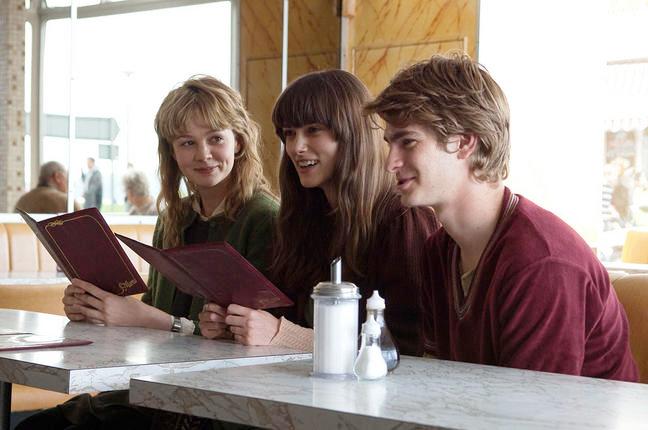
Mulligan stars as Kathy, reared in an English boarding school with close friends Tommy and Ruth (Andrew Garfield, Keira Knightley) for the specific purpose of growing up to become organ donors. Titles near the beginning of the film inform us that the average life expectancy reached 100 in 1967, due presumably to this program.
Of course, kids will be kids (or is that clones will be clones?) and they do have feelings and romances and longings develop alongside dreams of avoiding "completion," i.e. giving all that they can before their bodies are tossed aside like so much garbage.
Mulligan centers the film as well as she can, but it's a depressing slog. Garfield comes off even better. He had a helluva 2010 — in this film, The Social Network and the 1974 installment of the Red Riding Trilogy, even though I couldn't make it through all of that crime procedural series, finding it slow and overrated.
For me the real surprise is Knightley. Did you know she is able to act when not wearing a corset? Actually, in all seriousness, though she has been good in some of her seemingly endless run of period pieces, I think this is the best performance she's given. Her Ruth really gets the most development of the three central characters and it gives Knightley a chance to show sides she never has before. It's just a shame it's not in a better movie.
Never Let Me Go also contains the always welcome presence of Charlotte Rampling who provides some good moments as the headmistress of the boarding school, especially in the film's anticlimactic denouement.
I wasn't a big fan of One Hour Photo and Romanek has been busy with music videos since, according to IMDb, but there's not much movement to be found in Never Let Me Go. It's established fairly early what the plot is, so no mystery drives the film and the would-be triangle doesn't go anywhere either. The movie just sort of lies there, asking you to be forlorn about a story that's established early in the running time.
With the rush to catch up with 2010 films, Never Let Me Go seems foreordained to be one that in a few months I'll have forgotten that I even watched.
Tweet
Labels: 10s, Carey Mulligan, Keira Knightley, Merchant Ivory, Rampling
TO READ ON, CLICK HERE
Monday, September 27, 2010
Oliver Stone's Other Favorite Lizard King Returns

By J.D.
It has been more than 20 years since Wall Street (1987) was released in theaters and, at the time, it was blamed for cashing in on the stock market crash that wiped out more than a few people’s fortunes. The financial landscape has changed radically since then and so, in many ways, has Oliver Stone’s career. In the 1980s and early 1990s, he was on an unbelievable roll, cranking out controversial, headline-grabbing films such as Platoon (1986), JFK (1991) and Natural Born Killers (1994). And then he made Nixon (1995), arguably his most ambitious and complex (both stylistically and content-wise) film to date — critics were divided and audiences failed to show up.
Stone continued to plug along gamely but after his longtime director of photography Robert Richardson left after the neo-noir oddity U-Turn (1997), the director lost his most important creative collaborator. Any Given Sunday (1999) was an energetic if not flawed expose of professional American football and well, let’s just say that the 2000s have not been kind to him (see Alexander, World Trade Center and W.) With the release of Wall Street: Money Never Sleeps (2010), there’s a glimmer of hope that this new project might be a return to form for the auteur. He’s never done a sequel before but with how radically the financial world has changed since 9/11 it is an intriguing prospect to see what a character such as Gordon Gekko would be doing now. With recent scandals such as Enron and the Dow Jones meltdown in 2008, a Wall Street sequel is very timely.
It’s 2001 and Gordon Gekko (Michael Douglas) has been released from prison. There’s no one to pick him up and instead he’s handed a check for $1,800 and a train ticket. Seven years later, he’s peddling a book, Is Greed Good? and trying to get back into the game. Meanwhile, Jacob “Jake” Moore (Shia LaBeouf) is a young and ambitious proprietary trader working Keller Zabel. This whiz kid is trying to develop an alternative energy project. Stone immerses us in the trading floor and boy, does it look different than it did back in 1987. The technology, obviously, is vastly different but the frenetic energy is still the same. Jake is living with and engaged to a beautiful young woman named Winnie (Carey Mulligan) who is an Internet journalist working for a liberal-minded Web site. Oh yeah, her estranged father just happens to be Gekko, much to her chagrin.
When Jake's investment firm's stock takes a major hit, his distraught and disillusioned mentor Lewis Zabel (Frank Langella) is pushed out of the company by ruthless hedge fund manager Bretton James (Josh Brolin). Devastated and humiliated, Zabel takes his own life. Jake goes to see Gekko speak and is impressed by what the man has to say. Maybe he’s found a new mentor. Afterward, Jake meets Gekko and tells him about his plans to marry Winnie. They strike a deal: Jake will help Gekko reconcile with his daughter and in return Gekko will help Jake exact some payback on James, the man who sent Zabel over the edge.
With Gekko’s help, Jake does some digging and spreads a few rumors that cause Churchill Schwartz, the company that James works for, to take a notable hit. Impressed by what he did, James hires Jake because after all, keep your friends close and your enemies closer. Jake naturally accepts as it brings him in close proximity to James so that he can ultimately bring him down. And like that, it’s on with Jake and James going after each other with Gekko as the wild card, begging the question, what is his stake in all this?
Shia LaBeouf, an actor known for mindless blockbusters (Transformers and Indiana Jones and the Kingdom of the Crystal Skull) and generic thrillers (Disturbia and Eagle Eye), finally shows some actual acting chops in his first legitimate dramatic role that has him up against heavyweights like Michael Douglas, Josh Brolin and Frank Langella — guys that can really act. Being in their company forces LaBeouf to raise his game and he holds his own. This time around, it is LaBeouf who is the idealistic young man swimming with the sharks and in danger of being seduced by lots of money.
It is great to see Michael Douglas back in his most famous role and he slips back into it effortlessly. Gekko is as cagey as ever and like Jake we’re never quite sure what his true intentions are but one thing’s for sure, he’s not to be underestimated. And Douglas does a nice job hinting at the dangerous Gekko that lurks under his smiling façade. He has more than a few tricks up his sleeve and with all the cunning of an exceptional card player.
Josh Brolin plays a smug, cigar-smoking shark with no heart. He’s a grinning, deliciously evil bad guy. Carey Mulligan doesn’t have much to do but does a fine job with what she has to work with, especially a scene where Winnie and Gekko finally have it out over how his dirty financial dealings destroyed their family. One of the weak spots of the original Wall Street was Bud Fox’s relationship with his love interest and Stone tries not to make the same mistake with this film by casting a stronger actress with Mulligan and by placing a bigger emphasis on the relationship between Jake and Winnie. However, the film stalls when the focus shifts to them when we really should be tracking Jake plotting revenge on James.
The screenplay throws all kinds of financial jargon at the audience but it is all really window-dressing because all that matters is what it all means and Stone makes sure that we understand the bottom line. The dialogue still has some of the crackle and pop of the original film, especially in a good scene where Gekko and James spar verbally. If there is any glaring flaw in this film it is the overuse of David Byrne songs to the point of distraction. Each cue puts too fine a point on the scene with lyrics that spell out exactly what we are watching. Not to mention the songs are milquetoast drivel robbing the film of its fast-moving momentum at times.
Stone does a good job of keeping things visually interesting but the cinematography lacks the energy and that special something that Robert Richardson brought to the first film. Wall Street: Money Never Sleeps is easily the best film Stone’s done since Any Given Sunday. Of course, that’s not saying much but at least it feels like the kind of film that Stone used to make back in his prime. There is a confidence that comes with being back on familiar turf that Stone displays with this film. Wall Street: Money Never Sleeps is just the kind of film that he needs to reinvigorate his career and remind us why we regarded his films so highly in the first place.
Tweet
Labels: 10s, Carey Mulligan, Josh Brolin, M. Douglas, Oliver Stone
TO READ ON, CLICK HERE
Thursday, June 17, 2010
You know what happens when you assume

By Edward Copeland
However long it's been since the 2009 Oscar nominations were announced and the awards actually presented, I've finally seen the 10th of the 10 best picture nominees (or, at any rate, the one title I'd yet to see, The Blind Side). Admittedly, my enthusiasm for seeing the movie was not high, based on clips that seemed to me that I'd be in store for a cloying, saccharine tale and a shaky, Southern accent from star Sandra Bullock. How very wrong I was.
Don't get me wrong: The Blind Side is not an undervalued masterpiece that defies formula, but it is surprisingly well-made and effective and doesn't hit its audience over the head with its message of good. While there has been much reporting of the liberties taken in this true story from the book by Michael Lewis, it's to writer-director John Lee Hancock's credit that he didn't try to shape the material into nauseating feel-good hokum. Admittedly, sometimes he does downplay aspects of the story a bit much (such as the inherent racism of well-off Memphis society and the idea that the Tuohy family might be just as interested in helping their alma mater's football team as they are in giving a downtrodden youth a better life).
Bullock does a fine job as Leigh Anne Tuohy, the well-off Memphis woman who takes in the homeless, hard-knock-life Michael Oher (Quinton Aaron) and gives him a family, an education and a route to the NFL. Would I have given Bullock the Oscar? No, I'd have voted for Carey Mulligan for An Education, but her win is hardly an embarrassment, especially in comparison to winners past, and my fears of another poor attempt at an accent based on the clips proved to be unfounded.
Bullock doesn't stand alone in the film. She's ably supported by fine work from Kathy Bates as a tutor, Ray McKinnon as the private school football coach who paves Mike's way into the school, Kim Dickens (Treme, Deadwood) as one of the teachers who believes in him and even country singer Tim McGraw as Bullock's husband.
Where the film does come close to making missteps is its portrayal of Oher as a quiet, gentle giant, so traumatized by his past that he barely speaks and has to be taught to smile. I imagine if The Blind Side had caught me in the wrong mood (and I bet it did catch many in the wrong mood), the portrayal of Oher would prove grating and borderline insulting after awhile. It could easily teeter into the realm of the offensive, giving Aaron little help in the way of making Oher a real person instead of a caricature. If he didn't play football and instead could heal with his touch and lived behind bars, at times you'd think he escaped from The Green Mile.
I find myself without much more to say about the film. If pushed for a one-word feeling to describe my immediate reaction after seeing it, it would be relief. I feared The Blind Side was going to be the type of film that works on me like nails on a chalkboard and it walks precariously on that tightrope, but it navigates from one pole to the other with real balancing skill and avoids the plunge to the arena mat below.
There certainly were worse films nominated for best picture in 2009 and if you care to see how I would have ranked their 10, as Oscar voters had to do under their new idiotic system, click here and go to the very end.
Tweet
Labels: 00s, Carey Mulligan, Deadwood, Kim Dickens, Oscars, Treme
TO READ ON, CLICK HERE
Monday, April 05, 2010
Live and learn

By Edward Copeland
You can never really claim that a year in movies has an overriding theme, but if you could, 2009's would be that so many of the better films were dependent on a single performance that almost single-handedly raised his or her film to a higher plane. You saw it with Jeff Bridges in Crazy Heart to Sam Rockwell in Moon and Tilda Swinton in Julia. This is most decidedly the case with An Education, which would probably be a fine film anyway but becomes an even better one with Carey Mulligan as its lead.
Mulligan stars as Jenny, a bright 16-year-old attending an all-girls school in the London suburbs in 1961 in presumed preparation for her eventual enrollment at Oxford. She's smart, funny and talented and can't help but show it, even if it means often offending those around her, including teachers such as Miss Stubbs (Olivia Williams, unrecognizable from those who only know her from Rushmore) and her stuck-in-the-mud father (Alfred Molina). As many smart teens can be, Jenny thinks she knows a lot more than she really does and, unfortunately, she suffers for it in the end.
One day, while walking home from concert rehearsal with her cello in a driving rainstorm, a handsome thirtysomething stranger named David (Peter Saarsgard) charms Jenny into his car and before long, despite the age difference, the two are dating, despite Jenny's insistence that she's hanging on to her virginity until she turns 17.
Jenny's classmates find it quite chic that she's seeing an older man while her teacher and especially the school's stern headmistress (the always reliable Emma Thompson) give her strong warnings, some threatening her future at the school. Her parents (Molina and Cara Seymour) would probably be similarly suspicious, but David manages to seduce them at a faster rate than he does Jenny. The sometimes veiled (and sometimes not-so-veiled) anti-Semitism doesn't even seem to factor in even though David is Jewish.
Before long, her parents are allowing Jenny to go on overnight trips with David and even a journey to Paris, all under the assumption that David's "aunt" will be along as a chaperon. David and Jenny's clubbing and traveling companions are usually Danny and Helen (Dominic Cooper and Rosamund Pike) and some of their actions, as well as David's, should clue Jenny in to the idea that her boyfriend might not be all that he claims to be, but the heart of a first love has a terrible defect that allows for the masking of a significant other's defects.
Everything hits the fan soon after David takes the big leap and proposes marriage to Jenny, who is torn since her whole life had been geared toward continuing her education at Oxford. Her father, who'd supported the idea her entire life, is quick to abandon it for a good marriage because, really, what career can she expect to have? Even Thompson's headmistress tells her there are more opportunities than just teaching for young women now: There's also the civil service.
The sparse, deliberate and well-written screenplay by Nick Hornby was adapted from the memoir by Lynn Barber and smoothly directed by Lone Scherfig. The performers all do well, especially Molina and Williams. Sarsgaard's British accent isn't even half bad. If the film has a weakness, its final scenes seem rushed to try to tack on somewhat of an unnecessary happy ending that seems out of place with what went before.
However, as far as Mulligan goes, a star is born. She is so beguiling that the overwhelming number of comparisons of her to Audrey Hepburn certainly seem earned. While you are watching Mulligan in An Education (and I don't recall any scene she's not in), you can't take your eyes off her. It's not often that you see a performance from a relative newcomer that immediately makes you anxious to see what she does next. Carey Mulligan is an actress to watch.
Tweet
Labels: 00s, A. Hepburn, Carey Mulligan, Emma Thompson, Jeff Bridges, Sam Rockwell, Tilda Swinton
TO READ ON, CLICK HERE


