Tuesday, January 04, 2011
Those Brits sure can be bleak
By Edward Copeland
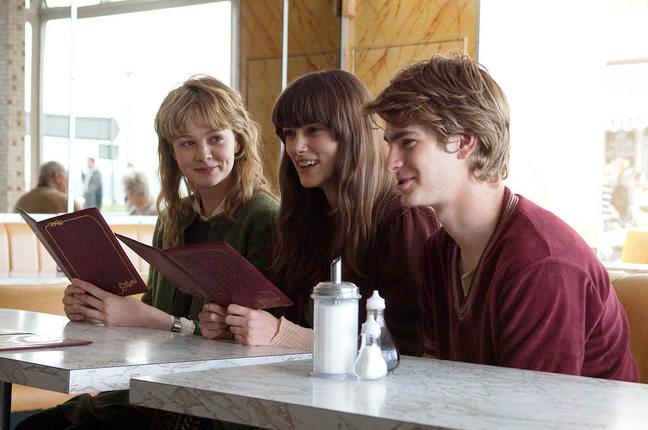
When Never Let Me Go opened, I didn't hear much about it beyond its status as Carey Mulligan's followup to her brilliant work in An Education. It seemed to appear and vanish rather quickly and I don't recall even absorbing much of what it was about, so it surprised me when I caught up with it and realized that it was another British tale of a downbeat world, only instead of being set in the future, Never Let Me Go takes place in a parallel timeline of the final decades of the 20th century.
Never Let Me Go is based on the novel by Kazuo Ishiguro, who also wrote the novel that spawned my favorite Merchant Ivory film, The Remains of the Day, though the subject matter of the two tales couldn't be further apart. Never Let Me Go comes closer to feeling like Children of Men or Dirty Pretty Things than that exquisite tale of unrequited love. The new film also marks the first feature by director Mark Romanek since 2002's One Hour Photo.
Mulligan stars as Kathy, reared in an English boarding school with close friends Tommy and Ruth (Andrew Garfield, Keira Knightley) for the specific purpose of growing up to become organ donors. Titles near the beginning of the film inform us that the average life expectancy reached 100 in 1967, due presumably to this program.
Of course, kids will be kids (or is that clones will be clones?) and they do have feelings and romances and longings develop alongside dreams of avoiding "completion," i.e. giving all that they can before their bodies are tossed aside like so much garbage.
Mulligan centers the film as well as she can, but it's a depressing slog. Garfield comes off even better. He had a helluva 2010 — in this film, The Social Network and the 1974 installment of the Red Riding Trilogy, even though I couldn't make it through all of that crime procedural series, finding it slow and overrated.
For me the real surprise is Knightley. Did you know she is able to act when not wearing a corset? Actually, in all seriousness, though she has been good in some of her seemingly endless run of period pieces, I think this is the best performance she's given. Her Ruth really gets the most development of the three central characters and it gives Knightley a chance to show sides she never has before. It's just a shame it's not in a better movie.
Never Let Me Go also contains the always welcome presence of Charlotte Rampling who provides some good moments as the headmistress of the boarding school, especially in the film's anticlimactic denouement.
I wasn't a big fan of One Hour Photo and Romanek has been busy with music videos since, according to IMDb, but there's not much movement to be found in Never Let Me Go. It's established fairly early what the plot is, so no mystery drives the film and the would-be triangle doesn't go anywhere either. The movie just sort of lies there, asking you to be forlorn about a story that's established early in the running time.
With the rush to catch up with 2010 films, Never Let Me Go seems foreordained to be one that in a few months I'll have forgotten that I even watched.
Tweet
Labels: 10s, Carey Mulligan, Keira Knightley, Merchant Ivory, Rampling
TO READ ON, CLICK HERE


Sunday, January 04, 2009
Keira dons period garb again

By Edward Copeland
I wonder: At this point in her career is Keira Knightley capable of playing a role set in the 21st century? Then again, if it keeps her making films as passable as The Duchess and out of junk such as Bend It Like Beckham, who am I to offer her career advice?
I didn't expect a lot from The Duchess and was watching it mainly because the waiters and the florists nominated Ralph Fiennes for supporting actor for it. So it was with a great deal of surprise that I found The Duchess as watchable and enjoyable as I did.
Knightley, aka "Ben Lyons' future bride," is quite good as the title character, an 18th century woman who at the urging of her mother (the always good Charlotte Rampling) enters into a marriage (more like a deal) with the Duke of Devonshire (Fiennes) to provide him a male heir, only he's a cold, uncommunicative sort, made worse by the fact that her womb keeps producing females.
Fiennes is quite good. It would have been easy to make the duke into a standard villain given the way the duke treats his wife but Fiennes manages to make him a three-dimensional character that you even have some sympathy for when he's at his worst, keeping the duchess from her true love, the non-nobleman and rising politician Charles Grey (Dominic Cooper).
While Fiennes is great and deserving of his Golden Globe nomination, I'm surprised that with the three nominations the HFPA gave the great In Bruges, they didn't pick him for his great supporting work as the eccentric crime boss in that one.
Period dramas can often end up being as stiff as the corsets the women wear, but The Duchess is livelier than most.
Tweet
Labels: 00s, Keira Knightley, Ralph Fiennes, Rampling
TO READ ON, CLICK HERE
Wednesday, December 19, 2007
Where the Truth Lies
By Odienator
After finishing the novel Atonement, Grace Slick invaded my brain: "When the truth is found to be lies," she sang. She was followed by Nelson from The Simpsons, whose "Haaaaaa-hah!" might not have been what Ian McEwan had in mind when he wrote his "big middle finger to happily ever after" novel, but it felt appropriate. I had just been played by the author and the tool of his betrayal, Briony Tallis. Briony exists in the novel as a precocious 13-year-old girl with wrong-headed ideas about sex and romance, a nurse drowning her sins in the blood of the World War II wounded, and an old lady dying of vascular dementia pulling the rug out from under the reader. I was reminded of my aunt's retelling of The Wizard of Oz when I was a kid. After Glinda the Good Witch tells Dorothy how she can get home, Dorothy replied "you mean I went through all this shit for nothing?! I could have gone home three hours ago?!!"
Unlike Glinda, McEwan does tip his hand to the outcome of his novel, so that when it arrives, it's less of a shock than a confirmation of the old Carleton Young line from The Man Who Shot Liberty Valance: When the legend becomes fact, print the legend. McEwan gives us both legend and fact as a means of attrition for Briony, but my sneaky suspicion is he did so to ensure we would hate her forever.
Atonement, as written, is quite unfilmable. Its construction is contingent on literary bearings, not cinematic ones. Director Joe Wright and screenwriter Christopher Hampton take a very good, successful crack at reproducing the novel's cadences in the film version of Atonement, though he treats large portions of his film in a more theatrical manner than one might expect if one hasn't read the book. There were moments when the camera and the dialogue evoked the need for Dennis Potter; some shots and sequences cry out for a lip-synching number by the miserable characters who populate the frame.
As in the novel, Briony appears to us in three guises, first as the 13-year old (Saoirse Ronan), whose immature ideas about love spawn a play she hopes to put on for her much older brother Leon's visit. While looking out the window, she sees her older sister Cecelia (Keira Knightley) in a sinister-looking altercation with the housekeeper's son, Robbie Turner (James McAvoy). He seems to force her to strip to her skivvies and jump into the fountain. Cecelia storms away angry, her undergarments stuck to her body. Robbie looks at her the way one would look at Keira Knightley in the 1935 equivalent of a wet t-shirt contest. Briony notices Robbie's look and comes to her own conclusion. Wright rewinds this scene, and a few others, so that we can see where the truth lies, toying with the notion of perception in as best a fashion as he can without McEwan's written words funneling through his readers' brains.
Later, Robbie asks Briony to deliver a raunchy letter to Cecelia, which Briony reads before concluding that Robbie is a "sex maniac." Barely understanding the term, Briony is convinced that her sister is in danger and confides in her 15-year old cousin Lola. Lola has her own problems: her parents are divorcing and her younger twin brothers are a bunch of brats. She's also just realizing her name is probably short for Lolita, and her flirtation with the much older Paul Marshall (Benedict Cumberbatch) is telegraphed as a disaster waiting to happen.
Cecelia receives the letter and is intrigued by Robbie's use of "see-you-next-Tuesday." Meanwhile, brother Leon invites Robbie to dinner, much to both his sisters' and Robbie's chagrin. Through the kindness of her dad, Robbie joined Cecilia at Cambridge for his degree. They kept away from each other (the whole Upstairs, Downstairs thing), but upon their reuniting at the house, the sparks flew, leading to the raunchy letter Robbie accidentally gives to Briony to deliver. The PG-13 rated version intended for Cecelia remained in his room, which is where Robbie would rather be than embarrassed in Cecelia's company.
Robbie keeps his appointment with his benefactor's family, which leads to a charged erotic encounter with Cecelia against a bookcase. Briony is, as usual, in the wrong place at the wrong time and, to paraphrase Cold Comfort Farm, she sees something nahsty in the library. Robbie's sex maniac status is confirmed by Briony's own eyes, the same eyes she will use to condemn Robbie a little later, when she finds Lola being sexually assaulted in the woods.
As in the novel, Robbie is sent away to prison, and then to Dunkirk during World War II. Here we meet the second of our three Briony's (Romola Garai). Feeling guilty for her sin against the innocent Robbie, and currently estranged from Cecelia, Briony tends to wounded Allied soldiers. She washes the blood from her hands, scrubbing violently like Lady MacBeth, and immersing herself in the worst of the carnage as a means of baptism by fire.
It is in this section that Wright tips his hand, seemingly as homage to McEwan doing the same (though with a different device) in the novel. Wright presents an astonishingly long unbroken shot of Robbie Turner on the beach at Dunkirk, a sequence that is as brilliant as it is out of place. Some have complained that it took them out of the movie, but by film's end, I'm surprised they don't realize it was intentionally done. McEwan's writing in this section of the novel is equally ostentatious, and I wondered if he were doing this to draw my attention to the difference in style. He gives a much bigger clue later in the novel, which Hampton's script conveniently leaves out.
Also in this section of the film are several passages that sound a little too Harlequin Romance Novel to belong in this movie. Robbie and Cecelia reunite for a night and confront Briony when she comes to visit her sister. Again, by film's end, the stilted dialogue makes sense.
The last act of the book is the controversial revelation, which, as aforementioned, would be impossible to translate properly to the screen. Wright and Hampton attempt it, and here I must tread lightly, by casting Vanessa Redgrave as our third Briony. Wearing the same hairstyle she has had for 60 years — it looks like a straight man did her hair — the established author she has become appears on TV to discuss her new book. "It's my last book," she says, "because I'm dying." She then launches into a speech that reminded me why I love it so much more when Redgrave appears onscreen for an extended cameo than any time she's been the star of a film. She nails the complexity of her words, asking for a forgiveness neither the film nor the audience wants to give her.
In his piece over at The House Next Door, Matt Zoller Seitz disagrees with my assessment of this section of the film, and he is not alone. I am in the minority on my opinion, but I can't think of anything more despicable for Briony to do besides go on TV and use someone else's tragedy as an avenue to a forgiveness she can never attain. How you interpret this scene is, like the novel's version of it, based on your perception of Briony and the means by which she sacrifices your goodwill to save her soul. Is her definition of happiness an acceptable one, or has she not learned anything since she was 13? I find it telling that she has the same hairstyle in the first scene as in the last; it's as if she's learned nothing about herself or her misdeeds.
Keira Knightley fans will have much to rejoice about, though they may be surprised at how little she is in this film. She gives a fine performance and does for that green dress what Monroe did for the MTA, but she is at best a supporting performance. McAvoy, who is top billed, is onscreen longer, cementing his heartthrob status and showing he can do more than be intimidated by Forest Whitaker or molested by CGI in Narnia.
As the three Brionys, Ronan, Garai and Redgrave give performances that flow into each other. I bought into the notion they were the same character. Ronan is onscreen the longest, and has the most to do. She manages to make Briony hateful but at some points an object to be pitied. Redgrave makes her pathetic, and Garai makes her penitent, though we see things differently by the end.
Jimmy Ruffin once sang that "Happiness is just an illusion." A good love story doesn't always end with the happily ever after, though it's human nature to want one. I wouldn't be giving too much away by saying that Robbie and Cecelia do live happily ever after, but there's a reason this paragraph begins with the quote it does.
Tweet
Labels: 00s, Books, Fiction, Keira Knightley, The Simpsons, Vanessa Redgrave
TO READ ON, CLICK HERE
Tuesday, June 12, 2007
This Time, The Accent's on Action
BLOGGER'S NOTE: This post is part of the Action Heroine Blog-a-thon being coordinated by Nathaniel R. at The Film Experience Blog.
By Odienator
Meryl Streep is many things: She is to accents what Lon Chaney was to faces. She is the most nominated actress in Oscar history. She is equally at home in comedy or drama, and she's sometimes too mannered in both. She was not, however, anybody's idea of an action hero. Both Sigourney Weaver and Linda Hamilton had cornered the market when The River Wild came along, so casting Meryl as the action heroine was a bit of stunt casting akin to asking Kate Hepburn to beat someone's ass with nunchucks. Imagine Bette Davis flying through the air while a huge explosion went off behind her, followed by her doing a somersault while holding the two guns she'll use to blow away the villain mid flip. As she lands, she'll look at the bullet ridden body of her nemesis, shake her head and say "Peter, Peter, Peter!" This seemed less preposterous than casting Meryl Streep as an action heroine.
Director Curtis Hanson has been known for making odd casting choices that somehow paid off. Before he put Kim Basinger in L.A. Confidential and after he put freaky French femme fou Isabelle Huppert in The Bedroom Window, Hanson cast Streep as Gail, the feisty mom who takes her son river rafting for his 10th birthday. Her former life as a river guide, coupled with her missing Deliverance when it was in theaters, gives her the false notion this is a good idea. She is joined by her workaholic husband, Tom (David Straithairn), who originally turned down her invitation. Their family bonding adventure turns into a nightmare when she runs afoul of Wade (Kevin Bacon) and Terry (John C. Reilly), two thieves who have stolen a large sum of money.
When Wade falls overboard and nearly drowns, Tom saves his bacon. Wade repays him by kidnapping Gail and her kid, forcing her to help the thieves escape with the stolen loot. To succeed, Gail must navigate through a treacherous rapids section known as the Gauntlet, a stretch of water as violent and terrible as the Clint Eastwood movie that shares its name.
Once the action kicks in, Streep silences any doubt that she can hang with the Big Girls. With her slightly dieseled arms, she paddles through the Gauntlet assisted by Robert Elswit's cin-tog and Jerry Goldsmith's score. Though the outcome is never in doubt, seeing Streep in an action sequence apparently doing her own stunts adds a level of suspense and excitement to the proceedings. Even though the film takes some of the action out of the hands of its heroine, there is still enough to make Streep credible. She also gets to handle a gun, something every action heroine from Pam Grier on down should have the opportunity to do in her film.
Perhaps the flimsiness of the plot prohibited Hanson from casting a known action film actress in the role. One look at Weaver or Hamilton and you knew they'd immediately ram an oar into the villain's orifice. While they may have been better at outrunning aliens and cyborgs turned politicians, Streep was more masterful at handling the shadings of family tension that make up the majority of The River Wild. Watch how her subtle, girly reactions to the younger Wade's flirtations turn into outright hatred of the character when he puts her family in danger.
The one thing Gail has in common with her sisters in action, Ripley and Sarah Connor, is using her maternal instinct as the catalyst to kick ass. This notion seems quaint nowadays, with younger characters such as Lara Croft and Keira Knightley's babe from that Disney Ride movie putting a boot to booty just for the thrill of it all. Gail doesn't get into as many fights or set pieces as her contemporaries, but the character does enough to be allowed entry into the Women in Action Blog-a-thon.
Tweet
Labels: 90s, Bette, Blog-a-thons, Eastwood, John C. Reilly, K. Hepburn, Keira Knightley, Kevin Bacon, Sigourney Weaver, Streep
TO READ ON, CLICK HERE


