Wednesday, November 30, 2011
No easy resolutions, but one spectacular performance

By Edward Copeland
It's always difficult to comprehend the sick and twisted minds that would sexually abuse, molest or rape children, whether a disgusting Penn State or Catholic Church scandal is in the news or not. In the movie Trust, which came out earlier this year, it attempts to tackle the particularly sleazy world of Internet predators, but does so in a way that challenges a black-and-white approach to the subject — an attempt that sometimes comes perilously close to crossing lines — not so much into inappropriateness but retreats to formula. Fortunately, it avoids most of those traps, thanks mainly to the magnificent work of the teen actress Liana Liberato whose character the movie revolves around.
Trust marks the second feature film directed by actor David Schwimmer (though I haven't seen his first effort, the Simon Pegg comedy Run, Fatboy, Run) and Schwimmer performs adequately at preventing the screenplay by Andy Bellin and Robert Festinger from veering too far into melodrama and ratcheting up plot points from countless other movies by keeping most of the film's focus on its provocative and complicated nature.
The film stars two of my most welcome screen presences in recent years, Clive Owen and Catherine Keener, as Will and Lynn Cameron, suburban Chicago parents of three — two daughters, 14-year-old Annie (Liberato) and little sister Katie (Aislinn DeButch), and oldest brother Peter (Spencer Curnutt), who has left for his first year at college.
There's hardly a dysfunction to be found in the family as British transplant Will earns kudos for his work in the advertising and marketing field and Lynn serves dutifully as a loving earth mother to the clan. Their lives seem to be ideal except for the part of Annie's life that her parents don't know about, a life taking place in another world that exists within the walls of the Camerons' own home.
Annie has a boyfriend, albeit a virtual one at first, named Charlie that she has met online and grown very attached to through their computer chats. Those chats eventually lead to actual phone conversations. It bothers Annie slightly that Charlie's story keeps changing. When they first talk online, he's 16, though he ups it to 20 soon after. Later, he admits he's actually 25. Annie quizzes him about the lies, but every fabrication that Charlie explains, the teen she chooses to buy the reason he gives for having lied. Why? It's not that Annie is a particularly dumb 14-year-old girl, but she's vulnerable, enjoying the attention she gets from the virtual Charlie that the real boys at school don't give her.
Inevitably, Charlie talks her into a face-to-face meeting, claiming that it might be their only chance since he's told her that he lives on the West Coast and might not be in Chicago again soon. Of course, 25 was a lie as well and Annie feels betrayed, but Charlie (Chris Henry Coffey) charms her enough despite being at least in his mid-30s (if not older) to get her to stay and before Annie knows it, Charlie has taken her to a motel and what he views as seduction, anyone else would call forcible rape. The surprise comes that since Annie denies so much of the truth about Charlie, she claims it was consensual as well even though she fought him as it happened. Her personality changes and she all but brags about experience, which is part of what makes Trust more challenging than you'd expect.

Despite Annie's outward attitude, her best friend Brittany (Zoe Levin) realizes that something bad occurred and she tells school officials, who report it to the police. The film really takes its unusual turn at this point. Her parents, understandably, can't believe this happened without their knowledge. The FBI, in the form of Agent Doug Tate (Jason Clarke), gets in on the case since the assumption is that Charlie, whomever he might be, probably crossed state lines. It's Annie's reaction that proves to be shocking. She feels utterly betrayed — not by Charlie but by Brittany for reporting the incident and getting Charlie in trouble because she's "in love" with him. Then her anger turns on her parents who become overprotective (a bit too late), so she resents them for preventing her from being able to contact him and when she agrees to try with the FBI setting up a trap to try to locate, the cover gets blown and he never calls again. The interference of her ex-friend, her parents and the police have cost her the only person she feels found her special and beautiful.
Liberato, who was 14 when she made the film, gives a phenomenal performance that overpowers everyone else in the film, no minor achievement when the cast not only includes Clive Owen and Catherine Keener but also Viola Davis in the small role as a psychiatrist that Annie is forced to see. The film in no way argues that Charlie and Annie should be allowed to pursue their "love" and eventually Annie gets wise and her breakdown when realizing it is both heartbreaking and harrowing to watch. Liberato truly amazes, giving one of the best performances by an actress that age that I've seen in quite some time.

On the downside of Trust, while it makes Annie so complex and interesting, the screenplay doesn't flesh out her parents or any other characters in the same way, especially poor Keener whose gets a terribly underwritten role. Owen comes off better, especially when he gets some quiet moments toward the end of the film. Unfortunately before he gets there, he's stuck with not one but two clichéd reactions: First, he almost turns into a potential vigilante in the mold of a an infinite number of parents (or siblings or friends, etc.) in an infinite number of films (abetted by yet another portrayal of an inept FBI agent who lets Will steal his computer and files on potential pedophile suspects) that threatens to turn Owen into Liam Neeson in that godawful movie Taken. Second, he gets the ideal career so that he can reassess how he makes his living when he sees how his firm's latest ad campaign peddles young teen girls as sex objects. (The script even gives him a lecherous jerk of a co-worker played by Noah Emmerich to represent the evils of the ad industry.)
Those reservations aside, Trust contains enough thought-provoking material and its avoidance of easy and pat resolutions make up for the parts that border on silly and melodramatic. The credit for smoothing those bumps fall almost entirely on Liberato's young shoulders. I look forward to seeing where this young actress's career goes in the future.
Tweet
Labels: 10s, Clive Owen, Keener, Liam Neeson, Viola Davis
TO READ ON, CLICK HERE


Friday, June 26, 2009
The Wright stuff

By Edward Copeland
After having sat so recently through the pointlessness of the "thriller" Taken, Tom Tykwer's The International engaged my brain and my senses more than it probably had any right to, but I'll take two hours of riveting, if muddled at times, intelligent thrillmaking to an hour of mindless violence (let's face it: Taken's first half-hour was just domestic squabbling to stretch out the running time) any day.
Tykwer, who had showed his stuff with films such as Run Lola Run and The Princess and the Warrior, teams Clive Owen and Naomi Watts as an Interpol agent and an investigator in the NYC district attorney's office trying to take down an international bank involved in some worldwide arms dealing. Get this: the film doesn't even try to shoehorn a romance between its attractive leads into its compelling story.
The film also works as a wonderful travelogue bouncing to recognizable sites around the world. I hate to keep going back to Taken since the plots of the two films are so different, but where Liam Neeson's character never runs into any roadblocks in his quest in that film, Owen and Watts seem to be thwarted every moment they start to get somewhere and it only ratchets up the suspense.
What's even braver of Tykwer and the script by Eric Warren Singer is that it has the guts for ambiguity in its ending.
All the actors are strong in the film, including supporting turns by Armin Mueller-Stahl and Jack McGee, but Owen really powers the enterprise. His obsessed, running-on-fumes agent with a checkered past is a great character turn instead of your standard leading man action hero turn. Watts doesn't get as much to do, but she does fine as well.
Tykwer's direction is taut and the film's fabled Guggenheim Museum setpiece deserves the kudos it received. It earns comparisons to Hitchcock, not because the film, as good as it is, is anywhere near his level but by using such a recognizable landmark for an exciting piece of cinema.
If the thought of a new Michael Bay-directed large-pieces-of metal-blow- things-up-real-good turd deafening theatergoers this weekend depresses you, stay home and save your ears and your brain cells by watching The International instead.
Tweet
Labels: 00s, Clive Owen, Hitchcock, Liam Neeson, Naomi Watts
TO READ ON, CLICK HERE
Monday, March 09, 2009
All Around the World

By Jonathan Pacheco
Apparently, I'm a bit of a Tom Tykwer fan and never knew it. His name sounded familiar to me, and it was only when I looked up his credentials that I realized why: he's made some darn good films. The director is responsible for the uber-hip Run Lola Run, The Princess and the Warrior, Heaven (a part of Kieslowski's final, somewhat posthumous trilogy), and most importantly to me, Perfume: The Story of a Murderer. Tykwer has a little bit of an identity as a certain type of filmmaker, so I was a bit surprised to see him taking on a film, The International, that at first glance is much more mainstream — a thriller about an Interpol agent, Salinger (Clive Owen), and an American Assistant District Attorney, Eleanor (Naomi Watts), investigating the corruption of a major international bank.
I really have to take a moment and highlight the cinematography of this film. Like a lot of the best camera and lighting work, the cinematography of Frank Griebe (who also shot the gorgeous Perfume) blends into the theme of The International, only revealing itself as truly outstanding when you take a moment to reflect on it. The muted colors, mostly blues, whites, and shades of grey, fit perfectly into the world of banks, Interpol, and corporate conspiracy. Many of the shots were backlit by bright, overexposed sunshine bursting through giant glass corporate windows, creating semi-silhouettes out of each character. There were also a few moving shots that surprised me in their duration and direction. If you think of your typical TV show such as Fringe or CSI, you’ll notice that they contain dozens of aerial establishing shots of major downtown areas. The camera flies over Boston or Las Vegas for all of two seconds, and then we cut to the scene down below. The shots are basic, possibly stock, and really have no punch or zip. I noticed a few times that The International took this idea and went just a little bit further. In one instance, it took the same idea, using those “generic” helicopter shots, but instead of cutting once it establishes the location, it keeps moving, passing over the tallest building, tilting down to reveal action behind it, below on the streets.
It establishes a general setting (the city), but rather than settling for that, it moves beyond the typical shot and reveals action behind what you thought was important. This could be taken as a sort of metaphor for the film (moving beyond the big shiny high-rise to reveal the reality behind it), but I think it mainly stems from a love of architecture, either from the cinematographer or the director. There are many "beauty shots" of buildings, a pivotal sequence takes place in the spiraling Guggenheim, and, in one of my favorite shots of the film, we are treated to an overhead view of a political rally gone wrong. When an attack takes place at an Italian plaza, we get a rather symmetrical bird’s-eye shot of the stage and surrounding area, almost as if we’re looking at a blueprint while hundreds of tiny people dash in every direction.

All of these can seem like relatively insignificant and minor tweaks to a cinematography scheme that we seem to know so well, but that’s the point; tweaks here and changes there can create such a satisfyingly fresh visual experience without having to be I Am Cuba or Watchmen.
But a film shall not live on cinematography alone. While I won't pretend to know anything about international banks beyond what this film spoon-fed me, I could see that the story that resides underneath the visual surface isn't airtight, nor is the story-telling, as seemingly important developments, tangents, and theories are abandoned in favor of shiny new plot turns. While it sounds frustrating, it's not something I noticed until after the film was over, finding myself thinking, "Hey, what ever happened to that one thing? They never explored that...."
In a way, it's as if the writer, Eric Singer, had a few scenes and lines that he knew he wanted in the final product, regardless if they fit. That's the only reason I can think that an investigative thriller would turn into a straight shoot-'em-up just for one long sequence. Or why every once in a while, in the middle of a very natural conversation, a character will rattle off a line that sounds like it came from an inspirational poster. The character of Eleanor is almost exclusively compromised of these scripted lines, relegating the talented Watts to uttering dialogue like, "We just had a major breakthrough in the case!" and "Let's make sure he didn't die in vain...." Not all is as cliched as it sounds, though. The film makes some very smart choices, such as underplaying the connection that Eleanor and Salinger have. At times, it was a bit refreshing, really.
The point is that The International is engaging, if in ways that are slightly different than what you've come to expect, and even if it's not a film that will linger with me for very long. Tykwer has done greater work, but he's not too shabby here either.
Tweet
Labels: 00s, Clive Owen, Naomi Watts
TO READ ON, CLICK HERE
Thursday, February 14, 2008
Let the costume do the acting
By Edward Copeland
I liked Cate Blanchett's performance in Elizabeth better than I liked the movie itself. I was somewhat surprised that she managed to snag an Oscar nomination for Elizabeth: The Golden Age, given the tepid reviews and box office. Now that I've seen it, while I think it might be more fun than its predecessor and Blanchett is fine, it's still more a case of great costume design and art direction than it is great filmmaking.
One thing that I think hurts Shekhar Kapur's film is the bountiful number of projects about Elizabeth I over the past decade or so, especially the recent HBO miniseries Elizabeth I with the great Helen Mirren.
Kapur's film is campier than his first one, but there really isn't a lot in the way of characterization to offer his cast, be it Clive Owen as Walter Raleigh or Blanchett herself who, quite literally, often blends into the background. She pulls off seeming like an older version of the woman she played so well in 1998, but the entire film ends up being of limited effect.
Blanchett probably deserved the Oscar nomination more than Angelina Jolie in A Mighty Heart, but I still think there were other, better choices out there.
As eye candy, Elizabeth: The Golden Age has its moments, but as a film, it's a nonentity.
Tweet
TO READ ON, CLICK HERE
I liked Cate Blanchett's performance in Elizabeth better than I liked the movie itself. I was somewhat surprised that she managed to snag an Oscar nomination for Elizabeth: The Golden Age, given the tepid reviews and box office. Now that I've seen it, while I think it might be more fun than its predecessor and Blanchett is fine, it's still more a case of great costume design and art direction than it is great filmmaking.
One thing that I think hurts Shekhar Kapur's film is the bountiful number of projects about Elizabeth I over the past decade or so, especially the recent HBO miniseries Elizabeth I with the great Helen Mirren.
Kapur's film is campier than his first one, but there really isn't a lot in the way of characterization to offer his cast, be it Clive Owen as Walter Raleigh or Blanchett herself who, quite literally, often blends into the background. She pulls off seeming like an older version of the woman she played so well in 1998, but the entire film ends up being of limited effect.
Blanchett probably deserved the Oscar nomination more than Angelina Jolie in A Mighty Heart, but I still think there were other, better choices out there.
As eye candy, Elizabeth: The Golden Age has its moments, but as a film, it's a nonentity.
Tweet
Labels: 00s, Blanchett, Clive Owen, HBO, Jolie, Mirren, Sequels
TO READ ON, CLICK HERE
Wednesday, December 13, 2006
The bleak shall inherit the earth
By Edward Copeland
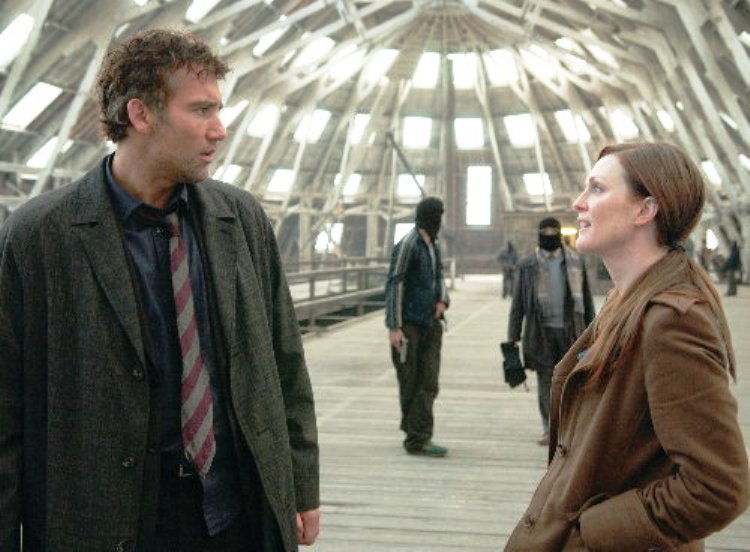
The initial scene of Children of Men jars the viewer with its puzzling premise. Clive Owen is gathered with others around a TV set announcing the death of "the world's youngest person." Not knowing anything about the film's premise, I was intrigued — even more so when the broadcast adds that the deceased was shot for refusing to sign an autograph and was 18 years old. Then, the film gives away its game: The setting is London in 2027 and various unnamed cataclysms have made the entire planet infertile and the person killed was the last human to be born — in 2009.
Soon, the moviegoer gets shaken up again as Owen's character barely misses being in the wrong place when a huge explosion occurs. 2027 in London doesn't look like a place you'd want to visit, let alone live in by choice. The government has turned totalitarian, partially in response to a huge influx of immigrants it can't deal with and "terrorists" take all sorts of actions to try to restore normalcy.
The main issue remains the same for everyone though: For the first time, earth is facing absolutely no population growth. The fascinating premise of Alfonso Cuaron's film, based on the novel by P.D. James, manages to hold your interest, even though the movie itself fails to satisfy as a whole. Owen plays Theo, a man whose role in the various events seems unclear, especially when he's abducted by a Julian Taylor (Julianne Moore), who turns out to be a former lover and fellow activist with whom he once shared a child before the world went barren.
Soon, Theo finds himself responsible for the safety of a young woman named Kee (Claire-Hope Ashitey), who somehow has found herself pregnant and is viewed as a sign of hope and leverage by all sides in the battle.
The technical aspects of Children of Men are superb and it does contain a fun performance from Michael Caine as a hippie-like ex-political cartoonist. Despite such a thought-provoking premise, much of the movie proves confused and drags in far too many spots to truly make the experience worthwhile. When you set up a story this intrinsically interesting, I think a bit of closure or guessing at what comes next isn't too much to expect. It's a misfire, but an interesting one.
Tweet
Labels: 00s, Caine, Clive Owen, Julianne Moore
TO READ ON, CLICK HERE
Tuesday, September 19, 2006
Spike's 2nd 2006 home run

By Edward Copeland
Spike Lee has roared back in 2006 in a big way. I had all but written off the talented filmmaker, but then this year brought a one-two punch of a great documentary and a great action film. Inside Man actually preceded his great When the Levees Broke: A Requiem in Four Acts, but I just caught up with it on DVD and I was impressed. It's probably the film of his I've liked best since his work in the early 1990s.
Looking back at old reviews of his films I wrote at the time, I noticed the recurring theme of fault usually lay with Spike Lee's screenwriting. In the case of Inside Man, he works from a script by first-time screenwriter Russell Gewirtz and it seems to have freed Lee up as a director and he moves this heist thriller along at a breakneck pace with much style.
Sure, he still feels required to use that damn moving sidewalk shot that he's been using in practically every film he's made for more than a decade, but it's so brief that you let it slide. Hell, Lee even manages to get a score from his favorite composer, Terence Blanchard, that enhances the film instead of serving as a suffocating distraction.

The story, which I'll only provide in the vaguest of terms in order to let the movie unfold for those who haven't seen it, concerns the takeover of a Manhattan bank by a team of thieves led by Clive Owen. Thanks to a vacationing detective, Detective Harry Frazier (Denzel Washington) and his partner Detective Bill Mitchell (Chiwetel Ejiofor) get the assignment, despite the fact that Frazier remains under suspicion for stealing some money from a case. The setup seems familiar from many other films, most notably Dog Day Afternoon and more fictional heist tales, but Lee and Gerwitz's script keeps springing surprises on the audience and makes the entire enterprise fresh. On top of the great performances by Washington and Owen, who has to act most of the time beneath a mask, Inside Man also includes a mysterious fixer played by Jodie Foster in her best role in ages and the bank's aging founder (Christopher Plummer) who secures her services to make certain that some things in the bank don't get out with the robbers. I can't recall a performance from Foster that seems less mechanical or embraces glamour the way she does here as Madeline White. Her screen time is limited, but she gives the movie a jolt every time she appears, whether she's opposite Washington, Owen or Plummer.
Still the real star of Inside Man is Spike Lee, who seems to have rediscovered his talent both in fiction and documentary. After many years of disappointments from him, it brings a smile to your face to know Lee still has it. It makes you wish Woody Allen could follow his cue and film someone else's script. Aside from the great movie itself, the DVD offers an often funny commentary by Lee (so much so that he often cracks himself up). He even offers advice (If you ever meet Christopher Plummer, do NOT bring up The Sound of Music) and gives lots of insight as to how shots were set up, asides about gangsta rap and even frequent updates about how the movie crew's baseball team performed. Inside Man provides a great ride — and I for one am grateful that Spike Lee seems to be back and I hope he gets to make his long-sought project with the 93-year-old Budd Schulberg (On the Waterfront) about Joe Louis.
Tweet
Labels: 00s, Clive Owen, Denzel, Jodie Foster, Plummer, Spike Lee, Woody
TO READ ON, CLICK HERE


