Sunday, December 25, 2011
A human life is strictly as frail and fleeting as the morning dew

"There was not a lot of dialogue. The titles were just to keep you up. It's the visual stimulation that hits the audience. That's the reason for film. Otherwise, we might as well turn the light out and call it radio." — Robert Altman
By Edward Copeland
Akira Kurosawa was 40 years old when he made the film that truly made moviegoers outside his native Japan take notice. Rashomon began filming July 7, 1950, and, in amazing turnaround time, debuted in Japan on Aug. 25 of that same year. However, the rest of the world didn't get to see Rashomon until 1951, starting with the Venice Film Festival in September where it won both the Golden Lion and the Italian Film Critics Award for best film. It unspooled next in the U.S., where it premiered 60 years ago today.
The Altman quote that I began this piece with comes from an introduction he taped for the Criterion Collection DVD release of Rashomon in 2002. While Altman certainly had it right about the visual wonders that Kurosawa summons in Rashomon, with the invaluable help of cinematographer Kazuo Miyagawa, with whom Kurosawa was working with for the first time, ironically (given the movie's subject), I
 believe the other much-missed filmmaker's memory may have been faulty when it came to the amount of dialogue. Granted, Rashomon isn't overly chatty, but the film says nearly as much verbally as visually, not that I fault Altman — those images beckon you to lose yourself in them, even if subtitles get missed as a consequence. After all, Kurosawa himself admitted in his autobiography Something Like an Autobiography that he tried in Rashomon to recapture the spirit of silent movies that film had lost when sound came along. Criterion printed an excerpt of his memoir in the booklet that accompanied the DVD. "Since the advent of the talkies in the 1930s, I felt, we had misplaced and forgotten what was so wonderful about the old silent movies. I was aware of the aesthetic loss as a constant irritation. I sensed a need to go back to the origins of the motion picture to find this peculiar beauty again; I had to go back into the past," Kurosawa wrote. "In particular, I believed that there was something to be learned from the spirit of the French avant-garde films of the 1920s. Yet in Japan at this time we had no film library. I had to forage for old films, and try to remember the structure of those I had seen as a boy, ruminating over the aesthetics that had made them special. Rashomon would be my testing ground, the place where I could apply the ideas and wishes growing out of my silent-film research."
Know what tickles me about writing a tribute to this film? Rashomon liberates me to go into excruciating detail (if I desire) about scenes — for instance, I can describe the scene where The Woman (Machiko Kyô) turns on both her husband, the samurai (Masayuki Mori), and the infamous bandit Tajômaru (Toshirô Mifune), accusing them both of being weak and egging them on to fight to the death over who gets to keep her — because that's merely one version of what happened that led to the samurai's death. No character in the movie nor any viewer in the audience can declare with 100% certainty which version, if any, depicts the truth. Rashomon makes the need for giving readers spoiler warnings moot, praise be not only to Kurosawa but to his co-writer Shinobu Hashimoto and especially Ryûnosuke Akutagawa, who wrote the two short stories, "In a Grove" and "Rashomon," which inspired Kurosawa to make the film in the first place. Once Kurosawa had all his elements in place — cast, crew, shooting locations, set being constructed — even his assistant directors came to the director and admitted that the screenplay "baffled" them and asked Kurosawa to explain its meaning. In his autobiography, Kurosawa wrote, “'Please read it again more carefully,' I told them. 'If you read it diligently, you should be able to understand it because it was written with the intention of being comprehensible.' But they wouldn’t leave. 'We believe we have read it carefully, and we still don’t understand it at all; that’s why we want you to explain it to us.' For their persistence, I gave them this simple explanation:

"Human beings are unable to be honest with themselves about themselves. They cannot talk about themselves without embellishing. This script portrays such human beings–the kind who cannot survive without lies to make them feel they are better people than they really are. It even shows this sinful need for flattering falsehood going beyond the grave — even the character who dies cannot give up his lies when he speaks to the living through a medium. Egoism is a sin the human being carries with him from birth; it is the most difficult to redeem. This film is like a strange picture scroll that is unrolled and displayed by the ego. You say that you can’t understand this script at all, but that is because the human heart itself is impossible to understand. If you focus on the impossibility of truly understanding human psychology and read the script one more time, I think you will grasp the point of it.
"After I finished, two of the three assistant directors nodded and said they would try reading the script again. They got up to leave, but the third, who was the chief, remained unconvinced. He left with an angry look on his face. (As it turned out, this chief assistant director and I never did get along. I still regret that in the end I had to ask for his resignation. But, aside from this, the work went well.)" It saddens me the number of books I'll never find time to read. I wish I'd read Kurosawa's autobiography at a younger age — I have
 so many unfinished and unstarted books lying around the house as it is. I digress. Rashomon may have puzzled Kurosawa's assistant directors, but I grasped it from the first time I saw it as a teen. Then again, perhaps geographical differences explain the comprehension gap. Sure — they shared a common country of origin with Kurosawa, but the director had immersed himself so deeply into Western culture through movies and literature, he might as well have hailed from the U.S. as Altman and I did, despite the large differences in our three ages. In fact, in my sophomore year of high school, not long after seeing Rashomon for the first time, my English teacher gave us an assignment to write something about our own time period based on the form of Letters from an American Farmer by J. Hector St. John de Crèvecoeur, which we'd just studied in clsss. The teacher made no requirement that our piece be true or realistic so I titled mine Rashomon, American Style and fabricated an attack on a classmate and wrote five letters by different people, each giving different accounts of what took place, though my piece didn't dwell remotely in philosophical realms — it aimed solely at the satirical side of life. I'm proud to say I received an A on the assignment. With that little anecdote, I've finally remembered to give a broad outline of the plot of Rashomon, which I've neglected to do so far. As much as I do love Rashomon, it might not make the top five if I ranked my favorite Kurosawa films. I know it doesn't make the top four. For Altman, it and Throne of Blood were his two favorites. In that introduction, Altman said:
"Rashomon is the most interesting, for me, of Kurosawa's films.…The main thing here is that when one sees a film you see the characters on screen.…You see very specific things — you see a tree, you see a sword — so one takes that as truth, but in this film, you take it as truth and then you find out it's not necessarily true and you see these various versions of the episode that has taken place that these people are talking about. You're never told which is true and which isn't true which leads you to the proper conclusion that it's all true and none of it's true. It becomes a poem and it cracks this visual thing that we have in our minds that if we see it, it must be a fact. In reading, in radio — where you don't have these specific visuals — your mind is making them up. What my mind makes up and what your mind makes up…is never the same."

Since I've avoided, not on purpose mind you, giving even a cursory synopsis or Rashomon's plot, I suppose now offers as good a place as any other to pen a brief summary for anyone unfamiliar with the film (in the unlikely event that their eyes remain fixed on this Web page this deep into the post). The title refers, according to Kurosawa's autobiography, the main gate to the outer precincts of Japan's 11th century capital city. As the movie opens, a Commoner (Kichijirô Ueda) seeks refuge from a heavy downpour of rain beneath the gate where a Buddhist Priest (Minoru Chiaki) and a Woodcutter (Takashi Shimura) sit visibly shaken, repeating variations of how they just don't understand and never have encountered a story as strange as this one. This intrigues The Commoner, who pumps both men for information about their rambling. "War, earthquakes, winds, fire, famine, the plague — years where it's been nothing but disasters. And
 bandits…every night. I've seen so many men getting killed like insects, but even I have never heard a story as horrible as this," The Priest tells him. "This time, I may finally lose my faith in the human soul." When The Priest says that, The Commoner starts to lose interest. He just wanted to get out of the rain, not listen to a sermon, he responds, then The Woodcutter shares his involvement in the story and we get our first flashback, filmed as a long tracking shot through mountainous woods behind from behind the Woodcutter before it circles around him and continues as he walks toward it — stopping when he discovers a woman's white hat and veil hanging off a bush. He continues on and finds another item on the path until he finally stumbles upon the corpse of The Man and runs back to report it to the police. The Commoner learns that The Priest and The Woodcutter had come to the gate after being at the courthouse where they listened to the testimony of the famous bandit Tajômaru (Toshirô Mifune), who was apprehended by a Policeman (Daisuke Katô); The Woman (Machiko Kyô), who was discovered at a temple; and even The Man (Masayuki Mori), who may have been murdered, but tells his version of events through a Medium (Noriko Honma). No one's version of the events matches the others' completely and The Woodcutter believes everyone, even the dead man, lied. "Dead men tell no lies," The Priest insists. "It's human to lie. Most of the time we can't even be honest with ourselves," The Commoner replies, repeating nearly verbatim what Kurosawa told his confused assistant directors. Most character lists you'll find for Rashomon agree to call Chiaki and Shimura's characters The Priest and The Woodcutter, but you'll find many names Ueda's role such as The Commoner, The Peasant, The Beggar, etc. Within the movie itself, only Mifune's bandit receives a name, Tajômaru. Somehow though IMDb gives full names to The Man and The Woman who could be called The Husband and The Wife or The Samurai and The Wife, but never get proper names.
While I didn't intend for this anniversary tribute to end up reading as if it were a paid advertisement for the Criterion DVD of Rashomon, the disc also contains excerpts from the documentary The World of Kazuo Miyagawa where the late director of photography explains how he pulled off the complicated dolly shot of the Woodcutter's trek through the woods as well as other tricks on Rashomon. The movie marked his first teaming with Kurosawa. The Woodcutter's walk was one of the very first shots scheduled, so Miyagawa set out to impress the director. He had the track built so the camera could do a 180-degree turn and then at the proper time had Takashi Shimura cross over the track to allow the camera to view the actor from the front. Some other Rashomon secrets that Miyagawa (and Kurosawa) share
 in the excerpt involve what tricks they employed to get desired effects in the woods of the Nara, Japan, region where they filmed because the trees stood unusually tall. As a result, it interfered with Kurosawa's wish for shadows and light reflecting on the actors' faces at various times. Miyagawa used the same tool to help with both problems — mirrors. To deflect the distant rays of the suns on to the performers, Miyagawa stole the full-length mirror from the costume department and set it up so it would catch the sunlight and direct it exactly where Kurosawa sought to aim it. The director also sought to darken portions of the actors' faces with tree branches — which would have been fine if the cast all had been about 8 feet tall. Since they weren't, they jerry-rigged some mesh out of sight of the camera and attached branches to it. After that, they again made use of the mirror to reflect the shadows of the standalone branches where they wanted on the actors. One other detail the documentary excerpt includes came only from Kurosawa, who talked about the trouble of filming rain. He said that when you want to film rain, it always had to be a downpour otherwise, the rain never shows up on the film. Even then, in the case of Rashomon, he admits that they tinted the color of the rain to make certain it could be seen. Though Miyagawa and Kurosawa worked together well, they only teamed up two more times since the two men seldom worked at the same Japanese studio at the same time. Their next collaboration didn't occur until Yojimbo and, though he wasn't the d.p., Miyagawa did consult on the photography for Kagemusha. Since Miyagawa served as cinematographer on more than 80 features between 1938 and 1991, he did work with many of the biggest names in Japanese cinema at least once (often multiple times) including Kon Ichikawa, Takashi Imai, Hiroshi Inagaki, Teinosuke Kinugasa, Kenji Mizoguchi(including Sansho the Bailiff and Ugetsu), Yasujirô Ozu (on Floating Weeds) and Masahiro Shinoda, among many others.
Though the importance of the visual ingredients of Rashomon shouldn't be understated, I believe that ultimately the film's success depends on the two separate trio of performers. First, we have Shimura, Chiaki and Ueda as The Woodcutter, The Priest and The Commoner, essentially static characters that function as narrators of a sort as well as our surrogates, debating the philosophical ideas that the movie raises. The Priest struggles with his faith in light of what he has heard while The Woodcutter already has abandoned his on the basis of what he has heard and saw. The Commoner, who receives all the information about the events in the woods second hand, serves both as the audience surrogate and as
 someone who long ago realized that the world doesn't function in black-and-white terms and that horrible things happen every day. When he first arrives, The Priest informs him that a man has been murdered. "So what? Only one? Why, up on top of this gate, there's always five or six bodies. No one worries about them," The Commoner responds. At a later point, The Priest seems unable to listen to any more. "I don't want to hear it. No more horror stories," The Priest pleads. The Commoner fails to react with the shock of the other two men. "They are common stories these days. I even heard that the demon living here in Rashomon fled in fear of the ferocity of man," The Commoner tells him. That part always reminds me whenever a news anchor reports on a workplace shooting somewhere and leads his or her report with someone being "shocked." How many of these over how many decades do these news readers have to talk about until they feel it's OK for them to drop the illusion of being shocked by them? I've also heard there's gambling at Rick's. All three actors serve their roles well but, as always, I'm amazed at the physical changes Takashi Shimura undergoes in his various Kurosawa roles. From a "modern" detective his own age in Stray Dog to The Woodcutter here, from the old dying civil servant in Ikiru to the main samurai in Seven Samurai — I'd be hard-pressed at any time to tell you how old he really was or what he looked like in everyday life. By cheating, I can find his age. He was 45 when he made Rashomon. He died in 1982 at 76.

The second trio's task provides a more difficult acting challenge for Mifune, Kyô and Mori. The three performers aren't simply portraying The Bandit Tajômaru, The Woman and The Man — the film requires them to play widely divergent versions of those characters while still staying within the roles' essential frameworks. All three do well but, as you'd expect, Mifune stands out, though Kyô gives him a run for his money as The Woman. When Tajômaru gives his version of events, he testifies about The Woman's reaction, saying, "Her face turns pale. She stares at me with frozen eyes, her expression intense like a child's." However, when The Woman gives her own testimony, The Woodcutter and The Priest who were at the courthouse say she was docile and nothing like Tajômaru described. The Man's tale given through The Medium paints yet another portrait.


When The Woodcutter finally comes clean about witnessing the events instead of just finding The Man's body afterward as he said before, he draws a sketch of The Woman as completely manipulative and evil. Kyô excels at all these variations. There comes a moment in one version where she's lying on the ground sobbing and suddenly sits bolt upright and lambastes both men that will send a chill down your spine. Mifune's most consistent quality is The Bandit's maniacal laugh, but his face seems incapable of exhausting possible expressions. He can be menacing, romantic, insane, sad — you name it, he probably plumbs it as Tajômaru. They even go so far as to show the difference in fighting abilities in the different version. In Tajômaru's testimony, he claims that he and The Man had a spirited sword fight and that no man had fought him as well as this samurai so he felt he owed it to him that he die admirably. In the account told by The Woodcutter only to The Priest and The Commoner, The Woman forces the two men to fight and their swordplay is sloppy and not done very well. Altman says in his intro that when Tajômaru's interrogation takes place, we never see anyone asking him questions because the audience is doing the interrogation and he was on the money about that. It's not as clear in the testimony from The Woman and through The Medium, but Tajômaru looks right into the camera and speaks to us. In that respect, Kurosawa achieved his goal of going back to the past and recapturing the days of silent movies because in many ways, that's how what divides the film and its two trios. The three men at the gate reside in the talkie and while dialogue exists in the woods, much of what happens, each time that it happens, occurs on the actors' faces.

The pair of prizes Rashomon picked up in Venice were just the first two in a long string of honors and nominations the film received stretching from September 1951 through the spring of 1953. Before Rashomon officially opened on Christmas Day 1951, the always-and-forever mysterious National Board of Review, shortly after changing its name from The Illuminati, awarded Kurosawa best director and gave the movie best foreign film more than a week earlier. The Oscars didn't have a competitive foreign language film category until 1956
 so at the ceremony for 1951 films (held in early 1952), Rashomon became the fifth foreign language film to receive an honorary Oscar from the Academy's Board of Governors "as the most outstanding foreign language film released in the United States in 1951." The previous four went to Vittorio De Sica's Shoeshine and The Bicycle Thief in 1947 and 1949, respectively; Maurice Cloche's Monsieur Vincent (1948) and René Clément's The Walls of Malapaga (1950). (Three additional foreign language films receive honorary Oscars before the regular category was added: Clément's Forbidden Games in 1952, Teinosuke Kinugasa's Gate of Hell in 1954 and Hiroshi Inagaki's Samurai, The Legend of Musashi aka Samurai I: Musashi Miyamoto in 1955.) Apparently, Rashomon didn't make it to England until 1952, because it was for that year that it received a nomination for best film from any source from the British Academy Film Awards, handed out in spring 1953 (and not yet merged with the British TV Academy to form BAFTA). What doesn't make sense is that NBR and the Academy both recognized that Rashomon's U.S. release occurred in 1951. Somehow though when the 1952 Oscars rolled around, the Academy nominated production designer Takashi Matsuyama and set decorator H. Motsumoto for their black-and-white art direction. Forget for the moment the question of how they ruled Rashomon eligible again but consider that being eligible the Academy ONLY nominated it for art direction in 1952, that year The Greatest Show on Earth won best picture. Also for the year 1952, Kurosawa received a Directors Guild of America nomination, the only DGA nomination he ever received, though he lost to John Ford for The Quiet Man — one of the 17 other contenders in the category. Hell, we’re already spending too much time talking about this year’s awards, I’ll stop talking about awards six decades ago now.
Besides, the honors aren't what matters in the end, it's the influence and it would be impossible to list all the movies, TV shows, plays and novels that have been influenced by Rashomon, which, of course, had its own influences to draw on before Kurosawa filmed it. Movies made before Rashomon had told a story through multiple points of views (most notably Citizen Kane), but nothing had really had alternate versions of a single event until Rashomon. When I watched Rashomon again most recently, the most recent film that popped into my mind was (500) Days of Summer where Joseph Gordon-Levitt's character's interpretation of Zooey Deschanel's character and moments they shared changed depending how he felt toward her at that given moment. In 1964, Martin Ritt directed an actual American remake called The Outrage that set the story in the Old West and starred Paul Newman, Laurence Harvey and Claire Bloom in the roles equivalent to The Bandit, The Man and The Woman and Edward G. Robinson, Howard da Silva and William Shatner in the parts equal to The Commoner, The Woodcutter and The Priest. Two recent films with similar premises, updated for the modern age, were Courage Under Fire and Vantage Point. A little Rashomon peeks out at times in Tarantino's Reservoir Dogs and Jackie Brown. Many TV shows, especially sitcoms, have enjoyed borrowing the premise over the years, including a classic All in the Family where Mike and Archie differ over what happened when a TV repairman and his African-American apprentice came over. Almost by formula, any police or detective show has that quality to some extent. However, The Simpsons delivered by far the funniest dialogue exchange referring to the movie. In the 10th season episode "Thirty Minutes Over Tokyo," Marge says to Homer, "You liked Rashomon the last time we saw it" to which Homer replies, "That's not how I remember it."
What remains important about Rashomon is that 60 years later, we do still remember it and the film has injected itself far enough into the cultural bloodstream that we'll continue to reference it. Sadly, the same can't be said for so much of our past works of film, television, music and literature as we increasingly become a disposable culture where it's been decided the most things should have an expiration date, usually tied somehow to the date Entertainment Weekly began publishing. Thankfully, Rashomon seems to have slipped by the pre-1990 terminators. Long may it baffle.
"It certainly changed my perception about what is possible in film and what is desirable. You just have to be able to let the audience come to that conclusion and they say, 'Oh, that isn't what happened.' Everybody that you would talk to about it — you'd sit down and make a person see the film — and ask them questions, you would not get the same answers from anybody which is the art of art. That is what art is — it penetrates your intellect…and your experience and history has to react on this new information. You're reacting from your own persona on it, but that's what gives it the power." — Robert Altman
Tweet
Labels: 50s, Altman, Awards, Books, De Sica, Edward G., Foreign, Gordon-Levitt, John Ford, Kurosawa, Mifune, Movie Tributes, Newman, Nonfiction, Oscars, Ray Top 100, Shatner, Silents, Tarantino, The Simpsons
TO READ ON, CLICK HERE


Wednesday, November 02, 2011
Some call it elegance, some call it cruel

By Edward Copeland
Believe it or not, after hearing his name for years, watching 13 Assassins marked the first time I viewed the work of Japanese director Takashi Miike. Obviously, I can't compare it to his other films but I can say that it did make me eager to check out what else Miike has made. Set in 1840s Japan as the samurai era was ending with the shogun period soon to follow, 13 Assassins remakes a 1963 Japanese film by director Eiichi Kudo titled The Thirteen Assassins (which I haven't seen) and serves as an homage to classic Kurosawa samurai films, specifically Seven Samurai.
The film creates a truly great screen villain in Lord Naritsugu (Gorô Inagaki), the sadistic young son of the former shogun as well as the younger brother of the current shogun — which basically makes him untouchable and has made him arrogant enough that his atrocities prove truly heinous. He rapes and kills at will and, in perhaps his most horrifying act, cuts off a woman's limbs and tongue just to use her as a plaything until he tires of her.
When a father goes to Naritsugu's shogun adviser, Sir Doi (Mikijiro Hira), after Naritsugu rapes and kills his daughter-in-law and murders his son and prepares to commit ritual suicide, Sir Doi attempts to talk sense to the evil young lord but his advice falls on deaf ears. Realizing what horrors could befall the land should Naritsugu rise higher in power, Sir Doi secretly enlists a retired samurai named Shinzaemon Shimada (Kôji Yakusho, who has appeared in many films such as the great Tampopo as well as films that earned notice or were partly U.S. productions such as Memoirs of a Geisha, Babel and Shall We Dance?). In many respects, Shinzaemon reminds one of Takashi Shimura's character Kanbê Shimada in Kurosawa's Seven Samurai, even sharing the same family name, hardly the last homage or coincidence between the two films.
As in Kurosawa's classic, Shinzaemon gathers other samurai to help with the urgent mission, though there isn't an extended sequence of tests of his recruits as in Seven Samurai — time isn't a luxury that the hired swords have. Naritsugu plans to head to his family's land with his protector Hanbei (Masachika Ichimura) and 70 men. Once there, not only will the cynical and evil young lord be even more protected, he'd be even closer to succession in the shogunate rule. To get there, he must pass through the town of the father who was going to commit harakiri. Shinzaemon talks the man into denying Naritsugu passage so that he and his men will have to follow one of two paths around the village to get there where the samurai assassins can spring their surprise attack.
Problems ensue with that approach: 1) Hanbei catches wind of the plot and enlists some ronin to challenge some of the assassins, who were setting up a town as a trap that Naritsugu would have to pass through; and 2) Naritsugu and his men disappear once they're turned away. Shinzaemon take his men into the mountains to try to figure out what's going on where they discover a mysterious man (Yûsuke Iseya) who calls himself Kiga suspended in a cage in a tree. He has no love for samurais and claims he was put there as punishment for chasing his boss's wife. He calls himself a hunter, but ends up helping the group anyway and at times seems to have inexplicable abilities. Parts of his personality seem quite reminiscent of Toshirô Mifune's Kikuchiyo in Seven Samurai. Kiga becomes the 13th assassin. Before too long, one of those 13 rides back with news that Naritsugu and his men have reappeared — only what once was a force of 70 now numbers nearly 200. Hanbei had simply hid out to wait for reinforcements.
Then Miike directs 13 Assassins in one of the most incredible extended action sequences I've witnessed. The film runs about 2 hours and 5 minutes in length. The climactic clash lasts for nearly 50 minutes — from when it starts to almost the end of the film itself, with very few moments to take a breath. Miike gets immeasurable aid from his editor Kenji Yamashita, director of photography Nobuyasu Kita and production designer Yuji Hayashida. In an interview on the DVD, Miike admits he didn't set out to make the melee run as long as it does, it just turned out that way in the editing process. It turned out well. It's never confusing when characters die, some getting deaths that almost are afterthoughts, others receiving truly memorable ends.
Though action might be perceived as the selling point of 13 Assassins, Inagaki's great performance as Lord Naritsugu shouldn't get slighted. He creates a hissable bad guy without going over-the-top, but also gets many of Daisuke Tengan's best lines that show how odd this fellow is. As he stands next to Hanbei amid the chaos and bloodshed, he gazes at the death and destruction in wonder. "You think the age of war was like this?" he asks Hanbei who says, "Perhaps." It makes the bastard positively giddy. "It's magnificent. With death comes gratitude for life. If a man has lived in vain, then how trivial his life is. Oh, Hanbei. Something wonderful has come to my mind. Once I'm on the Shogun's council, let's bring the age of war," he tells him, excited at the prospect. When his inevitable end comes, he doesn't have a change of heart, but he does learn the hard way that war ain't all it's cracked up to be.
While 13 Assassins turns out to be great fun and one of the best films released in the U.S. this year, it's not quite up to the quality of the Kurosawa classics or even John Woo's recent Red Cliff, even though it's not a samurai picture. 13 Assassins provides a damn entertaining time. I just wish that all of the characters were developed as well as Lord Naritsugu, Shinzaemon and Kiga.
Tweet
Labels: 10s, Foreign, Kurosawa, Mifune, Remakes, Takashi Miike, Woo
TO READ ON, CLICK HERE
Tuesday, September 13, 2011
"I get paid for killing and this town is full of people who deserve to die."

By Edward Copeland
The title of Akira Kurosawa's Yojimbo fills nearly the entire expanse of its Tohoscope 2.35: 1 image in Japanese characters while mountains stand in the distance beyond the letters in Kazuo Miyagawa's crisp, stark
 black-and-white cinematography. Then he enters the frame behind the continuing credits, seen only from the back, though his sword is visible. He scratches his hair and proceeds to walk as the credits go on, still viewed from behind, accompanied by the drum-dominated pulsating portion of Masaru Satô's magnificent score. The samurai turns and we briefly see him in profile and, as if we didn't know already, we recognize the great Toshiro Mifune. Soon, Kurosawa films Mifune solely from the back again, only this time moving in closer, letting us see him only from the shoulders up. Every so often, Mifune does a little shoulder shrug reminiscent of the move people doing bad Cagney imitations make when they say, "You dirty rat." As he keeps moving on, the camera pans
 down to his feet and his sandals as he passes some markers. The credits end, the music stops and we see him in his entirety — he's come to a crossroads where he could take one of four paths. The samurai picks up a stick and tosses it in the air. letting it decide for him. That stick certainly selects a path that will prove challenging for the samurai but that piece of bark (a symbolic Kurosawa surrogate) also chose one helluva entertaining journey for the moviegoer when 50 years ago today, Yojimbo opened in the U.S., one of the rare times in Kurosawa's career when one of his films was released in the United States in the same calendar year as in Japan.
Technically, Mifune's samurai isn't a samurai since he no longer has a master, which means he should be called a ronin. He hasn't been on the path the stick chose for him that long when he comes across a farmer (Yoshio Tsuchiya) and his son (Yosuke Natsuki) arguing in the middle of the road. The son, probably in his late teens, insists to his father that something "could be chance for the battle of a lifetime." His father calls him a crazy fool, saying it's only going to be a chance to get killed and that a farmer's place is in the fields. The son tells him that if that means a lifetime of eating gruel, he can have it, adding that he's determined "to live well and die young" before he takes off. The ronin hasn't said a word this whole time, but when the son leaves, he
 asks the farmer if he can have a drink from his well. The farmer gives him a dirty look, but doesn't object as he goes into his house and blames his wife (Yoko Tsukasa) for not stopping the boy. She asks what she could have done. Gambling have driven all kids these days crazy, she declares. Besides, she worries about her and her husband's future. Who knows if there will ever be another silk market where they can sell their goods anyway as long as the gamblers fight for control of the town. The ronin moves on. When he arrives in the town the farmer's wife mentioned, the streets have emptied of any evidence of people, though as he walks, people spy through blinds on their windows. The only sign of life — and death — comes prancing down the dusty street in the form of a dog, a severed human hand clutched in his mouth. It's a more grotesque image than the panting, overheated dog that Kurosawa used to open his 1949 film Stray Dog, but somehow it comes off as more comical even this early in Yojimbo just as the Stray Dog image set the more serious tone for that film. David Lynch paid a kind of dark comic homage to the Yojimbo scene in Wild at Heart when a robbery goes wrong.
Though Yojimbo opened in the U.S. three years before Sergio Leone translated it into his spaghetti Western A Fistful of Dollars (which didn't open in the U.S. until 1967) and recast Mifune's mysterious ronin into Clint Eastwood's Man With No Name, more moviegoers even today probably have seen Leone's film, which is a shame. Not that A Fistful of Dollars isn't fine, but Leone's other spaghetti Westerns — the other two with Eastwood and Once Upon a Time in the West — are vastly superior to Fistful and Yojimbo leaves Fistful in the dust. Also, while there is much plot to comprehend in Yojimbo, for those who still frown on films with subtitles, Yojimbo actually can be followed fairly easily if you miss a few without losing the essential enjoyment of
 the film (Plus, it offers good practice for those who lack the subtitle reading skill required to truly appreciate movies in a language not their own). What many miss (mainly those who haven't seen Yojimbo) is that in essence, it is a Western. It contains mostly swords and merely one revolver, but it is set in the 1860s as opposed to Kurosawa's The Seven Samurai, which took place in the 16th century and the town's design purposely echoes the American West of that time more than it does Japan. Should it be called a sake Western? The funny thing about Leone's remake: It wasn't official and Kurosawa and co-writer Ryûzô Kikushima sued for copyright infringement, winning 15 percent of Fistful's worldwide gross in addition to distribution rights for Leone's film in Japan, Taiwan and South Korea. Later, Kurosawa said he made more money off A Fistful of Dollars than Yojimbo. Ironically, while the style of Yojimbo definitely shows the influence of Western movies Kurosawa had seen, some say he lifted its plot from Dashiell Hammett's 1929 detective novel Red Harvest, where a nameless private eye is hired by the president of a mining company to clean up a mining town overrun by mobsters the company had hired to break the union there. It's from that novel that the term Blood Simple originated.
As the ronin returns to his survey of the street after the dog with the unusual treat has moved along, he tries not to be obvious about all the gawkers hiding behind their windows. From behind a door, a small grinning man, eagerly rubs his hands together and practically dances over to the stranger in the street. He is Hansuke (Ikio Sawamura), the town's constable, and immediately tries to ascertain how much the ronin wants to be a bodyguard and asks whose side he's going to take. Mifune's ronin stays silent and ignores Hansuke, continuing to walk up the street,
 failing to notice the constable as he ducks inside a building behind him. Suddenly, a large group of swordsmen (they aren't all swordsmen — one carries a large mallet). No one says a word or makes a move until one of the group finally speaks up, "It's a public road — even dogs pass safely." The men all laugh and return inside as the ronin switches directions. The cagey constable comes out of hiding, criticizing the ronin's approach, telling him that no one will hire him that way. Those guys aren't that tough, he insists. You have to show them what you can do, cut an arm off or something, Hansuke suggests. The ronin continues to ignore him, especially when he spots a sign that the subtitle reads as RESTAURANT, though in all the reference sources they refer to it as a tavern. The tavern's owner, Gonji (Eijiro Tono) sticks his head out. Hansuke keeps babbling. "Mind your own business, you bastard," Gonji says as he allows the ronin inside and closes the door.
The tavern owner asks the ronin if he wants sake, but he seeks only food. Gonji informs him because of the way business has been, he doesn't have anything except for rice and it's cold. The ronin tells him that it will be fine, but that he doesn't have any money so he offers his services in exchange. This sets Gonji off. He tells his
 visitor that he'll feed him for free, but that this town has seen enough fighting, blood and death so he has to promise to leave afterward. The ronin asks what happened to turn this town into this cesspool. "One boss in a town we can tolerate, but two is a disaster," Gonji says. For a scene of exposition, Kurosawa, through the vehicle of the actor Eijoro Tono, handles it quite efficiently and makes it visually interesting. Instead of just sitting next to Mifune and spilling the entire story, the tavern's design comes with shutters on most sides that Gonji can slide up quickly with a zipper-like sound to point out not just the plot points and the characters but the town's geography as well. First, before the details begin, a pounding from next door gets to Gonji. Only the casket maker prospers now, he says. What started the trouble was when Seibei (Seizaburo Kawazu), who ran the gambling and the brothel, decided to step back a bit from the day-to-day running of all his territory. His right-hand man Ushitora (Kyu Sazanka) assumed he'd be the natural successor,
 but Seibei passed a large part of his territory on to his son Yoichiro (Hiroshi Tachikawa). A furious Ushitora left and started his own regime, taking about half of Seibei's men with him and the fighting began. Gonji ceases his tale as he hears an arrival next door greeting the casket maker (Atsushi Watanabe). Gonji's tavern has an open window that looks directly into the neighboring business and they watch as a rotund fighter with three other men gets the body count for his side and the other. When they leave, Gonji explains that the man doing the talking was Inokichi (Daisuke Kato), Ushitora's brother. Inokichi means wild boar, Gonji says, and never has a name been more appropriate. "He's a half-wit and he's brought three more fighters back with him," the tavern owner sighs. "Instead of buying silk, they're buying thugs." Hearing talk, Gongi peeks outside and sees Hansuke laughing and bowing to Inokichi. Gonji despises the constable,
 who should be arresting these people, he spits. When they've moved on, he raises the shutters all the way and points to the building across the street. Tazaemon (Kamatari Fujiwara) is the mayor, but a silk merchant by trade, he tells the increasingly intrigued ronin, but when the split occurred, he sided with Seibei. Gonji leads his guest to the opposite side of the tavern and raises those shutters. As a result, the sake merchant Tokuemon (Takashi Shimura) took Ushitora's side and declared himself mayor. Now, Gonji says, "Tazaemon beats on his prayer drum all day, hoping Seibei wins." Gonji sits down next to the ronin. "This town is doomed," he laments. "You gain nothing getting sucked into this evil." His patron puts down his rice bowl. "I like it here. I think I'll stay," he declares. Gonji asks if he didn't just hear what he told him. He'd be nuts to want to stay. Mifune, who I once argued may be the greatest screen actor of all time, explains why in a nice, pithy speech.
"That's why I'm staying. Listen, old man. Think about it. I get paid for killing and this town is full of people who deserve to die. Seibei, Ushitora, the gamblers and drifters — with them gone, the town could have a new start."
Gonji calls him crazy again — it's not as if he has nine lives. The ronin says he's not going to do it alone. Gonji asks who would help. He responds, "Sake. I think while I drink." The ronin and the audience now know the players (for the most part: a major one will appear later and lesser roles will be introduced), so the game can begin. Basically, the ronin with no name will use the town as a chessboard, Seibei's gang vs. Ushitora's, only he will be the one moving their pieces. (Actually, he will give a name, though obviously a fake one, when Seibei asks what it is when hiring him as a bodyguard. The ronin sees something out the window and calls himself Sanjuro Kuwabatake, though he tells Seibei it doesn't matter since he doesn't know him. Sanjuro, of course, became the title of the 1962 sequel.) Yojimbo (which translates to the bodyguard) has the look and feel of a Western set in Japan, but it also carries elements of gangster films since what are Seibei and Ushitora, who
 make their livings off vice and destroy people through their weaknesses, but mobsters. It's as if more than 40 years ahead of time, Kurosawa told the story of the blood grudge between New York and New Jersey in the last year of The Sopranos , only an entire town of innocent people pay a price and both families are headed by Phil Leotardo. When you get down to it though, the genre that Yojimbo belongs to is that of the dark comedy. While preparing to write this tribute, I stumbled upon a well-sourced article on the Web called "Yojimbo: Study of a Disintegrating Society" written by Joaquín da Silva in 2004. It makes a reasoned case that Yojimbo represents Kurosawa's criticism of changes in Japan in both the 1860s when the film is set and the late 1950s and early 1960s when Yojimbo was written and made and how they led to the breakdown of traditional Japanese society and values, and that every character in the film essentially is disreputable or evil and that Seibei and Ushitora actually are just henchmen for the silk and sake merchants, respectively. Since I know next to nothing about Japanese history in that sort of detail, I can't argue for or against the case but just watching and enjoying Yojimbo as many times as I have, I don't sense a message movie lurking beneath the surface and given the portrayal of the cowardly silk merchant, beating his prayer drum all day, he doesn't strike me as someone who's capable of pulling anyone's strings. It is an interesting read though if you have the time. What I do see in Yojimbo is a great filmmaker indulging himself in a masterful romp following more than a decade of cinematic
 excellence that, for the most part, dwelled in darkness. Remember, this followed films dating back to his first international hit in 1950, Rashomon, and others such as The Idiot, Ikiru, Throne of Blood, The Lower Depths and The Bad Sleep Well. The Seven Samurai came in this period as well, but it freely mixed the dark with the light. In an essay called "West Meets East" by the late Alexander Sesonske in the booklet that accompanies the Criterion DVD of Yojimbo, Sesonske wrote, "Kurosawa, often called the most Western of Japanese directors, now seems to have thought, 'Enough moral fervor, I'll show you how Western I can be.'" In The Films of Akira Kurosawa by Donald Richie, Kurosawa is quoted as saying about his inspiration for Yojimbo, "The idea is about rivalry on both sides, and both sides are equally bad. We all know what that is like. Here we are, weakly caught in the middle, and it is impossible to choose between evils. Myself, I've always wanted to somehow or other stop these senseless battles of bad against bad, but we're all more or less weak — I've never been able to. And that is why the hero of this picture is different from us. He is able to stand squarely in the middle and stop the fight. And it is this — him — that I thought of first. That was the beginning of the film in my mind."
 While Mifune has given some of the best performances in the history of film, with Yojimbo he also has a part that lets him have fun. He's a thinker surrounded by idiots, carrying a perpetual look of bemusement on his
 face, usually with a toothpick dancing in his mouth. When it comes time to fight, his skills border on the supernatural, quick and deadly, but later in the film, when his sympathy for a broken family gets the better of him and the sharpest of the bad guys — Tatsuya Nakadai as Unosuke, Ushitora's younger brother who has returned from a long trip elsewhere — learns of his deception, they savagely beat and torture our ronin, who shows the effects of the pummeling, until he manages to escape and gets help from Gonji and the casket member to spend time in a faraway temple to heal for awhile. It makes him reminiscent in a way of Bruce Willis' John McClane in Die Hard who achieves the amazing when outnumbered, but shows the lumps for
 it. A piece in the Criterion booklet describes Unosuke's outfit as well as I possibly could. "Unosuke makes his screen entrance with a Springfield revolver stuck in the breast of his kimono and a red plaid scarf wrapped around his neck." Though Yojimbo was shot in black-and-white, his costume is so vivid you can almost tell that the scarf is red, much in the same way you saw the red in Bette Davis' dress in William Wyler's black-and-white Jezebel in 1938. That same article in the booklet recounts a reporter asking Kurosawa about the outfit's accuracy for its era, he replied, "Unosuke spent time in the international port town of Yokohama, so it's not all that unbelievable. Besides, a costume works when an audience looks at it and — wham! — something about the character sinks in. It's a mistake to get too caught up in whether it's historically accurate or not." The Criterion booklet also contains a 2002 conversation with Nakadai, who played Unosuke, and he shared how Kurosawa explained the relationship between his character and Mifune's and how
 heroes and villains should be portrayed generally. "'Mifune's Sanjuro and your Unosuke are like a stray dog and a snake' Kurosawa told me. 'Some films place the hero above the villain from the beginning, but that's just boring. If you're going to set two characters against each other they should be equal strength…No, the bad guy should be made to look even stronger,'" Nakadi retold. "Kurosawa flashed me a really cool smile when he said that." That always has been the case, no matter what type of genre. The film is only as good as its villain. Die Hard wouldn't be the classic it is without Alan Rickman's Hans Gruber (You have 60 seconds — without using any sort of reference material, name or describe the villain in Renny Harlin's godawful Die Hard 2. Thought so.) and you can go down the list of Bond films and the best ones inevitably have the greatest bad guys, which is why nearly everyone loves Goldfinger the most.
While Yojimbo has its share of action scenes, by today's ADD generation's standards, there aren't that many. This isn't Michael Bay explosion-filled building-crushing nonsense with a brain the size of a gnat (all the better to match the audience's attention span). More than an endless series of skirmishes, Yojimbo's greatness lies in its embrace
 of strategizing over mindless killing. When Mifune's ronin says, "I drink while I think" the strength of the line doesn't lie in its humor but in the fact that he thinks. That's something getting excised further and further from action films as filmmaking goes on. As recently as Die Hard in 1988, while it's a different breed of film than Yojimbo, it still slowed down long enough for McClane to contemplate what his next move should be against Hans and his gang. Twenty-two years later, we get crap such as Taken which should carry a warning label that logic and rationality will not be allowed during viewing of the film. What’s funny about that is that Mifune’s character, until the late arrival of Unosuke, truly exists as the only character in Yojimbo who uses his brain (unless you count the previous ronin that Seibei employed, Homma (Susumu Fujita), who gets offended that Seibei hires Sanjuro at such a higher rate and hightails it out of town
 before a planned face-off between the gangs). As Sesonske wrote, "Sanjuro is a supersamurai, a whirlwind in combat; the village gangs are so grotesquely wicked they become ludicrous and enlist neither our sympathy nor our belief. By the film's end, most are dead, but we feel no regret at the slaughter nor do we cringe at its execution. The exaggerated evil of the gangs leaves them no other appropriate fate, and theirs is achieved with such style and cinematic verve that we are exhilarated by the spectacle and not at all dismayed by its content." While you can't disagree with Sesonske's assessment that the two groups of villains that Sanjuro so skillfully plays off each other are absurd to the point of silliness at times, Kurosawa compensates by distinguishing so many of them. Seibei and Ushitora are quite distinct from one another. You won't confuse Ushitora's brother Inokichi with the giant Kannuki (Tsunagoro Rashomon), who resembles a Japanese Richard Kiel. They may be cartoons, but they aren't just blank slates biding time until termination.
We shouldn't neglect the cinematic magic that Akira Kurosawa's collaborators behind the camera brought to the film. Upon this viewing, what stood out more strongly than it ever had before was Masaru Satô's eclectic and multifaceted musical score. For every sequence and emotion, Satô composes themes that perfectly
 complement the action without overwhelming or undercutting them. From comical or suspenseful, to lush and portentous, it's as if Satô wrote scores for a dozen films yet they all fit. As I mentioned in the beginning, there's also the vivid black-and-white cinematography of Kazuo Miyagawa who, in a 1993 conversation also in the Criterion booklet, spoke of the difficulties he had with the pan focus that Kurosawa insisted upon for Yojimbo. "Everything had to be in perfect focus, whether it was right in front of you or at the very rear of the shot," the d.p. said. "So we decided to work in a spectrum of tones that would accentuate that would accentuate the contrast as much as possible and give objects a hard, metallic edge. We aimed at the kind of atmosphere you get at high noon, when shadows are at their most intense.…it was what we needed to match Yojimbo's hard-boiled subject matter."
 In the end, Yojimbo offers as its greatest strength Mifune and Kurosawa, arguably the greatest actor-director team in film history with Mifune clearly relishing his role as the cleverest and bravest character in the film, and Kurosawa delivering many astounding shots and unique framing of scenes. Together, the vitality this duo brings to Yojimbo makes it play as fresh today as it must have 50 years ago.
Tweet
Labels: 60s, Bette, Cagney, Eastwood, Fiction, Foreign, Kurosawa, Leone, Lynch, Mifune, Movie Tributes, Ray Top 100, Remakes, Rickman, Sequels, The Sopranos, Willis, Wyler
TO READ ON, CLICK HERE
Wednesday, March 09, 2011
Mean Streets ... and Rough Around The Edges

archetypal young males who act like moronic boneheads...self-centered simpletons: Urban Dictionary
By Squish
Mean Streets was Martin Scorsese's fourth feature, after his first teaming with Harvey Keitel, 1967's Who's That Knocking at My Door?, the documentary Street Scenes and a Depression-era tale named Boxcar Bertha. Looking through Scorsese's filmography is like climbing a steady slope of films that become ever more popular than the last as one follows his career. Mean Streets has a young and completely arrogant Robert De Niro character as well as his second time working with a young and ironically wiser than usual Keitel. But youth doesn't mean grace, and, if you'll allow me to continue with the climbing analogy, watching Mean Streets feels more like a warmup than a workout.
My lukewarm reception of this film stems from that same youth I spoke of earlier. The cinematography shows signs of inexperience and the scenes are often rote. The most disappointing of all is that the end played out exactly as I had expected it would half way through the story. We open with a quote, a wise one, "You don't make up for your sins in church. You do it in the streets. You do it at home. The rest is bullshit and you know it."
Charlie (Keitel) has a thing about reminding himself of the pain of Hell by putting his hands over flames, and though his reasons are well known to us, this theme of Hell and sin doesn't ever become relevant or poetic, remaining merely a reminder to the audience of Charlie's internal code of failed morality.
Of course, as is true of any cinephile, there's plenty to like. Being a fan of grand entrances, I was glad to see Johnny Boy introduced with a flourish — his first scene had him blowing up a mailbox in a New York City street in broad daylight. Also it's Robert Goddamned De Niro, and no matter how bad a movie is, if he's in it, well, Hell it's OK... mostly. Every word he speaks is idiotic, stupid, brash, smart-mouthed and... mookey.
And hey, there's even a young David Carradine (who'd worked with Scorsese in his previous feature Boxcar Bertha) playing a bit part as a raging drunk.
That being said, Scorsese is one of those directors that everyone eventually learns is extremely important, and potentially worthy of a completist study. Those embarking on a quest to watch his films in chronological order will get a certain grin on their lips when they watch Mean Streets, the same way I did watching early Kurosawa and seeing Mifune for the first time, the same way I did when I watched my first real definable Hitchcock. Those movies weren't great, but they were signs of an auteur developing his craft, and even if it's not that great, it's still effin' Scorsese.
Tweet
Labels: 70s, De Niro, Hitchcock, Keitel, Kurosawa, Mifune, Scorsese
TO READ ON, CLICK HERE
Tuesday, January 25, 2011
Requiem for a lifestyle
By Edward Copeland
As much as an icon as Humphrey Bogart has been and for as long as he's held that status, it's hard to believe that he already was 40 years old before he became a true movie star and that his career as a legend lasted a mere 15 years. The film that gave him his first starring role and launched him into the celebrity stratosphere, High Sierra, was released 70 years ago today.

Bogart had been kicking around the Warner Bros. studio system in supporting gangster roles since he made his big impression repeating his Broadway role as Duke Mantee in the 1936 film version of The Petrified Forest. Bogart would never have received that break if the star of the play and the movie, Leslie Howard, hadn't insisted that Bogart must repeat the part on film. Warners had gained a reputation as "Murderers Row" with its success in the gangster genre and its stable of famous crime movie stars such as James Cagney, Edward G. Robinson, George Raft and Paul Muni. The studio didn't see the need for bringing out a New York actor for the part, but Howard and Bogie won out. Bogart got a contract with the studio out of the deal, but his career seemed stuck in neutral.
W.R. Burnett, who wrote the novel Little Caesar, whose film version just happened to premiere 80 years ago today, penned the novel High Sierra and Warners snapped up the rights two weeks after publication, envisioning it as a vehicle for Muni. They gave the book to one of their young writers, John Huston, to turn
 into a screenplay and he produced a script that followed the book fairly faithfully, but Muni rejected it. The studio brought Burnett in to work with Huston on another draft, but Muni nixed that one too. In the meantime, Bogart had seen the High Sierra script and knew he had to play Roy Earle, seeing in him a part that could lift him to the next level of Hollywood actors. The studio pursued Raft, who happened to ask Bogart his opinion of the script. Bogart acted less than enthusiastic, telling Raft that it just seemed like another standard tough guy role who gets shot up in the end. He successfully talked Raft out of it and the studio turned to him, even though Earle is substantially older than Bogie was. They began makeup tests and when those passed muster, the part was his. Raoul Walsh was assigned to direct and Ida Lupino was cast as the girl of one of the criminals. Bogart, Lupino and Walsh had all worked together in They Drive By Night. Since Bogart still wasn't a bankable name and They Drive By Night was considered a big hit for Lupino, she got top billing. High Sierra was the last film Bogart made where his name didn't appear first. High Sierra also launched the friendship that led to one of the all-time great actor-director partnerships between Huston and Bogart, which would premiere later that year with Huston's directing debut, The Maltese Falcon.
Walsh opens his film with the credits scrolling up with the Sierra mountain range in the background, foreshadowing its role in the film's climax, before he fades into a shot of the Governor's Mansion. We move inside where we see a man, presumably the governor, as he signs what we see in closeup is an unconditional pardon for Roy Earle. We then see a montage of shots from a prison: Inmates going about their day, the cells,
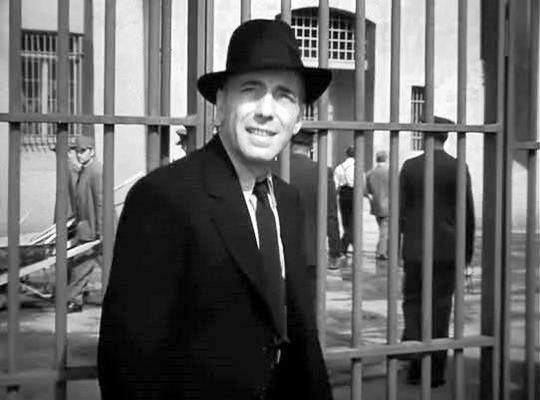
 the guards, etc., until we see its name: Mossmoor Prison and sidle down to the prison gates where a man waits in a car. Then Roy Earle (Bogart), looking sharp in a suit, tie and hat shakes a guard's hand, the gates open and he steps out to freedom. The driver (George Lloyd) gets out and tells Roy he's been waiting more than an hour for him. "I've been waiting too — over eight years," Earle replies. The man who picked up Roy notices his distracted air and asks him if he's OK. "I will be, just as soon as I'm sure that grass is still green and trees are still growing," Roy tells him before heading for a walk in the park where he bypasses a newspaper announcing his release from prison (He's identified as a "Famous Indiana Bank Robber" and people are upset by his early release) to enjoy nature and even toss a baseball back to some kids. That's what separates Roy Earle from the usual gangster you'd find in that movie genre. Sure, he's a tough guy, but he also has a tender, empathetic side as we will see later, a side that will hurt him in a way no bullet ever could.
Following his brief sojourn with nature, Roy heads to a house where he expects to find Big Mac. (No, not the sandwich, the crime boss who backs his heists and arranged his pardon.) A man and a woman are waiting for him: the man reading the newspaper and wondering what's keeping him, the blonde (Isabel Jewell) filled with
 excitement at the prospect of meeting the infamous Roy "Mad Dog" Earle. The man (Barton MacLane) tells her that when Earle gets there, she needs to lock herself in the bedroom and stay out of sight. She pouts and hears the car indicating Earle's arrival. She dutifully goes to the bedroom, but keeps the door cracked so she can peek, so the man tosses a book at the door to get her to shut it. When Roy enters the house, he wants to know where Mac is and the man introduces himself as Jack Kranmer, whom Earle immediately pegs as a cop, though Jack insists he's an ex-cop. Kranmer tells him that Mac is in California and wants Earle to head that way. He's planning a jewelry caper at a ritzy hotel in the resort town of Tropical Springs. Kranmer rubs Roy the wrong way and Earle expresses suspicions about him, wishing to talk to Mac himself. Kranmer reminds him that Mac spent a fortune springing him from prison so Mac "calls the tune and you dance to it." We finally get to see the tough side of Earle as he gives Kranmer several quick slaps on each side of his face before exiting.

While on the road to California, after a brief stop for a nostalgic look at his childhood farm (this Earle really is a softie at heart), Roy's driving skills save himself and another vehicle from having an accident when the other car swerves wildly when a rabbit darts across the two-lane-highway. Down the road a bit later, Roy stops for some gas and the lonesome attendant chatters away about the sight of the Sierra range ahead and Mount Whitney, the highest point in the U.S. The car that almost collided with Roy happens to pull up and the old man in it (Henry Travers) hops out to extend his gratitude to Roy for saving them from a wreck. He says his granddaughter Velma (Joan Leslie) was driving at the time and she probably had been driving longer than she should have been. He introduces himself and his wife (Elizabeth Risdon). It seems that they have just lost their farm and are heading to California to live with Velma's mom. Roy wishes them luck and departs with a kind smile.
Earle rolls into a lakeside lodging camp where his two caper associates are staying. The place is mostly a site for fishermen and the first person he encounters is a black man named Algernon (Willie Best), who
 unfortunately is played as the worst of comic stereotypes of the era. It's really one of the few blights on an otherwise classic film. Algernon tells Roy two men have been expecting him and points out which cabin Roy's staying in and which cabin holds the two men. Roy also meets a scrappy little dog named Pard. (In the opening credits, they get it wrong and say 'Pard' as 'Zero', though it's fixed for the end credits.) Earle compliments Algernon on Pard, but is corrected. Pard isn't his: His original master got killed in an accident there and Pard just never left. Roy asks Algernon to drive his car to his cabin and take his bags inside and he heads up to meet the men who will be his partners in crime. Before he meets the men, he grimaces, because a woman sits outside the cabin, idly stirring the dirt with a twig. He asks her about the men and first Red appears (a very young Arthur Kennedy), followed by Babe (Alan Curtis). They introduce the woman as Marie (Lupino). Earle asks Red if he can speak to him alone. He learns that Babe picked up Marie and Roy tells him to get rid of her, send her away. A woman will just be a distraction.
Red returns and shares the news with Babe and Marie. The two men provide a study in contrasts in their assessments of Earle. Red practices a sort of idol worship as far as Roy is concerned, while Babe thinks Earle
 looks old and out of touch and doesn't like him giving them orders. Marie adamantly declares that she doesn't want to go. She has no intention of returning to the dime-a-dance joint where she used to work to make a living. She decides that maybe she can change his mind herself, but Red and Babe laugh at her. The next morning, Algernon comes to Roy's cabin with Pard and asks if he can do anything for him. Earle says he can use some breakfast, but Algernon says that Marie already has prepared that for him. He then shows off how smart Pard is by demonstrating some of his tricks. As Roy begins to dine, Pard comes begging. Earle compliments the dog as a born panhandler just as Marie arrives and Algernon excuses himself. Marie eases into the subject, suggesting first that Roy should go outside and get some sun. "Where I was staying, they didn't let me get out in the sun. Afraid I might spoil my girlish complexion," Roy responds. Then Marie brings up the subject of her leaving as gracefully as she can, telling Roy that she hears he wants her to go back to L.A., but she'd prefer to stay. Marie then drops a little bit of information on him. Be wary of Louis Mendoza, she tells him. Mendoza's their inside man at the Tropico hotel, where he's the night manager. Marie tells Roy that Mendoza has a tendency to talk too much. Marie's gambit seems to have worked as Roy tells her she doesn't have to leave immediately. They'll see how things play out first.
Later, Mendoza (Cornel Wilde) drops in for cards with the guys. Earle comes by for a visit and interrupts their game, figuring it's a perfect time to go over the heist plans. The shifty Mendoza makes him nervous. They lay out the floor plan for the hotel to start planning the heist. Red, excitedly, bring out a violin case to show Roy what they've acquired: a trusty submachine gun. Roy takes the opportunity to tell a story about a crew with a similar weapon, a crew convinced they had a rat in their ranks. As that crew sat around, their leader held the gun with his finger on the trigger as they made small talk and watched the suspected rat sweat. The more they talked, the more he perspired. The leader's finger slipped and the gun went off three times — which Earle punctuates with three quick loud taps on the table — and the rat was dead. Just like that, Roy repeats, doing the taps again. He'd made his point: Mendoza was thoroughly intimidated and stood, wiped his brow and told them that they should be ready in a couple nights. Earle similarly excuses himself. Even Babe is impressed at Roy's ability to get his message across.
While waiting for the night of the heist to come, Roy takes an excursion to Los Angeles to meet with Big Mac. On the way, he encounters a traffic jam caused by a wreck. It turns out that the fender bender — a parked car pulled away from the curb without signaling and dented another vehicle — was caused by the same family he met on the road. The driver they hit raises a ruckus, but Earle smooths things over and slips the guy some cash, despite a witness saying that Velma was driving. When she gets out of their car, the witness yells,
 "Look! She's a cripple!" For the first time, Earle learns that Velma's problem is a club foot. Roy asks her "Pa" about the foot and he tells him that when she was young a doctor told them she could have it fixed, but nothing came of it. Her grandfather thanks Roy for helping them again and Earle continues his journey to Mac's. When he reunites with Mac (Donald MacBride), he finds that the crime boss isn't well. He's confined to bed, but he's still partaking of plenty of booze, despite doctor's orders. Mac tells Earle how overjoyed he is to see an old pro like him again since he's been forced to work with such screwballs. "All the A-one guys are gone, dead or in Alcatraz," Mac tells Earle. "Times have sure changed." Roy agrees, adding, "Yeah, ain't they? You know, Mac, sometimes I feel like I don't know what it's all about anymore." It's here where High Sierra makes clear what its underlying theme is. This isn't your typical gangster story or even a tale of an aging criminal. High Sierra plays as an elegy for all the gangsters and the type of gangsters movies that made Warner Bros. in the 1930s. There would still be others of course, and some great ones such as White Heat, but, in a way, as war was enveloping Europe and would soon draw in the U.S., High Sierra was composing a sort of requiem for the genre.
Mac and Roy hear the arrival of his doctor, so Mac urges Roy to hide the liquor. The doctor turns out to be another old pal, Doc Banton (Henry Hull), who while not a real doctor, has worked with and on Mac and Roy's criminal crews for a long time. Roy's surprised that Doc has moved his operations west as well. "Roy, this is the land of milk and honey for the health racket," Banton says, "Every woman in California thinks she's either
 too fat or too thin or too something." After giving Mac the once over and again warning Mac to lay off the booze, Roy asks if he can talk to Doc in the other room. He asks what he knows about club foots and the possibility of fixing them. Doc says it depends on how bad it is, but it is certainly possible, but he couldn't do the surgery himself. Roy asks if he could take a look at Velma for him and Doc agrees, though he advises him that it could be expensive. Roy returns to Mac, who immediately motions for him to bring back the liquor. Earle hesitates, mentioning what Doc said, but Mac brushes him off. Mac says Doc may think that if he doesn't stop drinking, it will kill him, but he's going to die, but he's going to die anyway. "We all are, aren't we?" Mac says. On that subject, Mac gives Roy an envelope. Should something happen to him before he can get the booty from the heist, Roy should open this envelope and follow the instructions inside. It's late when he returns to the cabins, and he finds Marie in his, sitting in the dark. He turns on the lamp and sees the large bruise on her face. He asks if Babe did this and she confirms it, saying that he and Red got into a drunken brawl and she took an errant blow. Roy told her not to fret and proceeds to go talk to his associates about how to behave. Earle's demeanor has softened toward Marie, just as it has toward Velma. He's a hard-bitten criminal, but there's are soft spots inside him, not just for the women either, even for the dog Pard.
While a heist motors the plot of High Sierra followed by a man hunt, really this isn't your standard suspense outing in the crime genre. It really does have that wistful feeling about it and thanks to Bogart's starmaking turn, it's really more of a character study than other films you'd find in this realm, one where many of the characters have a nihilistic streak, seeing not only the end of their line of work but of their lives as well. Walsh directs it quite beautifully, knowing when to tease with moments that need the suspense, but also ably handling
 the more tender sides. Of course, Walsh would reinvigorate the genre again in White Heat and before High Sierra he'd helmed They Drive By Night and The Roaring Twenties as well as many classics in other genres including Westerns, musicals and comedies and he'd been working since the silent era, including making one of Gloria Swanson's most famous films, Sadie Thompson. In High Sierra, Walsh fills the frame with some gorgeous shots, thanks to cinematographer Tony Gaudio, who makes excellent use of the natural settings that surround the story. Gaudio's name isn't often mentioned when listing the great d.p.'s of that era but he also worked on some other marvelous looking films such as Michael Curtiz and William Keighley's The Adventures or Robin Hood and William Wyler's The Letter. Having never read the novel High Sierra, I can't say for certain how much of the dialogue was lifted directly from it, but just from hearing so much of his other work, I have to believe that John Huston has to get the credit for the majority of memorable lines that run throughout the course of the entire movie. He got his start as a writer and a script doctor and it was his work on this film, on which he spent a lot of time on the set, that finally gave him a chance to sit in the director's chair. How fortuitous, if only for allowing the bonding that took place between him and Bogart. They became one of the greatest actor-director teams in the history of film, alongside the pairings of Kurosawa and Mifune, Ford and Wayne and Scorsese and De Niro. Before High Sierra, Huston's credited work included Jezebel, Juarez, Dr. Ehrlich's Magic Bullet and Sergeant York. He also did uncredited work on Wuthering Heights and, years later, on Orson Welles' The Stranger. Huston was a very talented man — and he could act too.
By this point in the movie, all the pieces and characters are in place for the various story strands that will lead to Roy Earle's undoing, emotionally and physically. It may seem an odd comparison, but when I wrote on one of my favorite films, Broadcast News, I titled the post "An unrequited love triangle" and that's really what you
 have set up in High Sierra. For all Roy's initial warnings to Red that having a dame around while planning a caper would be a distraction, that's exactly the trap that Earle falls into with Velma. He's not just playing good Samaritan in his plan to fix her foot. Despite the huge gap in their ages, he pictures her as his bride once the job is done. Pa thinks Roy would be good for her, though he warns him that she's stuck on a fella back where they used to live. "It seems to me I've been close to Velma for a million years," Roy tells him while Doc is in the other room examining the feasibility of an operation. Everyone is overjoyed when he says that he's seen much worse and he's talked to the best surgeon in L.A. and thinks it can be done. Velma displays much gratitude to Roy, but it's obvious she doesn't share the romantic feelings the older crook has developed. As Doc and Roy drive away, Doc tries to talk sense to Earle, asking him what he thinks is going to happen once Velma and the rest of her family learn what he really does for a living. He tells him that she's not the type of girl for him. He needs someone who can run as fast as he can. "Remember what Johnny Dillinger said about guys like you," Doc tells him. "Said you were just rushing toward death." Again, by citing the real-life dead gangster the film keeps its theme alive of the dying of a lifestyle.
Now to have a triangle, you need three points, even if it's an unrequited one, and that third point is Marie. When we met her, we were given the impression that she was Babe's gal, but the film never shows any indication of warmth or affection between the two of them. We also assume that as she warms up to Roy it's more a matter of her wanting to avoid a return to her less than savory lifestyle at the dime-a-dance joint, but as the film develops, you see she's developing a true attachment to him. Part of it is that she recognizes that softer side that he usually hides from his criminal cronies as when they discuss what kept him going in prison and how he would never go back behind bars again. At another point, Marie happens to catch Roy having terrible nightmares while he sleeps. Roy, who was eager to get her out of the lodging camp for fear of complications, comes to
 accept her presence, but not for romance or because she's pleasing to the eye, but because he suspects she might be a useful part of the heist crew — and probably more competent than either Red or Babe. When he decides to check out the Tropico himself, he takes Marie along. Unexpectedly, he takes a third member: Pard. The mutt also has grown attached to them, having already lost his previous master, so when he hears Roy's car leaving, Pard furiously chases it, until Roy stops the car and lets the dog hop in and ride in Marie's lap. When the night of the actual heist actually arrives, they pay Algernon to lock Pard up, but the resourceful pup manages to open the cabin window and get out and chase the car again that night. Roy grumbles then that he probably should have shot the dog, though we know he doesn't mean it, and then adds, "Of all the 14 karat saps — starting out on a caper with a woman and a dog."
After Roy spends $400 for the surgery to fix Velma's foot (and it's deemed a success), he goes to visit her while she's still recuperating in bed. He's ecstatic and feels it's time to lay his heart out to her and proposes marriage. The question takes the happy Velma aback. She's grateful for all Roy's done to help her, but she tells him that there's someone else back home and now that her foot is fixed, nothing should stand in the way of
 her marrying Lon. Bogart's demeanor will break your heart. He plays Roy as being stoic as he can at the news, but you can see that he's been shattered. Nothing really matters to him at this point but the job and if it ends badly for him, so be it. He never says it in words, but the realization that he was stupid to think a man his age (the movie never pins that down, but he's obviously supposed to be older than Bogart's 40 years) could win the heart of a cute young 20-year-old, or was he merely trying to buy it by fixing her foot for her? He makes a hasty exit, though he promises Pa that he'll come back and see her again when she's up and walking, though you know he doesn't want to see her ever again. After he leaves, Pa sits at Velma's bedside. She's upset because she didn't want to hurt Roy after all he's done for her, but, "I'm not crippled anymore Pa and I'm gonna have fun." Her few tears are gone as Velma dreams of dancing with Lon and tells her grandfather she doesn't love Roy and she never could. Her grandfather doesn't say anything, but you can tell he's disappointed in her and sees in her a bit of her trashy, good time gal mother, who we saw briefly in an earlier scene, who annoys her father to no end.
After what seems like an eternity of waiting, the time finally comes for the night of the heist. Roy goes over the plans once more with Red, Babe and Marie (Pard doesn't get specific instructions, since they don't know
 he'll be tagging along at this point). As is the usual staple in most movies of this sort, the caper does not go smoothly. Roy will keep the lobby employees at bay (including Mendoza) while Red and Babe break into the security deposit boxes for the jewelry. Marie will sit outside in Roy's car and honk if she sees anyone approaching. It seems to be going OK, with only a waiter to worry about, when a rich couple arrives. Marie gives the signal and Earle herds the pair and the waiter into the sitting area to watch over. Marie has to honk again though when a security guard making his rounds gets suspicious and comes in. Roy gets him to drop his weapon at first, but something startles the woman who screams and Roy ends up killing the guard. Red and Babe return with the booty and the nervous wreck Mendoza insist that he come with them because he didn't realize anyone would get hurt and he knows he'd break. Mendoza joins Red and Babe in their car, Marie, Roy and Pard head off in his. For some reason, Red heads off on the wrong exit and Roy follows them only to see the other car spin out of control, turn over and burst into flames.
Roy knows that the wreck means trouble, even if all three perished, so he figures he better head straight to Los Angeles to give the jewelry to Mac, get his cut and hightail it out of town. When he gets to Mac's, he's not
 happy to see Kranmer greet him at the door. The news of the heist is all over the news and Kranmer informs him that Red and Babe are both dead but that Mendoza only suffered a broken collarbone. Earle suggests that they show Mac the goods so he can get out of there. Kranmer says Mac had been sleeping, but he'd want to wake up for this. When they enter the bedroom, they realize Mac's not sleeping — he's dead. Kranmer sees it as an opportunity for the two of them to split the bounty themselves, but Roy tells him that Mac anticipated this might happen and left him instructions. He opens the envelope and then calls the name inside and tells the person what happened to Mac. He's preparing to leave, when Kranham pulls a gun and says that he'll be taking the jewels and taking care of Earle as well. He thinks he might get a reward, maybe even reinstatement to the police force. "Like I told Mac," Roy says, "a copper's always a copper." Earle then tosses the box at Kranham, pulls his piece and kills him, but not before Kranham gets a shot off as well, wounding Roy. He grimaces his way to the car with the box and tells Marie she'll have to drive and tells her to take him to Doc's.
Doc says the wound barely missed his heart, but he'll need to take it easy. Roy apologizes that he doesn't have anything to pay him right now, but he's going to get it soon. When he gets back in the car, he tells Marie he has to keep a promise as long as he's in L.A. and he goes to Velma's house. He finds Pa at wit's end because Velma and Lon (John Eldredge) are drinking and dancing with two of Lon's friends. Roy's visit delights Pa, but Velma seems particularly annoyed. Hurting from his wound (both the physical and mental one) and seeing what type of person Lon is, Roy actually asks Velma if Lon is the type of person she wants to spend her life with as says he could give her so much more. He's unaware that Marie has entered the house just as Velma lashes out at Roy and says she could never love someone like him, telling him he's old and practically calling him ugly. Earle has a few choice words for Lon and then rushes out. Pa tells Marie that he hates what just happened because Roy has been so good to them, but Marie says maybe he needed to see and hear it for the truth to finally sink in. Once Roy and Marie are safely out of earshot, Lon says he should have punched him for the way he acted. High Sierra really takes an interesting twist on the usual female roles in the crime pictures. Velma, who seems to be the "good girl," turns out to be the heartless one while Marie, set up as the hardened gangster moll, really has the big heart full of love and caring.

Roy has Marie drive him to the man on the phone to collect his cut and get the hell out of town. Unfortunately, the man tells him it will take a few days for him to unload the jewelry and give him the full
 cut. Earle tells him he better not be trying to pull something on him. The man assures him he's not and gives him two options: he can keep the jewelry until the money comes in and risk being caught with it or he can advance him a couple hundred bucks now and wait for the full payment. Earle opts for the cash and leaves the jewelry, though he does take a ring. When he returns to the car, he slides the ring on to Marie's finger. He says it's a gift. She says it's the wrong finger, but she welcomes it anyway. They then head off to find a hotel to hole up in until Roy can get his full $40,000. While there, Marie notices that his wound still is bleeding and she tries to patch it up the best she can. Later, when he goes outside the room to grab a paper, a stranger mentions something that Roy realizes he's been made. He takes the man inside the room at gunpoint.
After knocking the man out and locking him in the closet, he opens the paper and sees his picture with his hated nickname "Mad Dog." He realizes that Mendoza has been talking and regrets not killing him when he followed them out of the hotel. He tells Marie to go the store and get a basket that she can carry Pard in and a suitcase for him. They are going to have to separate. Marie doesn't want to leave him, but he reminds her that he told her that at some point he might have to park her somewhere for her own safety. "Brother, when they hang that No. 1 tag on you, they shoot first and argue afterwards," he tells her. He gives her the money he got and tells her to get on a bus to Las Vegas and he'll try to get there when the heat is off. She protests, but eventually agrees and gets on the bus. Roy, strapped for cash, stops at a drugstore and holds it up for some cash, but is identified. It leads to a chase that takes him to a dead end and forces him to climb the Sierras for refuge. On the bus, Marie hears a radio account of what has happened and asks the driver if there are any buses going the other way and she heads back west to try to help Roy.

The authorities set up camp at the bottom of the mountain and try to communicate with Earle to no avail. They also work at trying to get a sniper into place above him, but are having difficulty in that respect as well. Roy just stays in the rocks, day and night, with his gun. Eventually, they are able to move a marksman into place above him, but not to where he can get a good shot.

The standoff begins to weigh on Earle. He knows he's reached the end of the line and that he's not getting out of this one. As he's starting to face his own mortality, Marie has joined the gathered crowd at the mountain base. She tries to cross the police line and gets pushed back until one of the lawmen notices her basket and asks if she might happen to have a dog in there. He identifies her as the woman with the dog that had been witnessed on the run with Earle and he brings her forward and tries to get her to talk to him, but every time she starts to, she stops, fearing she's being used just to bring about his death.

Unaware that Marie is even there, Roy begins writing a note. It says that he knows that he's not going to make it out of this, but when they find this note on him, he wants the authorities to know that Marie had nothing to do with his criminal activities. At that moment, Pard pops his head out of the basket and barks. Earle recognizes the voice and stands up, the note being blown to the wind at the same time, calling, "Marie."

That's all the marksman needs and he squeezes off the fatal shot that brings about the end of Roy Earle, who tumbles down the mountain. When he lands, Pards runs to him, licking his hand and his face. Another master has been lost. The authorities lead Marie off in tears and Walsh ends the film as he began it, with credits scrolling up over the mountain range. Roy Earle's career as a criminal had come to an end, but Humphrey Bogart's career as a superstar had just been born. As Bosley Crowther wrote in his 1941 New York Times review of High Sierra: "Mr. Bogart plays the leading role with a perfection of hard-boiled vitality." Earle was just the beginning. A few months later, he'd bring us Sam Spade in The Maltese Falcon and in November of the following year, Rick Blaine in Casablanca. It's not just that they don't make movies like High Sierra anymore, it's that we don't get actors/stars like Bogie anymore either.
Tweet
Labels: 40s, Bogart, Books, Cagney, Curtiz, De Niro, Edward G., Huston, John Ford, Kurosawa, Lupino, Mifune, Movie Tributes, Raft, Scorsese, Walsh, Wayne, Welles, Wyler
TO READ ON, CLICK HERE


