Thursday, October 13, 2011
Another fine movie ensemble

By Edward Copeland
Sometimes a film's cast proves so damn good and likable and the underlying story interesting enough that you feel like giving the movie a pass even though it doesn't give you anything to rave about. Somehow, even when deep down you know the film doesn't deserve much praise, you feel that picking apart its weaknesses would be akin to kicking a puppy. Such is the case with writer-director Tom McCarthy's third film Win Win.
McCarthy, who previously made the overrated film The Station Agent and The Visitor with its great Oscar-nominated performance by Richard Jenkins, and who himself played the prevaricating reporting on the final season of The Wire, co-wrote the story for Win Win with Joe Tiboni. Paul Giamatti stars as Mike Flaherty, a lawyer with a struggling practice who also coaches a high school wrestling team part-time. One of his clients happens to be a fairly well off man named Leo (Burt Young) who has slipped into dementia in his later years and is estranged from his only daughter, his only living family.
The hearing is to decide whether the state should become his guardian, which would mean placing him in a nursing home. Mike, in theory, is only there to represent Leo's desire to stay in his own home, even though that's unlikely to be the ruling. Flaherty discovers that a guardian for Leo would receive a monthly stipend of $1,500 and at the last minute volunteers to be his guardian, saying that way Leo would be able to stay in his own home. Flaherty actually has no intention of doing such a thing, placing Leo in a nursing facility anyway and telling him that the judge ruled that is where he must stay, while Mike and his supremely odd pal Terry (Bobby Cannavale) plot what to do with the accumulated money they can raise off the old man.
You're off to a good start with a cast that features Giamatti, Young and Cannavale, but we're also rewarded by having Amy Ryan (fast becoming a national treasure) as Flaherty's no-nonsense wife Jackie. I think it took me a long time to recognize Ryan's greatness because I've yet to see her in two roles that seem alike whether it be Officer Beatrice Russell on The Wire, her Oscar-nominated turn as the drugged-out mom with the kidnapped daughter in Gone Baby Gone or last year's underrated Jack Goes Boating.
We aren't done with the acting riches yet — we've got Jeffrey Tambor as Flaherty's assistant wrestling coach, Melanie Lynskey as Young's estranged daughter who comes sniffing around when she thinks that there is money to be gained and even a brief appearance by recent Emmy winner Margo Martindale. Interestingly enough, with this big and strong an ensemble, the second most important part next to Giamatti's goes to a teen who has never acted before.
Alex Shaffer portrays Kyle, Leo's teenage grandson who runs away from his Ohio home with his mother (Lynskey) hoping to live with the grandfather he's never met. Instead, the Flahertys end up taking him in and Kyle also turns out to be a wrestling prodigy (in real life as well as the film). Even though what Mike does initially isn't ethical, he isn't a bad man. Win Win, for the most part, doesn't have heroes or villains, though Lynskey's Cindy doesn't get portrayed in the most positive of lights.
The problem with Win Win is that once it's over, even though it was watchable and the actors performed admirably or better, for the life of me I couldn't tell you what it is. It skews closest to the realm of comedy, not that I laughed that much. It never really bored me yet at no point did I feel invested in the characters' fates.
Ryan is excellent, Cannavale has some great screwy moments and for his first time acting, young Shaffer comes off pretty well. Giamatti, as nearly always, gives a good performance but I never forgot that I was watching Paul Giamatti. I wouldn't have minded more Tambor.
Win Win turns out to be a puzzlement. I imagine that years from now I'll flip past it on a TV channel, watch for a few minutes and then try to remember if I've seen the film before.
Tweet
Labels: 10s, Amy Ryan, Burt Young, Cannavale, Giamatti, Tambor, The Wire
TO READ ON, CLICK HERE


Monday, June 13, 2011
Giving Rodney some respect

By Edward Copeland
There used to be a story that recurred year after year in Rodney Dangerfield's later years where someone would nominate him to become a member of the Actors Branch of the Academy of Motion Picture Arts and Sciences and each time, his application would be rejected. It sounds like a setup for one of his jokes that would end in how he "don't get no respect," but it wasn't a joke, it was true. When you look again at his performance in Back to School, which was released 25 years ago today, there's a real actor there. His Thornton Melon is quite different from his Al Czervik in Caddyshack. Oh, and the movie itself holds up pretty damn well too.
Aside from the 1971 film The Projectionist, a 1977 TV movie and uncredited work as an extra in Stanley Kubrick's The Killing, 1980's Caddyshack truly marked the beginning of Dangerfield's acting career — when Rodney was nearly 60. Of course, his career as a comedian got a similar late start. After an unsuccessful early try, he gave it up for regular work until he tried again at the age of 40. In a movie full of funny people, Caddyshack really boosted Dangerfield's image. Unfortunately, his next film, 1983's Easy Money, didn't quite work, though no one could say his Monty Capuletti was a repeat of Al Czervik either.
As a rule, the more names you see credited with writing a film, the more likely the movie will be a mess. Back to School turned out to be a great exception to that rule with three people, including Dangerfield, receiving story credit and four people named as writing the screenplay. The four credited screenwriters were Steven Kampmann, who wrote seven episodes of WKRP in Cincinnati and played Kirk, the compulsive liar who ran the diner in the first two seasons of Newhart; Will Porter, who co-wrote two films with Kampmann and an episode of Newhart; Peter Torokvei, who wrote eight episodes of WKRP as well as co-writing Real Genius and Guarding Tess; and Harold Ramis, whose resume runs too long to list. With the exception of Torokvei, everyone, including the other two people who have story credit, Greg Fields and Dennis Snee, had ties to Dangerfield, often through TV comedy specials. Many also had separate ties to each other through other projects, so I think this familiarity helped Back to School break the multiple writer curse. What surprised me just looking up things for this post is that I forgot what a huge hit Back to School was. It grossed more than $91 million at the U.S. box office and in its opening weekend, beat Ferris Bueller's Day Off (though Ferris had a two-day head start, opening on a Wednesday) by $2 million. By comparison, Caddyshack's total gross was merely $39 million. (Ferris only ended up around $70 million.)

Not too long ago, Back to School was being shown on commercial TV a lot and I caught much of it many times, but re-watching the uncut version for this anniversary tribute was the first time I'd seen it from start to finish in a long time. I had noticed that the TV versions never showed the scene where Dangerfield sings "Twist & Shout" in the bar (and what strange synchronicity that two films that opened within two days of each other in 1986 both had that song in it, one sung by the star, the other with its star lip-synching The Beatles' cover), but there were quite a few scenes that seemed to have been excised from TV versions. I was relieved that "Twist & Shout" remains on the DVD. I feared it was another example of money-grubbing music industry strong arms forcing them to remove it because they didn't keep paying them extortion and the movie's producers and copyright owners were being threatened with broken legs and cement boots if they didn't keep coughing up the dough. Television does this re-editing of movies quite often and, surprisingly, it's not for content. Edward Norton's underrated Keeping the Faith has its entire framing device removed from the TV cut as well as the hilarious blind date scene Ben Stiller's character has with a woman played by Lisa Edelstein, better known as Cuddy on House. I know they do it to shorten films to squeeze more commercials in, but some of the cuts just seem odd and I wonder who makes these decisions.
My mind may be blanking, but I certainly don't remember the TV cuts opening with the nice black-and-white prologue. The first image we see is an old style phonograph player with the needle coming down to play some opera. We then see a city street scene identified as New York 1940 and a young boy (Jason Hervey, the older
 brother on The Wonder Years) admiring a fancy car pulling out into the street before he steps into Meloni's Tailor Shop, where his father (Boris Aplon) is busy working. He asks young Thornton how school was and he reluctantly hands over his report card, which does not contain glowing grades. His immigrant father expresses outrage — how does his son expect to go to college unless he gets good grades? Young Thornton says he doesn't want to go to college. He wants to work with his dad in the family business. Mr. Meloni gets angry and tells his son, "No matter how rich or successful a man is, if he don't got no education, he got nothing." Hervey even does Dangerfield's signature move and pulls at his shirt collar. As the rest of the credits roll, it's a great mockup of Thornton's coming of age into Dangerfield, changing his last name to Melon and transforming that little tailor shop into a successful chain of Thornton Melon's Tall and Fat Stores. Among the mocked up clips of Melon acquiring wealth and fame, they even sneak in a shot of him from Caddyshack, only in black and white. It then goes from the credit montage to Thornton's latest television commercial, which starts Dangerfield's verbal entrance in the film with a rapid series of one liners:
"When you go jogging, do you leave potholes? When you make love, do you have to give directions? When you go to the zoo, do the elephants throw YOU peanuts? Do you look at a menu and say, 'OK?'"
We realize he's watching the ad in the back of his limo, driven by his faithful chauffeur/man for all purposes Lou (Burt Young). You hear the ad espouse the store's sizes such as "heavy, stout, extra stout and their new Hindenburg line." It closes with his slogan: "If you want to look thin, hang around with fat people." Melon is en route to a board meeting at his corporate headquarters, where everyone at the conference table is chowing down. Among the ideas offered include a toy to compete with the-then popular Cabbage Patch Kids, only the Melon Patch Kids, instead of being adopted have been abandoned. The meeting gets cut short when Thornton gets a call from his son Jason (Keith Gordon) from college. His dad asks him how his fraternity and the diving team are going and Jason tells his father that everything couldn't be better, though we can see that he doesn't belong to a frat and he serves only as the towel boy for the diving team, where he's tortured by one of the team's members, Chas (William Zabka, the lead adversary in The Karate Kid). Then, Melon has Lou take him home to prepare for a party his wench of a wife Vanessa (Adrienne Barbeau) has planned and which he's dreading. As he confides to Lou, "She gives good headache." When they arrive, he tells Lou that he can't believe they've been married for five years. "It seems like yesterday — and you know what a lousy day yesterday was."
As Thornton says to a potential romantic interest later in describing his marriage to Vanessa (after decades of bliss with Jason's late mother), "I was an earth sign, she was a water sign. Together, we made mud." He hates her and she feels the same toward him, basically using him as a bank account to throw trendy parties
 where people come to suck up to her. She doesn't try too hard to hide her infidelities. Thornton even catches her at the party with Giorgio (Robert Picardo). Melon does his best to embarrass her, saying how he hates tiny food and taking most of the hors d'oeuvres off a table and turning them into a sandwich. When she introduces him to a couple she's trying to impress and compliments the woman's dress and its lovely shade of green, Melon's response is "If that dress had pockets, you'd look like a pool table." That's the final straw for Vanessa who asks to see Thornton in private where she demands a divorce. "I knew we had something in common," Melon says, whipping out divorce papers he's already had prepared. Vanessa vows he won't get off that easy — it'll cost him. Melon disagrees and starts showing her Polaroids he has of Vanessa and Giorgio in various places, though he asks for an explanation on one. "There's you, there's Giorgio…What's with the midget over here?" Vanessa storms out and Thornton takes a swim, tells Lou he's free and decides to visit Jason at college.
At Grand Lakes University (mascot: The Hooters), things aren't going well for Jason. In addition to not making the diving team or being accepted into a fraternity, his grades aren't doing well either. He's telling his iconoclastic dorm roommate Derek Lutz (a hilarious Robert Downey Jr., with splashes of blue and purple in his hair) that he's thinking of dropping out of the whole enterprise. It doesn't help that he's got a mad crush on
 Valerie Desmond (Terry Farrell), a girl who is sort of dating Chas and who Derek reminds him is far out of the league of dorks like the two of them. Farrell, who would go on years later to be Lt. Dax on Star Trek: Deep Space Nine is the movie's weakest link in a cast that otherwise amazes with the depth of its great collection of character actors. When Lou and Thornton arrive, Thornton first starts walking blindly into Greek houses looking for Jason, learning that he doesn't belong to a frat, and checks out the diving team, where he finds out he's really the towel boy. So, when Jason and Derek get back to the dorm, Thornton and Lou surprise them by already waiting inside. Jason's dad confronts him about what he's discovered and wants an explanation. Jason gives a straight-forward response, "I lied." His father hugs him but tells his son, "Jason, you don't lie to me — you lie to girls." When Jason tells Thornton that he's thinking of dropping out, Melon won't have it and repeats his father's words to him. "If you don't have an education, you don't have anything" and he decides, he's going to go through the process with him — Thornton Melon is going to enroll as a freshman at Grand Lakes University.
Now, Thornton can't just waltz into enrollment. He never finished high school, has no records or GED, ACT or SAT scores that the university can take into account when considering him, explains Dean Martin (admittedly, a cheap laugh they use too often) played by the always reliable Ned Beatty. Melon finds a way around those problems by suggesting he donate the money for construction of the future Melon
 School of Business, which introduces Thornton's villain for the film, business professor Philip Barbay (Paxton Whitehead), who holds Melon in disdain and feels his admission makes the accomplishments of students who worked hard to get there lack meaning. He shows up at the groundbreaking to protest to Dean Martin, who replies, "In Mister Melon's defense, it was a really big check." The rivalry grows worse when Melon becomes a student in Barbay's class and embarrasses him when he proposes the class set up a pretend business and Thornton corrects him on all the steps he left out that you have to go through to build a factory in the real world. The final straw though comes when Melon starts wooing his English teacher Dr. Diane Turner (Sally Kellerman), who had sort of been dating the stuffy Barbay.
Back to School was directed by Alan Metter and it can't really be said that he directed any notable films before or after this one (his most recent credit on IMDb is a 2005 Olivia Newton-John video) with a filmography that includes Girls Just Want to Have Fun, Moving, Police Academy: Mission to Moscow and, for television, The Growing Pains Movie. However, he has one bona fide winner on his resume with Back to School. It's almost wall-to-wall jokes, but it also has heart as well. No one can accuse it of being terribly original or having surprises in its plot (except for one delicious one which now, 25 years later, I'm sure every knows about). Thornton, who becomes a true party animal on campus treats college like
 he does his business: He delegates, bringing in experts to do his homework. When Jason tells him that he's got a paper due on Kurt Vonnegut and he hasn't read any of the books, his dad tells him he tried, but he just didn't get them. Then, there's a knock on the dorm room door and who's standing there but Kurt Vonnegut himself. Then, to add another layer on the joke, Dr. Turner gives Thornton an 'F' on the paper because she says she can tell he didn't do it and "Whoever did write this doesn't know the first thing about Kurt Vonnegut!" For the final punchline, cut from TV because of language, we see Melon calling Vonnegut up to complain about the grade. "And another thing Vonnegut, I'm gonna stop payment on the check. Fuck me? Hey, Kurt, can you read lips? Fuck you! Next time, I'll call Robert Ludlum."
What really holds Back to School together, other than Dangerfield himself and the high joke quotient, and helps it overcome its paper-thin, predictable plotting is the amazing cast assembled for it. In addition to the
 aforementioned Gordon, Young, Beatty, Whitehead, Kellerman and Downey, we also get supporting actor extraordinaire M. Emmet Walsh as the diving team coach and a single scene of Edie McClurg (who appeared in both films with "Twist & Shout" that 1986 weekend) as one of Thornton's secretaries that he sends to Barbay's class to take notes on a dictation machine. Gordon really has the hardest role of them all because he's basically playing straight man to an entire cast as well as trying to shoulder the more "dramatic" parts of the story as he deals with the embarrassment his father causes him on campus. It doesn't help that Gordon must also moon over his would-be love interest Valerie, as played by Farrell, which provides the film's dullest moments since, to be blunt, Farrell's acting is horrid. That plot also entangles Zabka, whom you can't really judge since he's just there to be a one-dimensional frat boy asshole the same way he was a one-dimensional karate school asshole in The Karate Kid two years earlier, though we do get spared a moment at the end where his character suddenly has a turnaround and shouts, "You're alright, Melon!"
Perhaps the most memorable appearance of the film — though it was the only film in which the comedian ever appeared — is one that should ensure that the legend of the far-too-short career of Sam Kinison will go on. Discovered in his club by Dangerfield, he insisted on finding a place in the film for the brilliant wildman. There never was and never has been another comedian quite like Kinison, who was a huge influence on my friends and I during our high school years. I remember the night when I learned of his death and calling up a friend with the news, crying out, "Why couln't it have been Dice?" In Back to School, Kinison has a brief role as American history Professor Terguson, a shell-shocked Vietnam vet who has a tendency to explode into the type of rants you'd find in a Kinison standup routine. It's a hlarious, brief encapsulation of the comic's style that hopefully encourages people to seek out his actual comedy. Gone far too soon.
Of all the supporting performances that deserve special recognition, more must be said about the wonderfully droll work of Burt Young as Lou — driver, bodyguard, confidant and whatever job Thornton needs to be done. He's a man of few words, but he can earn so many laughs with no words at all, whether he's crushing a napkin
 holder before proceeding to single-handedly beat up the university's football team or just laying in a chaisse lounge after Thornton and Vanessa finally split. He pulls off his one big speech when he tells Jason that he's being a big hard on his father, who needs his help for a change. "I know your pop 30 years. He understands. He's a nice guy and he's tough," Lou tells Jason. "Like me. I'm nice and I'm tough. I'll give you an idea what I mean. My two boys — I put one through college and the other I put through a wall. Your papa loves you. He's lookin' out for ya. Look out for him." Then, in one of my favorite moments, Lou gets to sit in the stands at the diving team event next to Derek who comments how no one heckles divers and blows an air horn when the opposing team dives (another scene cut for TV since it's an illegal act) prompting Lou to tell Derek, "I'm beginning to like you kid."
Back to School also offers one of the earlier Danny Elfman film scores, but it goes one step further. Elfman appears in the film himself with his band Oingo Boingo singing their song "Dead Man's Party" at a huge blowout that Thornton throws in the revamped dorm room that he, Jason, Derek and Lou share.
In the end though, this is Dangerfield's film and he deserves credit for giving an actual performance that goes beyond being a mere joke machine. True, Thornton Melon doesn't go too long without delivering a punchline,
 but he's also a character with depth, a man whose love for his son truly comes through, who can register hurt. It's a shame that in his lifetime the Academy were such snobs to always refuse him entry, especially when you see some of the people who they have allowed to join. (Hell, they allowed Barbra Streisand to join before she had her first film even released). Dangerfield made some bad movies, but he did show he could act, even in a film I despised such as Oliver Stone's Natural Born Killers. Back to School though I believe contains his best performance and it was his biggest hit. There was talk before he died about trying to do a remake. Don't even try. I can't imagine them finding an equal to Dangerfield or the rest of the cast. Leave well enough alone. If you've run out of new ideas, stop making new movies and just re-release the old ones. It would be better for the studios' bottom lines and audiences would be better served.
 Tweet
Labels: 80s, Beatles, Burt Young, Edward Norton, Kubrick, Movie Tributes, N. Beatty, Oliver Stone, Oscars, Ramis, Robert Downey Jr., Streisand, Television, Vonnegut
TO READ ON, CLICK HERE
Monday, June 11, 2007
Me and Tony

By Edward Copeland
I actually lived in New Jersey when I first met Tony Soprano. Courtesy of a friend with video screeners (Yes Virginia, there was a time when screeners came out on VHS), I got to see the first season just as the phenomenon was beginning to take root. It didn't take me long to get hooked. Through the course of the series, I've lived in four different residences and in two different states. I can't remember the exact moment where I knew the series had me: It was either when Livia ran over her friend in her driveway or when an outraged Paulie stole antique coffee equipment from a Starbucks-like store. Either way, I was sold. I actually saw The Sopranos before I saw Analyze This, which appeared around the same time. There was no contest. Not only did The Sopranos have more depth, it was much funnier than the Robert De Niro/Billy Crystal comedy.
In that first season, I felt as if I were part of an exclusive club, since most hadn't caught on to the series yet. By the time the second season rolled around, I had my own video copies of the first two years and became very popular with those without HBO. (I was in another state and another apartment by then and had HBO myself.) The second season was disappointing to me, but then it almost had to be coming off Season 1. There was so much time spent getting characters back in place: re-establishing Tony's visits with Melfi, the rift between Tony (James Gandolfini, who just got better the longer the series went on) and his mom and uncle. It seem to take a lot of time to get things in place. Sure, there were some great things (such as the addition of Aida Turturro as Janice), but it seemed obvious from the beginning where Richie Aprile was going to end up. It was just a surprise how he got there. It also seemed pretty obvious that Pussy's role as rat would be uncovered, especially after his disappearance and reappearance. While the dream elements of "Isabella" worked in Season 1, when we got to "Funhouse" and the damn talking fish, it was a clear sign that this was a series that should avoid dream sequences. Unfortunately, there were even worse ones to come.
When Nancy Marchand died after Season 2, I feared that the show would be unable to recover (I still can't believe she didn't win the Emmy for Season 1). In fact, I inadvertently was among the first to let HBO know about Marchand's passing. I was sitting at home (my first house) watching CNN when the news broke. I immediately called my friend who wrote about television for a living and when he called his HBO contact for a comment, they hadn't heard yet. Aside from the first two episode missteps (most significantly, virtual Livia, perhaps the most ill-advised use of CGI ever), Season 3 turned out to be the series' finest hour. It hit nearly every episode out of the park. It only grew stronger without Marchand, unbelievably. While episodes such as "Employee of the Month" and "Pine Barrens" are the ones most frequently cited, there were so many good ones that season: "Fortunate Son," with its great punchline that A.J. suffers from the same panic attacks as his father; "Another Toothpick" with its great guest turn by Burt Young as Bobby's dying father; "University" with its sad tale of the stripper Tracee; "Second Opinion" where the medical establishment mistreats junior and someone finally tells Carmela to face up to her life; "Amour Fou," finally bringing the affair with Gloria Trillo to a close. Then came the first insanely long wait for a new season.
The final episode of Season 3 aired May 20, 2001. We didn't get Season 4 until Sept. 15, 2002. By then, I lived in a new house, the one where I still reside. No wonder reviews were mixed, but it was an extremely bumpy season. Really, only "The Weight" stood out among the first eight episodes as something extraordinary as Johnny Sack was ready to kill Ralphie over a joke and Carmine was ready to take Johnny out as well over something that at its base was about a man's love for his wife. Then came "Whoever Did This" and Ralphie's death and Season 4 kicked into high gear, with only the awful "Calling All Cars" marring an otherwise great finish through "The Strong, Silent Type," "Eloise" and "Whitecaps." Then came yet another ridiculously long hiatus.
"Whitecaps" aired Dec. 8, 2002 but Season 5 didn't bother to show up until March 7, 2004. That's really trying your audience's patience. When contract complications, threatened to delay Season 5 (and perhaps the series) from ever returning, I was almost resigned to ending the show with "Whitecaps." Carmela kicking Tony out seemed as good a place to stop as any. Things worked out and it did return. The show was still good, with some standouts such as "Irregular Around the Margins," "Unindentified Black Males" and "Long Term Parking," but it also gave us "The Test Dream" and a lot of episodes that just seemed to be spinning their wheels to keep the story going. It didn't help that there was an influx of new characters that kept us from our favorites with the release of many gangsters (unknown to us) released from prison. Then came the worst wait of all: Season 5 wrapped up on June 6, 2004. Season 6 didn't show up March 12, 2006.
At least this time though, they started off with a bang with Junior's shooting of Tony and the Costa Mesa sequences that for a change (for the dreamworlds) actually worked. Then "Luxury Lounge" seemed to break the spell, and the remaining episodes in that batch seemed like placeholders. When Season 6 continued (I still don't buy that these final nine episodes are the "same" season), for the first time since the early years the wait was not more than a year and almost all of these first eight episodes were among the best the series ever produced. Only "Chasing It" was a little iffy. I'll miss the gang at the Bing and while I think at times they didn't live up to the high quality benchmarks in which they created, it's best that they leave now.
Tweet
Labels: Burt Young, De Niro, Gandolfini, HBO, The Sopranos, TV Tribute
TO READ ON, CLICK HERE
Thursday, December 07, 2006
Peckinpah and ninjas don't mix
By Edward Copeland
What goes up, must come down. Since over the past year or so, I've been on a Sam Peckinpah binge, I've been trying to see all of his films that I'd missed. I think I could have skipped 1975's The Killer Elite and been none the worse for wear.
It's not that the film isn't without its moments, but they are few and far between and certainly don't justify its 2-hour running time. The plot — in brief — concerns hired assassins (James Caan, Robert Duvall) who work for a private company that it is implied carries out deeds for the CIA. However, Duvall's character pulls a doublecross early, killing someone they were assigned to protect and nearly crippling Caan.
That's about the first 15 minutes — then we endure more than 30 minutes of Caan's rehabilitation that seems like outtakes from Born on the Fourth of July only without the laughs. Soon, despite the insistence of his bosses (Arthur Hill, Gig Young) that his career is over, Caan is put back on the case to safely ship an important Japanese client (Mako) back home and to get a chance for revenge on Duvall as a fringe benefit.
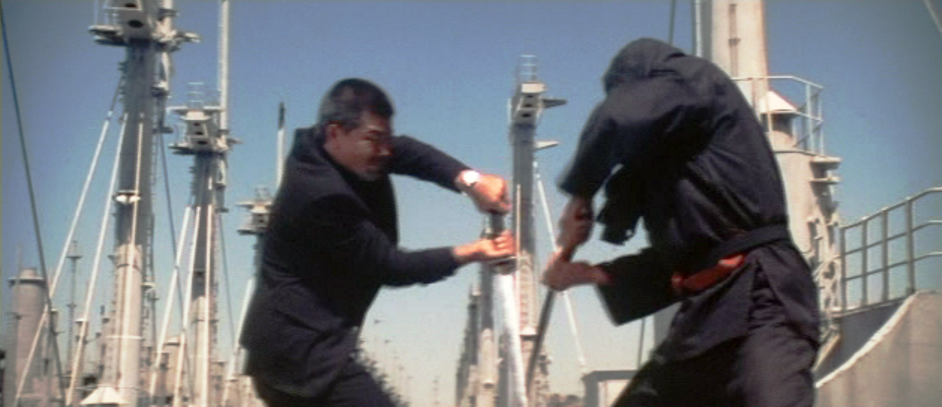
Along the way, there are lots of martial arts and more doublecrosses and enough muddled story that I couldn't tell you with any sense of confidence exactly what the hell was going on. The Killer Elite proves sad to watch because you definitely see Peckinpah beginning to slide.
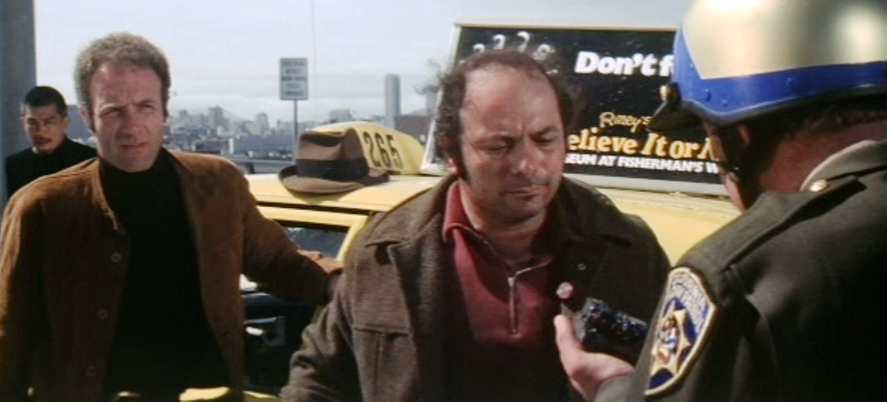 His slow-motion violence, groundbreaking and poetic in The Wild Bunch, already seemed a cliche in the otherwise great Bring Me the Head of Alfredo Garcia. When he pulls it out for the martial arts fights in The Killer Elite, it ends up being downright laughable. Plunging slow-motion screams seem straight out of martial arts cheapies and shouldn't be in a Peckinpah movie. What does give the film a bit of a boost is once Caan assembles his team for his assignment. Bo Hopkins and, most especially, a hysterical Burt Young breathe life into the otherwise dull and disorienting picture. Young's scene alone with a motorcycle cop is priceless. Unfortunately, it isn't enough to save the entire film.
Tweet
Labels: 70s, Burt Young, Caan, Duvall, Peckinpah
TO READ ON, CLICK HERE


