Saturday, October 02, 2010
Their nature is raw, they hate all law

They know the law always wins
They've been shot at before, but they do not ignore
That death is the wages of sin.
Someday they'll go down together
And they'll bury them side by side
To few it'll be grief, to the law a relief
But it's death for Bonnie and Clyde.
"The Story of Bonnie and Clyde,"
a poem by Bonnie Parker
By Edward Copeland
Forty years ago today, a landmark film was released, a film that caused critical spats and even encouraged some famed critics to change their minds. That film was Bonnie and Clyde and it remains great until this day. In fact, it still has some, such as A.O. Scott in Sunday's New York Times, questioning whether its mix of humor and violence was a bad thing and that his ancient predecessor Bosley Crowther might have been right by being dismissive of it. Phooey on them. Just because imitators suck, that doesn't mean the original isn't still peerless.

 Those lips. After the credits, with their brief notes of biography about the real Clyde Barrow and Bonnie Parker, those lips are what fill the screen and this unusual opening image (for 1967 at least) heralded the brash changes that lay ahead in Arthur Penn's film. From the lips, we get to see more of Faye Dunaway's Bonnie, seemingly pinned in a crib/cage much like Carroll Baker in Baby Doll. Then she spots the sharp-dressed man attempting to steal her momma's car and Bonnie sees a chance to bring some excitement to her drab, Depression-era world. (One thing I noticed this time that I don't remember catching before was the frequent placement of FDR posters
 throughout the film.) When Bonnie first meets Clyde, she notices his limp, caused by Clyde chopping two of his toes off to get out of work detail in prison, ironically just days before he got sprung. I remember reading the Mad magazine parody of Bonnie and Clyde long before I saw the film itself, so I knew the element of sexual repression that lay beneath the film. Rewatching it, I'd forgotten how much of that aspect there is, beyond Clyde's presumed impotence. In addition to that opening shot of her lips, we get lots of phallic suggestion such as the way she fondles and sips from a Coke bottle. It's funny to see
 legendary lothario Beatty playing an anti-stud who says of being a lover boy that he "Never saw the percentage in it." He may not be a lover, but he is one helluva of criminal and he's not modest about it. "I ain't good, I'm the best," he tells Bonnie as she decides to join his spree, even if he gets her all revved up with nowhere to boink. What's also fascinating about Penn's film is how successfully it shows how the Barrow Gang could be folk heroes in the throes of the Great Depression while not romanticizing that they are crooks who do kill on occasion. One of the best sequences to this effect is when Clyde gives Bonnie some shooting lessons on
 what appears to be an abandoned farm, only to be happened upon by the farm's evicted owners, foreclosed on by the bank, so Clyde lets them have their chance to shoot up the sign that proclaims the property as belonging to the bank. The farmer even lets his now unemployed black sharecropper lodge some bullets as well. As Clyde sympathizes with the men, calling the bank's actions a "pitiful shame," you understand how they could gather a following, something that makes absolutely no sense in later films that try to plumb the same territory such as Oliver Stone's awful Natural Born Killers. This scene also provides the first instance of perhaps the film's most famous line, "We rob banks," only it's Clyde who uses the phrase to describe their profession first, not Bonnie. The economic state of the country also comes through when Clyde takes Bonnie on her first robbery, only to try to stick up a bank that folded three weeks earlier. Still, you can see how they relish their reputation and encourage it, even giving customers back their own money during one robbery and laughing that they are getting blamed for robberies that occur far from where they even are. Later, when Bonnie writes the famous poem about their adventures, Clyde seems truly touched that she's "made him somebody they're gonna remember." The victims enjoy the spotlight as well, with one declaring that they did right by him and that he and his wife will gladly go to their funeral when that day arrives.
  Now, you can't really call it a gang when there are only two members, but Bonnie and Clyde soon get partners. First up, they encounter C.W. Moss (the ever-quirky Michael J. Pollard in his Oscar-nominated role) at the gas station he runs. The robbers are honest with C.W. about who they are and what they do and ask if he'd like to come along and Moss disappears briefly into the station's interior before returning, dumping the cash in their lap and coming along for the ride. Moss turns out to be an even worse parallel parker than Meadow Soprano when he serves as getaway driver for the first time. In that stickup, a bank employee tries to stop Clyde — permanently, forcing Clyde to kill him, but not without exhibiting remorse about the death. "Why'd he try to kill me? I didn't have anything against him?" he asks the universe. Soon, the Barrow Gang becomes five members
 strong when they hook up with Clyde's brother Buck (Oscar nominee Gene Hackman) and his nervous wife Blanche (Oscar winner Estelle Parsons). Of course, they meet soon after the killing and Clyde offers Bonnie the chance to get out since he knows there's no turning back since now he's a killer, not just a robber, telling her she should find a rich man, but Bonnie declares that she "don't want no rich man." "You ain't gonna have a minute's peace," Clyde warns. "You promise?" Bonnie replies. She can get her kicks in noncarnal ways as well. Of course, Clyde still is a man with a man's ego, so when Buck grills him about Bonnie, asking if she's as good in bed as she looks, Clyde lies and says she's better. Buck's own wife frequently proves a target of ridicule for Bonnie because of her somewhat prim and hesitant ways which makes Bonnie think of her as nothing more than "an ignorant hillbilly." Blanche also is leery of C.W. who just tries to be friendly as they discuss movie stars (His favorite is Myrna Loy) on their way to see a movie musical at the local theater. Bonnie proves to be a woman after my own heart, urging her companions to hush up during the film as they chatter on endlessly. People could be rude at movies even before television. There are great sequences and nice and odd touches throughout the film. Even though many of the accents are iffy and it often goes for a comic tone that seems to predict Raising Arizona, it works. There's the great scene where they humiliate a Texas marshal (Denver Pyle) to discourage "bounty hunting"
  and strange moments such as a scene where for some reason Pollard is wearing a WWI gas mask. Of course, there's also the classic encounter with Eugene and Velma (Gene Wilder, Evans Evans), whose car they steal but who end up going for a ride with the gang that's in turn comical and frightening, but ultimately a blast when this couple that the gang sees as "folks just like us" reveal what Eugene's profession is. The film though isn't strictly a comedy, proving unexpectedly touching when Bonnie gets a brief reunion with her family. Cinematographer Burnett Guffey, who won an Oscar for his work here, films the sequence as if it's a faded home movie and it's quite poignant when Bonnie seems reluctant to leave her mother, who advises, "You best keep running, Clyde Barrow." The stench of death
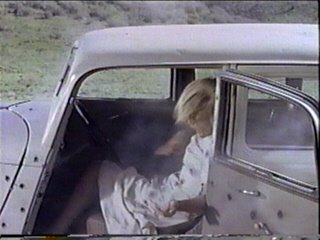
 never remains too far removed and at times the symbolism of the sexual and religious elements are a little thick, such as Clyde finally putting out before their ultimate demise, and a symbolic sharing of an apple. While the quick-cut editing of the film's climax is legendary, Penn and film editor Dede Allen use that style throughout the film and it must have truly seemed groundbreaking at the time, though hardly unique to movies. (Go back and watch the cutting of the hunt in Jean Renoir's 1939 The Rules of the Game for example.) So much has been written about that final sequence, that it almost seems pointless to add anything or to even include many screenshots of it, though I do have to get Dub Taylor as C.W.'s father seeking cover under his truck. Penn also makes frequent use of the voyeuristic elements with constant scenes of people peering through car windows, including the final shot.
Tweet
Labels: 60s, Arthur Penn, Dub Taylor, Dunaway, Hackman, Loy, Movie Tributes, Oliver Stone, Renoir, W. Beatty
TO READ ON, CLICK HERE


Sunday, July 11, 2010
“Fifty bucks never killed anybody.”

By Ivan G. Shreve, Jr.
I can’t always rely on what is admittedly a somewhat imperfect memory, but the way I remember it was that a group of my high school friends were gathered around and talking animatedly about a film they had just seen that, in the vernacular they used at the time, was “fucking hilarious.” One of my pals went into particular detail about a scene in which a woman’s dress got caught on a car hood that was being opened up, and in the process her breasts were exposed on live television…to the approval of a large audience who had tuned in to watch the weekly gridiron exploits on Monday Night Football.
I asked Mike, the friend who took pleasure in describing this gag what movie he was talking about. “Used Cars,” he replied. “Goddamn, it’s a funny movie.”
“Who’s in it?” I asked him further. “Kurt Russell,” he returned. Then he sounded sort of surprised. “You mean you haven’t went and seen it yet?”
I was a little too embarrassed to tell my pal that the likelihood of me seeing a movie with both Kurt Russell and naked breasts were pretty slim, given as how my family was used to watching the actor cavort in Disney films where he played a hapless college student that had weird things happen to him…like invisibility and super-strength. No, I’d have to wait until Used Cars (1980) turned up on pay cable to watch what is one of the funniest comedies in the history of cinema…because 30 years ago on this date, the film was released to theaters…and I was several months shy of my 17th birthday.
Upon its release, Used Cars received an “R” rating — and in fact, would be the only film directed by Robert Zemeckis to do so as of this post. Zemeckis, who had only two years earlier had his first feature film effort, the alternately silly and sublime I Wanna Hold Your Hand (1978), released to critical acclaim, was rapidly becoming the flavor-of-the-month in Hollywood by that time along with his longtime collaborator Bob Gale. Though the two men had experienced a temporary setback scripting Steven Spielberg’s failed bigger-isn’t-necessarily-better 1941 (1979), they would soldier on to greater triumphs, culminating with Zemeckis’ directing Romancing the Stone (1984)…and the 1985 mega-hit Back to the Future. Zemeckis would receive the respect of his peers by winning multiple Oscars for Forrest Gump (1994), a film that filled me with so much revulsion at the time that I seriously contemplated giving up movies. (Fortunately, saner heads prevailed.) He has since entertained audiences with ponderous special effects outings such as Contact (1997) and The Polar Express (2004), movies that have since made me nostalgic for those earlier vehicles that relied on nothing more complex than how the lives of several individuals were changed by the appearance of John, Paul, George and Ringo on The Ed Sullivan Show.
Theatres may not have enforced the “No one under 17 admitted” guideline with R-rated films back in my day, but Mama and Papa Shreve certainly did. In fact, I ended up taking my father with me to see Monty Python’s Life of Brian (1979) because I was only 16 at the time…and truth be told, I was a little bit embarrassed to be sitting next to him in the theater as the film unfurled. To my surprise, he genuinely liked the film…but admonished me: “I wouldn’t discuss the content of this movie with your younger sisters.”
Dad wasn’t around the first time I watched Used Cars, which I finally caught on HBO months after its abortive run in theaters. I’ve seen it several more times since then (a couple with my father), and I fervently believe that the film transcends its “loud, vulgar and unrepentantly raunchy” reputation (according to The Onion’s Scott Tobias) to be a first-rate, relentlessly cynical satire on “the American Dream.” Former Disney stalwart Russell plays Rudy Russo, a con man/used car salesman (I know, it’s pretty much redundant) without a whiff of scruples who’s employed by Luke Fuchs (Jack Warden), a slightly more straight-arrow car dealer with serious health issues (he has a bad ticker). Rudy has aspirations to advance to a position where the real graft is there for the taking — he has an opportunity to buy his way into a party nomination as state senator…and though Luke thinks he’s crazy, he agrees to help Rudy begin his journey into politics.
Luke has a twin brother, unrepentant douchebag Roy L. (also played by Warden), who’s learned through his attorney (Joe Flaherty) that his (Roy’s) car lot is going to be razed (via eminent domain) to make room for a new highway overpass. This will make his brother’s lot the most valuable piece of property in the area, and since efforts to buy out Luke in the past have failed, Roy L. has to resort to strong-arm tactics (a demolition derby expert (Michael Talbott) takes Luke for a wild spin test-driving a car, and Luke’s heart can’t take the excitement) to “inherit” the lot. Returning from his adventure, Luke expires on the floor of the New Deal Used Cars’ sales office…but Rudy, who’s counting on the money Luke promised him for the state senatorship, talks fellow salesman Jeff (Gerrit Graham) and mechanic Jim (Frank McRae) into concealing Luke’s untimely demise by placing him in his antique ’59 Edsel and burying him in a pit in the back of the lot.
Unbeknownst to Rudy, Luke received a phone call from his daughter Barbara Jane (Deborah Harmon) earlier that evening — she’s anxious to reconcile with her father after being estranged from him for a goodly number of years. She arrives at the lot for their reunion; putting Rudy in the uncomfortable position of having to continue the deception that her father is still hale and hearty (he’s told both her and Roy L. that Luke went south to Miami Beach for a little R&R). Because the deadline to submit the paperwork for the state senate office has been moved up, Rudy also has to get his hands on some fast cash — so he resorts to enlisting the help of a pair of electronic whiz kids (Michael “Lenny” McKean and David L. “Squiggy” Lander) to interrupt a televised football game to do a commercial for the used car business…which results in a financial windfall as several hundred customers arrive at the lot that next day. The “interrupting-your-regularly-scheduled-programming” shenanigans continue when our heroes are daring enough to preempt a presidential address being given by then -Commander-in-Chief Jimmy Carter.
Rudy and company make a valiant effort to keep the news of Luke’s demise secret from Barbara Jane and Roy, but eventually the cat is out of the bag — and furious at Rudy’s dishonesty, she fires him along with Jeff and Jim. But the three men have to pitch in to save Barbara Jane’s business when she’s hauled into court due to a false advertising lawsuit (Roy has used a little technical chicanery of his own to overdub a dubious claim into one of her commercials), and accomplish with a balls-out slapstick chase involving a “mile” of automobile clunkers driven by a pack of high school driver’s ed students.
The concept of Used Cars originated with writer-director-producer John Milius, who pitched the idea to scribes Zemeckis and Gale while they were still hard at work on what would become 1941. When the original deal to produce Cars fell through at Universal, Steven Spielberg (working on 1941 for Columbia Pictures) was able to secure financing through Columbia by signing on with Milius as an executive producer. Zemeckis shot Cars in a breakneck 28 days at a Chrysler-Plymouth dealership in Mesa, Ariz. — and the finished product scored extremely high with audiences at its preview. But Columbia foolishly chose to release the film in July 1980 (it was originally slated for August) at a time when Airplane! (1980) was just beginning to convulse audiences in theaters…and to add insult to injury, bungled the film’s marketing campaign to the point where anyone who did manage to see it in a theater was very, very lucky. Despite its low profile, the film received a great deal of critical acclaim, including the notoriously finicky Pauline Kael…who described Cars as “a classic screwball fantasy — a neglected modern comedy that’s like a more restless and visually high-spirited version of the W.C. Fields pictures.”
At the time of Used Cars’ release, the vogue in cinematic mirth-making was what was known as “slob comedy”—a trend that kicked off with National Lampoon’s Animal House in 1978, and later introduced hit films such as Meatballs, Caddyshack and Stripes. Cars is cut from the same bolt of cloth — it revels in its cheerfully bad taste — but it transcends its raunchy brethren in other ways by satirizing taboo, sacred cow subjects as politics, the legal system, television and consumerism. To borrow the words of critic Tobias, Cars “starts with the premise that all politicians are salesmen, all salesmen are liars and the best believe their own lies with stirring conviction.” “You know, it used to be when you bought a politician, that son of a bitch stayed bought,” snarls Roy L. Fuchs in a line that I’ll bet not a day goes by when either my father or I aren’t using it in some sort of context. There’s nothing particularly socially redeeming about any of the characters in the film — Zemeckis once described Cars as “a Frank Capra movie where everybody lies” — but it’s hard not to be in the corner of someone like Rudy, who despite his con man demeanor also is the classic American underdog, just doing what he can to hustle a buck and keep groceries on the table.
No other film comedy used profanity in such a gleeful manner as Used Cars, which surely must have held the record until Quentin Tarantino decided to get into the movie business. The line that still makes me laugh until there are tears in my eyes occurs when Jeff is in the middle of his FCC-violating car commercial during the president’s speech: “Now wait just a goddamn minute…what the hell is this? Is this a 1974 Mercedes 450SL for $24,000? That's too fucking high!!!” He then proceeds to destroy the car with a charge of dynamite. My other favorite is a line of Roy L.’s, said in response to Jeff’s annoying habit of repeating everything he’s just said: “What are you, a fuckin’ parrot?” (I later learned that Warden ad-libbed this, and it is a thing of beauty.)
The comedy centerpiece that everyone who’s seen Used Cars remembers to this day occurs shortly after Luke’s hair-raising mishap as the unfortunate passenger in the car piloted by the wild-and-crazy driver in Roy L.’s employ. At the same time this is occurring, Rudy is negotiating with a stubborn customer (Andrew Duncan) who’s determined to keep haggling about the price. “Fifty bucks never killed anybody,” the man keeps repeating over and over again like a mantra…until Rudy throws up his hands in frustration. “But I'm telling ya…my boss sees these figures — he's going to have a stroke.” Cue Luke’s entrance — red-faced and clutching his chest and in desperate need of the nitroglycerin he takes for his bad heart, he goes through a series of spastic motions before expiring on the floor. “OK, it's a deal, it's a deal! I'll sign! I'll sign!” the customer says, panicking as he grabs a pen and the agreement. (I defy anyone not to wet-their-pants in laughter at this truly classic moment.)
But there are other unforgettable comic encounters in Used Cars that do not necessarily rely on questionably bad-taste humor — my favorite is a hysterically funny scene where superstitious Jeff goes nuts in a bar, spilling salt and crawling under ladders (and finally throwing a chair through a mirror in the establishment) in an effort to bring on bad luck so that Rudy can beat the point spread on a football game he’s bet his entire savings on in an attempt to raise the kitty he needs for his state senator nomination. And then there’s the climactic car chase, as a multitude of high-school kids (which include Wendie Jo Sperber and Marc McClure, both of whom have memorable roles in Zemeckis’ I Wanna Hold Your Hand and Back to the Future) drive 250 cars back to the used car lot in order that Barbara Jane’s claim of New Deal’s “mile of cars” can be proved legit. Sequences like this would become a trademark in the comedies written by Zemeckis and Gale —such as Hand’s climactic events surrounding the Fab Four’s appearance on Sullivan, or Back to the Future’s breathless series of obstacles leading up to Marty McFly’s race-against-time maneuver to return to his own time period.
Actor Russell had been trying to make a concerted effort to shake the Walt Disney stigma at the time of Used Cars’ release, and though he had made inroads in that area with his critically lauded turn as the titular rock ‘n’ roller in the TV-movie Elvis (1979) it’s not entirely incorrect to say that Cars was the film in which he was finally allowed to “grow up.” Veteran character actor Warden wasn’t interested in Cars in the beginning but acquiesced after talking Zemeckis and Gale into letting him play both Luke and Roy L. Fuchs. These two incredible thesps head up an amazing cast of superb comic actors which also include, in addition to those already named, Dub Taylor (as the crooked party chief), Alfonso Arau, Woodrow Parfey…and the incomparable Al “Grandpa” Lewis as Judge “Hanging” H.H. Harrison. (Sharp-eyed viewers will also spot Roger Corman regular Dick Miller making love and a pre-Hill Street Blues Betty Thomas shaking her moneymaker on top of a used car.)
Normally, I would encourage anyone who hasn’t experienced the tasteless pleasures of Used Cars to see it in a theater the way most movies should be viewed (since it’s a comedy, it should always be seen with an audience) but unless you spot it at your local repertory the next-best solution is to buy or rent the DVD. That way, you’ll be able to enjoy writers Zemeckis and Gale and actor Russell spouting their memories and anecdotes into one of the best DVD commentaries ever recorded. Seriously — this is one of the most audience-pleasing comedies ever produced. Trust me.
Ivan G. Shreve, Jr. blogs at Thrilling Days of Yesteryear, and it took him months to get him to stop saying “Jesus Palomino!” after first seeing Used Cars.
Tweet
Labels: 80s, Capra, Corman, Disney, Dub Taylor, Elvis, Fields, Jack Warden, Kael, Kurt Russell, Movie Tributes, Spielberg, Tarantino, Television, Zemeckis
TO READ ON, CLICK HERE
Thursday, June 18, 2009
Your word isn't what counts, it's who you give it to

By Edward Copeland
You know a film is powerful when it's controversial when it opens and when a restored version is planned for re-release 25 years later, an MPAA ratings dispute over its violent images delays the re-release until it was 26 years old. Now 40 years old, Sam Peckinpah's The Wild Bunch not only retains its power, the film grows in magnificence. If re-watching it evokes anything negative, it's the sadness that great films such as this hardly ever get re-releases anymore, affording movie fans the chance to see movies made before their time in a theater. As theaters move toward digital, it's probably sadly passed. Still, DVD and a good home setup keep The Wild Bunch vibrantly alive, if not ideally viewed.
You can't begin any conversation about The Wild Bunch (or Sam Peckinpah) without inevitably hitting the topic of violence and whether or not the film glorifies it or not but watching it again, it's beyond me how
 anyone can see it that way. In fact, this time it seemed to me that Peckinpah builds the violence in the film to the crescendo of its finale. There is some use of slow-motion in the film's earlier gunbattles, the killings are quicker, more typical of what audiences are used to seeing in normal Westerns, without lingering on the wounds or carnage. Each subsequent encounter ups the ante leading to the famous finale, where the bloodshed contains the most meaning because the fight has the most meaning. When the bunch goes out in their blaze of glory, they aren't involved in a theft or running from a heist or a quick act of revenge, they are doing it because morally it's the correct thing for them to do, no matter that it is a suicide mission. That final melee is where you see the agony, the anguish and the pain. It's the way Peckinpah has set it up and the way it had to go because it needs to unfold this way for the characters to become flesh-and-blood people the audience cares about instead of just outlaws of a dying breed trying to hang on to a dying lifestyle in a fast-changing era.
As The Wild Bunch opens, the viewer can't really be certain what time period they are in. The military uniforms that the bunch are wearing seem to
 be early 20th century Army issue, but everything else seems to be from any Old West time period. It isn't until nearly an hour into the film when the would-be Mexican despot arrives in a fancy automobile and the bunch reacts with amazement and speak of reports of vehicles like birds that might be used in the next war that you realize we are several years into the 20th century and the Western lifestyle the bunch has enjoyed is passing the aging men by. Pike Bishop (William Holden), the group's leader admits that they aren't getting any younger and it's time they start "thinking beyond their guns." The impetus for this reappraisal of their lifework comes after the gang's latest assault on their favorite archenemy, the railroad. Peckinpah's opening setpiece really gets the movie galloping as we are introduced to the ruthlessness of the gang, taking the railroad's office as well as the equal ruthlessness of the railroad, who have staged a setup involving a team of bounty hunters in place to take out the bunch once and for all. There is no easy route taken of making the violent gang likable protagonists from the beginning. They are willing to leave an accomplice behind to almost certain death and kill another one with emotionless efficiency. This is their job and fun times come later. The fly in the ointment turns out to be the unexpected temperance union parade by a local church. When the siege is over, there are far more dead civilians than there are crooks or bounty
 hunters and the clergyman (Dub Taylor) lets the railroadman know it, but he's indifferent as big businessmen continue to be to this day as his interests and bottom line supersede the public's. This "do it on the cheap" mentality extends to the bounty hunters that the railroad hires. The leaders is a former member of the bunch, Deke Thornton (Robert Ryan), who has been promised an end to his prison sentence if he brings them back dead. Unfortunately, as help he's been given a motley group of misfits led by Strother Martin, who aren't above pillaging the corpses of the accidentally slain. Martin proves to be comic relief extraordinaire, especially with his large crucifix hanging around his neck. Ryan's performance as Thornton, the bounty hunter whose heart lies with his prey, grows deeper and better with each viewing.
 The actors who comprise the bunch are a strong ensemble. Three had won Oscars by the time The Wild
 Bunch was made and a fourth would win one two years later. In nearly every case, it's one of the actors' strongest performances and, in one case, I consider it his best. Holden is great as Pike and of course the list of great roles he played are legendary spanning from Sunset Blvd. to Network and many in between. Pike Bishop belongs in that hallowed company as Holden gives him a taciturn strength but isn't afraid to show his vulnerabilities and the toll time has taken on the robber. Often forgotten, since he's not as active in the gang's criminal exploits, is the great Edmond O'Brien as Sykes, who used to ride and kill with the best of them but now basically holds down the fort while the bunch is away. O'Brien is a riot, even if at times he borders on cliche and seems to be channelling Walter Huston in Treasure of the Sierra Madre. More comedy is provided by Warren Oates and
 Ben Johnson as the drinkin', whorin' Gorch brothers. (In the DVD commentary, one of the Peckinpah experts mentions that Johnson's wife never let him return to the sites of their Mexican scenes because of the scenes of his character's lechery depicted there. TV's Buffy the Vampire Slayer even saluted Oates' character with a vampire bounty hunter with cowboy sensibility named Lyle Gorch on a couple of episodes. The youngest and newest member of the gang, the one who gets them in trouble and helps them find their moral compass, is Angel (Jaime Sanchez), a Mexican who wants to help his people get out from under the thumb of the minidictators who ruled Mexico at the time. Politics is anathema to the others but when they witness the mistreatment that goes on of the poor, eventually even the aging crooks discover there are some fights worth joining. Of course, the
 second most important member of the bunch is Dutch (Ernest Borgnine). Though Borgnine has given many good performances, including his Oscar-winning one in Marty, it's clear to me after watching The Wild Bunch again that this is easily his greatest performance. He's always the one who seems to have the smartest take, the most regrets, and Dutch gets the others to realize their obligations when the final battle comes about. The grin that Borgnine lets loose before the gunfire is a sight to behold as are his quieter moments, turning his back when he's afraid to admit something tender to Pike or he's just sitting on a stoop whittling waiting for the others to finish their debauchery.
As all conversations about The Wild Bunch inevitably focus on the violence, I think we should end this anniversary discussing those aspects that are too often overlooked. In addition to the performances, not
 enough is made of the comic relief (the last images of the bunch are of them laughing at better times) as when the Mexican generale lets a machine gun go wild despite his German visitor's plea that he must place it upon a tripod. There's also the imagery. The kids torturing the scorpions gets cited often, but there also are nice touches such as a shot of a mother breastfeeding her baby while a belt of ammunition hangs across her torso. Finally, there is the suspense. Like all great suspense scenes, no matter how many times you see them, you still wonder what will happen, as when that wagon gets stuck on the bridge that's already set to detonate. I'd also be remiss if I didn't shower some praise on some of the film's other collaborators such as Peckinpah's co-writer Walon Green, the vivid photography of Lucien Ballard, the fine score by Jerry Fielding and the absolutely irreplaceable editing of Lou Lombardo.
Tweet
Labels: 60s, B. Johnson, Borgnine, Dub Taylor, Holden, Movie Tributes, Oates, Peckinpah, Robert Ryan, W. Huston
TO READ ON, CLICK HERE
Monday, February 26, 2007
Centennial Tributes: Saluting an Old Coot

By Edward Copeland
100 years ago today, one of the most familiar faces and least-familiar names in acting, particularly Westerns, was born. Dub Taylor died in 1994, shortly after he made his last screen appearance as a room clerk in the film remake of Maverick. It seems appropriate that his last credit was in the genre for which he was most strongly identified, but Taylor's work did venture outside the Old West. Taylor's first film credit was in Frank Capra's Oscar-winning You Can't Take It With You and was soon followed with an uncredited part in Capra's Mr. Smith Goes to Washington. From 1939-1949, he also appeared in dozens of short Westerns, many with Bill Elliott, and usually as a character named Cannonball.
Taylor proved to be a staple of many Western films and Western-theme TV shows such as Little House on the Prairie, How the West Was Won, Bonanza, Gunsmoke, The Big Valley, The Wild Wild West and Death Valley Days. However, Taylor's ample TV work led him to some surprising series both dramatic (McMillan and Wife, Emergency! Hawaii Five-O, The Man from U.N.C.L.E., The Twilight Zone and Perry Mason) and comic (Dennis the Menace, I Love Lucy, The Andy Griffith Show, The Odd Couple, Designing Women and The Cosby Show). Some of his episodic television appearances came in shows you wouldn't expect a veteran Western character actor to appear such as The Mod Squad, The Monkees, The Partridge Family and even Love, American Style.
Sam Peckinpah used Taylor often, even if the roles tended to be brief uncredited cameos. He worked with the director on Major Dundee, The Wild Bunch, Junior Bonner, The Getaway and Pat Garrett & Billy the Kid. He even used his voice talents in the animated film The Rescuers, dealt cards in The Cincinnati Kid and combined the Western genre he knew so well with sci-fi in Back to the Future Part III.
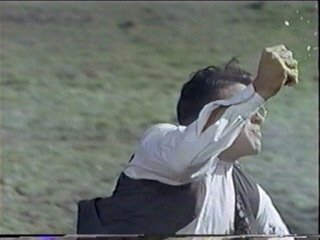
Of all the films on Dub Taylor's resume, my guess is the one which he will be remembered most for is Bonnie and Clyde, where he played the father of C.W. Moss (Michael J. Pollard) and led the robbers to their fateful ambush to save his son while he hid from the barrage of gunfire.
Tweet
Labels: Capra, Dub Taylor, Peckinpah, Television
TO READ ON, CLICK HERE


