Friday, April 20, 2012
What a glorious feeling

By Edward Copeland
Sixty years ago, another MGM musical extravaganza began to open across the country, premiering first in New York on March 27, 1952 — exactly one week after its star's previous lavish MGM musical, An American in Paris, took home the Oscar as 1951's best picture. An American in Paris just had opened about four-and-a-half months earlier in November 1951, so though both musicals came from the same studio, the same producer (Arthur Freed) and the same star (Gene Kelly), Paris essentially stole Singin' in the Rain's thunder, despite
 good reviews and decent box office (ultimately, Rain only grossed about $1 million less than Paris did worldwide). Over the course of the ensuing decades, Singin' in the Rain displayed staying power as more generations and critics discovered and delighted in its infectious shenanigans to the point that it routinely grabs the label as the greatest movie musical ever made, a title it most richly deserves. When the film came out in 1952 though, the shower of awards that rightfully should have left Singin' in the Rain drenched in accolades didn't occur, but rarely do the movie classics earn the kudos they should upon their original release. How Casablanca managed to snag its best picture Oscar truly belongs on a list of the wonders of the world. Singin' in the Rain garnered a total of two Oscar nominations and lost them both. The Academy felt the best picture prize for 1952 belonged to The Greatest Show on Earth, which beat High Noon, Ivanhoe, John Huston's Moulin Rouge and The Quiet Man. Admittedly, I'm a fan of High Noon and The Quiet Man, but neither is better than Singin' in the Rain. I admire much of Huston's film, but I couldn't go for Ivanhoe and, as far as The Greatest Show on Earth goes, the movie doesn't just stage a spectacular train wreck, that sequence serves as a metaphor, not so much for the decidedly mediocre circus film but for the majority of the Academy's choices for best picture throughout the years. The nearly always wrong Academy found no room at the inn in the best picture category for Singin' in the Rain and, yet once again, history proves that that organization almost always has figured out ways to screw things up. Oh, well. As our hero, Don Lockwood, would say to his fans, "Dignity. Always dignity."
 It's true — I did, I really did have a feeling of lightness about me when I first saw Singin' in the Rain on a small TV set in my bedroom when I was in grade school. The local PBS station aired it during one of its pledge drives late on a Friday or Saturday. I almost wrote something to the effect that though my age at that time stood in single digits, I wasn't unfamiliar with "older films." Then, I started doing something out of character for someone who spent his professional years in journalism: math. When Singin' in the Rain and I first crossed paths, the film still had a few years to go before it would reach its 30th anniversary. Figuring further, I realized that when I was born, the movie had existed for a mere 17 years. I suppose the point I should have been aiming for was that even as a youngster, I wasn't completely ignorant of films made prior to my birth — a contrast to an all-too-pervasive attitude pushed by magazines such as Entertainment Weekly that discounts most things made prior to its existence. I took a detour from my main point which was that no classic up to that point in my young life seized my imagination and prompted me to rattle about it nonstop the way I would a new release such as Star Wars could capture my youthful enthusiasm, but Singin' in the Rain did.

It probably didn't hurt that back in 1974 my parents took me to That's Entertainment! and I saw many of the film's famous musical numbers before viewing the entire picture. My attention also likely got captured early in the showing when the first face I noticed after the opening credits belonged to Aunt Harriet (Madge Blake) of TV's Batman. Blake begins the fun as she stands before a microphone in as Hollywood columnist/gossip hound Dora Bailey covering the 1927 premiere of The Royal Rascal, the latest Monumental Pictures production starring the hot team (onscreen and off, so they say) Guy Lockwood (Gene Kelly) and Lina Lamont (Jean Hagen), live outside Grauman's Chinese Theater. When I fell for Singin' in the Rain as a youngster, I could enjoy it immensely for its music and comedy, but I needed to age and accumulate knowledge of cinema history in order to appreciate its references and some of the silent figures it parodies. For example, the first name that Dora announces stepping onto the red carpet belongs to Zelda Zanders (played by a 19-year-old Rita Moreno, who my young eyes failed to recognize as the "HEY YOU GUUYYSSS!!!" lady from The Electric Company), known as "The Zip Girl," a play on silent superstar Clara Bow's nickname as "The It Girl." Following Zelda, comes the mysterious Olga Mara (Judy Landon), merging mostly Pola Negri with a bit of Gloria Swanson, based on her latest spouse, an older, wealthy aristocrat. Of course, I didn't need to know any film history to get a kick out
 of the exaggerated reactions of the starstruck fans crowding the barricades to catch a glimpse of the famous faces or to get the joke when Dora announces the arrival of Don's best friend Cosmo Brown (Donald O'Connor), who leaps out of his car and onto the red carpet only to watch the fans' faces fall in disappointment since he's a "nobody." With its marvelous screenplay by the legendary team of Betty Comden & Adolph Green, the songbook of lyricist Arthur Freed (yes, the same Freed producing the film) and composer Nacio Herb Brown and the second film pairing Kelly and Stanley Donen as co-directors following 1949's great On the Town, Singin' in the Rain had a damn strong team going in, even considering its start from such a vague kernel of an idea. Freed had left his songwriting days behind long ago, becoming a very successful producer at MGM, almost exclusively of musicals. (Last year, when I wrote my tribute to Stephen Sondheim's Merrily We Roll Along , I said that I never thought it made sense for a successful composer like that musical's Franklin Shepherd to switch gears and become a successful movie producer, but lyricist Freed did that in real life. I'm surprised no one called me out on that.) According to the commentary on the 50th anniversary DVD, Freed called Comden & Green and told them he wanted them to write a musical based around the old songs he wrote with Brown to be called Singin' in the Rain. "We didn't have a clue as to what it would be other than there had to be a scene where someone would be singing and it would be raining," Comden said on the commentary, which included her, Green, O'Connor, Donen, Debbie Reynolds, Cyd Charisse, Kathleen Freeman, Baz Luhrmann (who horned his way in somehow) and film historian and author Rudy Behlmer. Of that group, only Donen, Reynolds, Luhrmann and Behlmer remain with us 10 years later. As Comden & Green thought about the era in which those songs had been written — the late 1920s and early 1930s — they conceived the idea of setting the film in that time period and from that sprang forth the idea of making Singin' in the Rain be about Hollywood's transition from silent films to talking pictures.
At last, the car bringing the stars of The Royal Rascal, Don Lockwood and Lina Lamont, pulls up to the red carpet. Dora Bailey hardly can contain her excitement, telling her radio audience that Lockwood & Lamont go together "like bacon and eggs." If the parodies of silent screen stars flew over your head and the caricatures of overzealous fans somehow didn't give you an inkling of what type of musical comedy the behind-the-scenes team had devised for Singin' in the Rain, it becomes abundantly clear once Lockwood & Lamont arrive on the scene and Don steps up to Dora's microphone to recount to her listeners a brief primer of how he became the movie star he was that
 day. At first, it might seem as if he's being rude to Ms. Lamont, who looks as if she's trying to move toward the microphone to say something, but Don doesn't allow her to say a word. If you've seen Singin' in the Rain before, you know why that is. If you haven't, what in the hell are you waiting for? However, like what could happen with sound film projectors to come, the words emanating from Lockwood's lips didn't match the visuals we saw as he and Cosmo, beginning as pint-size hustlers sneaking into pool halls, began careers playing violin and piano at any old dive where they could earn a few measly bucks. Gene Kelly always had the knack when it came to singing and dancing, but he never received enough credit for his acting and from his entrance as the public persona of Don Lockwood, you can tell that Kelly has stepped up his thespian skills a notch. While he will perform some of his best and most memorable song-and-dance moments at the same time he's co-directing the film itself, Kelly will end up giving the best performance of his career as Don Lockwood. The Academy did see fit to nominate him for acting once (in 1945's Anchors Aweigh) and gave him an honorary Oscar for the year 1951, when An American in Paris took best picture, "in appreciation of his versatility as an actor, singer, director and dancer, and specifically for his brilliant achievements in the art of choreography on film." The Academy was only a year early because Kelly's best was yet to come. Lockwood's embellished flashback leads to the movie's first musical number. Once Don and Cosmo found their way on to the vaudeville circuit, they energetically performed the song "Fit as a Fiddle." The clip below begins with dialogue in another language, but the remainder is in English.

Kelly and O'Connor's choreographic chemistry confirms the correct choice in going with O'Connor as Cosmo instead of using Oscar Levant again following An American in Paris. On the commentary, O'Connor recalled that prior to rehearsal, Kelly had asked what his strongest dancing side was and expressed relief when O'Connor answered, "The right" which also was Kelly's strongest. O'Connor credited that for why they looked so well together as in "Fit as a Fiddle." Don's cursory version of his life story wraps up with him and Cosmo landing musician jobs at Monumental Pictures where Don soon finds himself working as a stuntman, hurtling over bars in the Old West, crashing airplanes and riding motorcycles to their doom. When he approaches Lina Lamont, already a star, she wants nothing to do with a lowly stuntman until the studio's president, R.F. Simpson (the great Millard Mitchell, notable in films such as Jules Dassin's Thieves' Highway and Winchester '73, who died too young at age 50 in 1953), offers Don an acting contract — then Lina can't keep her hands off him, but Lockwood quickly removes
 them. Following the showing of the swashbuckling Royal Rascal. Don and Lina come out and greet the audience briefly but, again, only Lockwood speaks. When they get off the stage, we finally hear Lina speak as she complains about never being allowed to talk and when you hear that squawk, which might have originated at a crossroads between The Bronx and Hell, you realize why it's best for all concerned that Lina Lamont stay mute. If anyone doubts me when I say how much this film enchanted me when young, I'll share a personal tale showing its magic holds for later generations as well. Several years ago, a friend of mine visited with her then 6- or 7-year-old daughter and as we drove, the subject of Singin' in the Rain came up. Mom asked her young daughter to do her Lina Lamont impression for me and the little girl did a dead-on Hagen repeating the line, "Waddya think I am, dumb or sumptin'?" That darling child turns 15 in a few months. Sigh… Hagen earned one of the film's only two Oscar nominations (losing to Gloria Grahame for her brief appearance in a more serious Hollywood story, The Bad and the Beautiful) and Hagen deserved that recognition. Two years earlier, Judy Holliday won an Oscar for perfecting the ditzy blonde by re-creating her stage
 role as Billie Dawn in Born Yesterday on the big screen. Lack of intelligence and hair color unify Holliday's Billie and Hagen's Lina, but where the characters diverge comes from inside. Billie Dawn may not be bright, but she means well. Lina isn't any smarter, but she's downright mean and devious when she feels her career needs protecting. Lina doesn't hear what everyone else does when she opens her mouth and that voice comes out. The studio fears the public hearing it then — and that's before talkies throw the studio into turmoil. What impresses even more about Hagen's hilarious work in Singin' in the Rain comes when they learn that the Hagen's primary reputation in theater and movies were dramas and film noirs such as The Asphalt Jungle and Side Street, where she inevitably played a moll or a femme fatale. "Jean Hagen was a legit actress. She'd never done comedy before so she didn't just play a ditzy blonde, she approached the role as if she were a ditzy blonde and she was brilliant," Donald O'Connor said on the DVD. Sadly, Hagen never really succeeded at capitalizing on her Singin' success except for earning three Emmy nominations playing Danny Thomas' wife on Make Room for Daddy. Hagen tired of the role though and quit, prompting a pissed off Thomas to kill her character off and change the show's title to The Danny Thomas Show. Hagen herself also died young, succumbing to throat cancer at 54 in 1977.
Following the premiere of The Royal Rascal and Lina's complaints about never being able to talk, despite the studio P.R. flaks trying to explain that it's to preserve her image as well as her insistence that she and Don's engagement exists and their romance wasn't cooked up
 by Monumental Pictures for publicity purposes. "Lina, you have to stop reading those fan magazines," Don tells her. "There's never been anything between us and there never will be." She just laughs it off, but the P.R. guys convince her that she and Don should travel to the after-party at R.F.'s house in separate cars to elude the fans and the press. Don hitches a ride with Cosmo in his jalopy which, unfortunately, gets a flat tire not too far from Grauman's, causing Don to be swarmed by fans seeking autographs, clothing and, perhaps one of his limbs. Cosmo offers no help to Don in this situation. When Don yells to him to call him a cab, Cosmo, standing out of range of the melee, simply says, "OK. You're
 a cab." Lockwood manages to escape the frenzy by leaping over a car and onto the roof of a streetcar before jumping into a young woman's convertible, causing her to scream, convinced he's a criminal fleeing the law. He tries to calm her down, but she spots a police officer and pulls over and the cop immediately recognizes him and then the young lady (Debbie Reynolds) realizes why he looked so familiar to her in the first place. She tells him her name is Kathy Selden and agrees to drop him off at his house so he can get out of the shredded tuxedo that he's wearing, explaining that its ventilation resulted from "a little too much love from my adoring fans." Kathy expresses shock that they would do something like that to him and thinks it's just terrible. Don thinks her sympathy might give him the opportunity to make some moves on the girl, trying to wring as much as he can out of the "burden of stardom" line. "Well, we movie stars get the glory, I
 guess we must take the little heartaches that go with it," he declares as he snakes his arm around her shoulder. "People think we lead lives of glamour and romance, but we're really lonely. Terribly lonely." Lockwood lays it on so thick even Lina would see through it and Kathy takes note of his hand and apologizes for mistaking him for a criminal before. She just knew she recognized him from somewhere. Don asks which of his movies she's seen, but Kathy can't remember which one it was. She thinks he was dueling in it and it had "that girl, Lina Lamont" in it. "I don't go to the movies much. If you've seen one, you've seen them all," Kathy says, putting a damper on his amorous mood rather quickly. His arm returns to his body, now crossed. "No offense. Movies are entertaining enough for the masses, but the personalities on the screen just don't impress me. They don't talk, they don't act. They just make a lot of dumb show," Kathy proclaims, scrunching her face in imitation of their facial mannerisms. "Like what I do," Don says. "Why yes," Kathy responds with a smile. Now, not only has Don lost any desire he had for this young woman, he's thoroughly pissed
 off. Do Kathy's criticisms about silent acting sound or, more accurately, read as familiar to you? If you're having trouble visualizing the context, remove Don and Kathy from the car, make Kathy a miscast brunette and rising sound movie star speaking too loudly during a radio interview at an upscale restaurant while Don dines at a nearby table, sports a mustache and overhears the insults to his profession indirectly. Also, let's swap out the gorgeous Technicolor cinematography by Harold Rosson for supercrisp, 21st century black-and-white imagery. Getting the picture now? If you're still in the dark, I imagine this photograph I've placed on the right should jog your memory. I know I refer to his quote too often, but when Godard said, "The best way to criticize a film is to make another film," he spoke words that cried out for repeated use. What puzzles me is how Kelly and Donen, Comden & Green and the rest of the Singin' in the Rain creative team applied Godard's advice pre-emptively, making their film rebuttal to the lackluster Oscar winner of 2011, The Artist, nearly 60 years before Harvey Weinstein bought the film its best picture statuette (and before Godard said that quote either, for that matter). Too bad Irving Berlin composed "Anything You Can Do (I Can Do Better)" for the musical Annie Get Your Gun instead of Freed & Brown — it would serve nicely as background accompaniment showing how Singin' in the Rain kicks The Artist's ass on every level.

When I wrote my review of The Artist, I admitted that I struggled to get a handle on the film. At first glance, it seems harmless but something gnawed at me. I watched it a second time before I wrote about it and figured out that it contained little beyond references and artifice. I did make a huge error on one point so blindingly obvious, I didn't see it at the time. I wrote, "Surprisingly, The Artist tends to steer clear of any direct references to the classic Singin' in the Rain… I don't think The Artist dared to go there because comparing it to Singin' in the Rain would be too dangerous. It can toss out references to great movies such as Citizen Kane, Vertigo and Sunset Blvd. because as a whole The Artist bears little resemblance to those films. Singin' in the Rain holds a mirror up to the essential emptiness inside The Artist."
 How I missed the borderline plagiarism in both imagery and plot turns. (The Artist's George Valentin even transforms himself from an adventurer in films to a song-and-dance man just as Don Lockwood does in Singin' in the Rain only The Artist doesn't provide a backstory to show that Valentin had any previous musical experience; Kathy Selden similarly gets discovered by the studio head in the chorus of a musical, though she doesn't rise as Peppy does in The Artist because of other factors,) The only explanation I can propose for missing steals that obvious stems from The Artist being too pedestrian for me to notice its similarity to something that rises so much higher in the ranks of cinematic greatness. Back to the brilliant movie. Don asks Kathy what she plans to pursue as a career that allows her to look down so much on his profession and — surprise — her goal involves serious acting in the theater. She plans to move to New York eventually. Kathy manages to get Lockwood so steamed by the time she drops him off at his house that when he tries to depart with some cutting remarks, his coat stays behind in her car door, getting shredded further, much to Ms. Selden's delight. Don stomps inside his home while Kathy drives on, stopping at another house and asking a servant if it's R.F. Simpson's house, explaining that she's from The Cocoanut Grove. "For the floor show," the
 servant says before pointing out where to park. Inside R.F.'s spacious mansion, the festivities commenced some time ago. Throngs of men surround Lina for a chance to light her cigarette; Olga Mara dominates the dance floor tangoing with some young buck; Cosmo makes time with a young lady with promises that he can get her into movies; R.F. holds court, wondering what's keeping Don. Lockwood finally appears in a tuxedo that hasn't been torn to pieces, but his spirits certainly could use boosting. He asks Cosmo if he thinks he's a good actor. "As long as Monumental Pictures signs my checks, I think you're the greatest actor in the world," Cosmo laughs before realizing that Lockwood isn't kidding around. He then tries to reassure Don sincerely. Don informs Cosmo he may need to be reminded occasionally. R.F greets Don, telling him that he's been holding his main attraction until he showed up. R.F. orders the movie screen opened, "A movie? We've just seen one," Don
 declares. "This is a Hollywood party — it's the law," Cosmo responds. Simpson informs everyone that he's about to show them something this madman has been coming into his office and bugging him about for months. When he gets the signal that everything is ready, the lights go out. Shuffling papers echo throughout the room and the long narrow face of a mustachioed man (Julius Tannen) addresses the room. "Hello! This is a demonstration of a talking picture. Notice, it is a picture of me and I am talking. Note how my lips and the sound issuing from them are synchronized together in perfect unison." The party guests think it's a trick with one woman accusing R.F. of hiding behind the screen until Simpson speaks up behind here. After the clip ends, the opinions vary. "It's a toy," one man grunts. "It's a scream!" a woman shouts. "It's vulgar!" Olga proclaims. R.F. informs them that production already has started on Warner Bros.' first talkie, The Jazz Singer. "They'll lose their shirts," R.F. says with certitude. "What do you think of it, Dexter?" Simpson then asks of Monumental's biggest director, Roscoe Dexter (Douglas Fowley). "It'll never amount to a thing." Roscoe replies. "That's what they said about the horseless carriage," Cosmo adds. Unlike The Artist, everyone keeps their heads buried in the sand about the coming sound revolution instead of presenting it as only Valentin against the world — a much more realistic look at the state of the times in a flat-out comedy. After the partygoers finish laughing at the idea of talking pictures, R.F. announces another surprise for his "starlets" Don and Lina — and he takes the pair to another part of the room where a man wheels a huge cake in for all to see. It truly surprises Don when he sees who pops out of that cake — and he's ready to mock the "high standards" of Ms. Selden mercilessly (and we get to see Debbie Reynolds' first number of the movie).
Where the clip ends, Don keeps pestering Kathy and a jealous Lina shows up. "Say, who is this dame anyway?" Lina wants to know. "Oh someone lofty and far above us all. She's an actress from the legitimate stage," Don informs Lina. Kathy has reached her limit and tells
 Lockwood, "Here's something I learned from the movies" as she grabs a pie — only Don's reflexes are quick and Lina's aren't so she gets the face covered with cream pie as Kathy darts from the scene in horror while Lina screams. Lina vows to kill her despite Don's insistence that Kathy had been aiming at him. Cosmo, always willing to help a situation, tells Lina that she's never looked lovelier. "It was an accident," Don insists to Lina. "Sure. Happens to me five or six times a day," Cosmo adds. Lockwood, who could care less about Lina Lamont, goes off in search of Kathy Selden, leaving Lina alone and covered in pie, crying his name. The other Cocoanut Grove girls inform him that she just "took her things and bolted," Don runs outside in time to see her car speeding away. He yells her name to no avail. He starts to return to the party, but instead just looks off wistfully and smiles. According to film historian Rudy Behlmer on the DVD commentary, one of the early drafts of the screenplay called for Don to sing "All I Do Is Dream of You" as a ballad at his home while wearing pajamas. As much entertainment as Singin' in the Rain has provided so far, its excellence only will escalate in terms of comedy, songs and dance — and this behind-the-scenes Hollywood story harbors some doozies of behind-the-scenes Hollywood stories of its own.
Tweet
Labels: 50s, Comden and Green, Cyd Charisse, Dassin, Debbie Reynolds, Donen, Gene Kelly, Gloria Swanson, Godard, H. Weinstein, Huston, Movie Tributes, Musicals, Oscars, Silents, Sondheim, Star Wars
TO READ ON, CLICK HERE


And you can charm the critics and have nothing to eat

When you get right down to it, everything that happens up to Kathy (Debbie Reynolds) accidentally missing Don Lockwood (Gene Kelly) and giving Lina Lamont (Jean Hagen) the pie in the face, serves as exposition for the remainder of Singin' in the Rain. (If the credits had been delayed until this point, it would have put Raising Arizona's opening to shame 35 years in advance.) That could be a huge detriment to a film, but here it grows a mighty oak from which the biggest laughs, the greatest songs and the most memorable dance numbers spread forth. As Al Jolson said in The Jazz Singer, "You ain't heard nothin' yet" only in Singin' in the Rain, you ain't seen nothin' yet either. In many musicals — either those produced exclusively for the movies back in their heyday right up to new ones premiering on stages today — the musical numbers usually exceed the books in quality (a quite common problem throughout the career of Stephen Sondheim, whose many scores rank among the greatest in musical theater history but often come shackled to lackluster or problematic scripts). Singin' in the Rain doesn't suffer that kind of problem because Betty Comden & Adolph Green's screenplay never slows down long enough to take a breath, let alone allow writing weaknesses to interfere with the glory of what Kelly and co-director Stanley Donen cook up with the Freed/Brown songbook. The next scene we see following R.F.'s party shows Guy arriving on the Monumental Pictures lot three weeks later, ready to commence shooting on the next Lockwood & Lamont silent spectacular The Duelling Cavalier (and yes, they spell Duelling with two l's in the film), another romantic, swashbuckling epic set during the French Revolution.
Don spots Cosmo (Donald O'Connor) reading Variety and chatting with an actor in full costume for a jungle feature being filmed. Cosmo fills them in about The Jazz Singer being "an all-time smash in its first week." The other actor continues to be a sound movie naysayer, predicting, "And an all-time flop in the second." Lockwood's mind obviously rests elsewhere, so the news doesn't capture his attention. He only mentions that he's back reporting for duty and walks off with Cosmo, ducking to avoid ruining a shot in a Western filming next to the jungle picture. Don tells Cosmo that he now can refer to him as Count
 Pierre de Bataille, alias the Duelling Cavalier. "Why don't you release the last one under the new title? You know — if you've seen one, you've seen them all," Cosmo jokes, but Don gets serious and asks him why he said that. When Cosmo inquires what riled him, Lockwood explains that Kathy said that to him. Cosmo expresses surprise that the girl remains on Don's mind and assures him that he didn't get her fired from her job at the Cocoanut Grove. Cosmo suggests that Don's preoccupation stems from the fact that she was the “first dame that hasn’t fallen for your line since you were four.” Cosmo, intent on cheering his buddy up, gives him his version of "the show must go on" speech, leading to O'Connor's solo number. During the preparations of Singin' in the Rain, Donen noted that there wasn't really a suitable solo number for O'Connor to perform and asked Arthur Freed if perhaps he and Nacio Herb Brown could write a new song for him. Freed agreed and inquired what kind of tune they needed. Donen suggested something along the lines of Cole Porter's "Be a Clown" which Kelly and Judy Garland performed in 1948's The Pirate, which Garland's husband at the time, Vincente Minnelli, directed and Freed produced. When Freed returned with "Make 'Em Laugh," everyone's jaws dropped. Musically, the song nearly matched "Be a Clown" note for note. Here are the two clips. First, O'Connor's energetic and delightful rendition of "Make 'Em Laugh" (The four-pack-a-day smoker sang, danced and performed acrobatically so enthusiastically, it sent him to bed for three days of rest, or perhaps hospitalization, afterward. To make matters worse, the footage got destroyed and he had to re-create the routine once back at work.) and then Kelly and Garland's number from The Pirate.
"None of us had the nerve to say, 'Arthur, this song is too close. You can't do that.' So we used it. Arthur brought Irving Berlin down on the stage when we were shooting 'Make 'Em Laugh,'" Donen said in a documentary on the fabled Freed Unit on MGM included on the 50th anniversary DVD. "Obviously, Berlin knew 'Be a Clown'…and as the song went on his head got lower and lower and lower and after about eight bars, he said to Freed, accusingly, 'Who wrote that song?' Arthur said, 'That's enough, Irving. We don't need to hear anymore. The guys and I, we all got together and we wrote the song. Come on, Irving.' And that was the easing out without admitting he had somewhat borrowed some of it." You would think that with music that so obviously mirrored Porter's earlier song, Porter would have filed a lawsuit, but he didn't. The prevailing conventional wisdom, such as written by Cecil Adams, theorizes that Porter "was still grateful to Freed for giving him the assignment for The Pirate at a time when Porter's career was suffering from two consecutive Broadway flops." Partially plagiarized or not, "Make 'Em Laugh" was one of only two songs in Singin' in the Rain written specifically for the film. The other, "Moses Supposes," stands out as the sole tune in the movie not written by Freed & Brown, instead composed of lyrics by Comden & Green and music by Roger Edens, the associate producer of the film and, according to Comden in the same documentary, "the backbone of the Freed Unit in every department." Green added that "(Edens) was the original trainer and overseer of Judy Garland." Edens also added a little something special to the film's most famous song. More on that later.
Stolen music or not, if O'Connor's bit weren't enough to tickle your funny bone, what comes next may well be my personal favorite nonmusical scene of the movie. Director Roscoe Dexter (Douglas Fowley) calls for his stars to come to the set to begin shooting The Duelling Cavalier. Lina exits her trailer in full 19th-century regalia, complaining about the period garb she wears. “This wig weighs a ton. Who would ever wear something like this?” she asks. Everyone used to wear them, Roscoe assures her. “Then everyone was a dope,” Lina declares. Don arrives, continuing to be crestfallen about Kathy — and even dim Lina detects what's bugging him. Lockwood expresses guilt about her firing when Lina admits that they weren't going to can her until she called and insisted. Before Don can throttle his co-star, Roscoe steps in to explain that in the scene about to film he needs to remember that he's madly in love with her. The moviemaking scenes in general but this one in particular pays off with some of the film's comedic highlights and makes me wonder if in the days of silent filmmaking, something similar ever occurred since no microphones picked up their words. It echoes the film's opening, when Don told the
 fans and radio listeners one thing while moviegoers saw the truth. This dialogue, delivered calmly, goes on while the two go through the motions of Don as Count Pierre de Bataille trying to seduce the maiden of the French aristocracy.
 DON: Why you rattlesnake you, you got that poor kid fired.
LINA: That’s not all I’m gonna do if I ever get my hands on her.
DON: I’ve never heard of anything so low. What did you do it for?
LINA: Because you liked her. I could tell.
DON: So that’s it. Believe me — I don’t like her half as much as I hate you, you reptile.
LINA: Sticks and stones may break my bones.
DON: I’d like to break every bone in your body.
LINA: You and who else, you big lummox?
After Roscoe calls cut, Lina tries to insist that Don couldn't kiss her like that and "not mean it just a teensy bit!" Don glares at her. "Meet the greatest actor in the world! I'd rather kiss a tarantula." She thinks he's lying. He requests a tarantula. Before the quarreling can
 continue, R.F. (Millard Mitchell) storms onto the set. It seems that he reads Variety also. He announces the closing of the studio for a few weeks — to reconfigure it for sound filmmaking. The sensation of The Jazz Singer has changed everything. "I told you these talking pictures would be a menace," R.F. shouts, conveniently forgetting his own history. He tells Roscoe and Don that movie theaters already have started adding sound equipment and they can't risk being left behind. The Duelling Cavalier now will be a talking picture. "Talking pictures, that means I'm out of a job. At last I can start suffering and write that symphony," Cosmo sighs. "You're not out of job, we're putting you in as head of our new music department," R.F. informs the pianist. "Oh, thanks, R.F.! At last I can stop suffering and write that symphony," Cosmo gladly accepts. Don expresses worry, saying that they don't know anything about this talking picture business. It doesn't bother R.F. It's the same
 thing — just add talking. "Don, it'll be a sensation! Lamont and Lockwood: they talk!" Simpson proclaims. Then, from across the set, a voice adds, "Well of course we talk. Don't everybody?" Uh-oh. You think the P.R. flaks at Monumental Pictures feared Lina speaking in public or on the radio — now what would they do when a collision between that voice and the masses couldn't be avoided. Diction coaches sounded like the best short-term solution. In the meantime, the studio dived into the lavish musical business — so lavish that Singin' in the Rain was considered one of the more expensive films made in that era at $2,540,800 (with $157,250 spent on Walter Plunkett's costumes alone). Compare that to The Godfather's budget of $6.5 million 20 years later. Using the Labor Department's Inflation Calculator, the Singin' in the Rain budget would be worth $22,416,892.06 today, but only $3,957,784.62 when The Godfather filmed. One look at the complete production number for "Beautiful Girl" (with Jimmy Thompson singing the song) and you see where much of that costume budget went. Sondheim cites Brown & Freed as one of the songwriting teams whose style he mimicked in his pastiche numbers in Follies. Follies even contains a song called "Beautiful Girls," but it sounds nothing like the Freed & Brown song. The "Beautiful Girl" sequence does contain an important plot point though since Cosmo spots Kathy in the chorus and rushes off to tell Don and R.F. likes her as well and decides to hire her to play the younger sister of Zelda Zanders (Rita Moreno) in her movie (slightly humorous since only four months separated her and Debbie Reynolds in real life).
As you no doubt noticed by now, movies that mean a lot to me such as Singin' in the Rain do start me prattling on like the grade school student I described in the first half of this piece. When you combine that with the accumulated knowledge I've gathered over the several decades since and new goodies I've picked up from commentaries, my impulses push me to regurgitate it all and ignore the writer inside
 me who yells, "Enough already! People stopped reading this before you even created the second page. You wonder why so few leave comments?" (I also must ask why I'm getting wordier the older I get. I love films such as Goodfellas and The Rules of the Game even more, but I kept their tributes to a page.) Prompting and provoking my worst traits in this regard happens to be the colossal collection of embeddable clips from Singin' in the Rain that YouTube contains. Admittedly, not every musical number exists in a pristine presentation — and the 17-minute "Broadway Melody" ballet sequence only gets represented by two clips of the Cyd Charisse portions of the epic dance piece — but YouTube even has examples of some of the hysterical dialogue scenes. The movie contains so much that I want to share it all. Granted, ruining twists in it wouldn't be the same as it would be in other films where the plot turns contain some significance, but in other ways, it would be worse here. I've seen films such as Fight Club where I've gone in knowing the twist and loved them anyway. You can't untell a joke. As much as I might want you to hear Gene Kelly sing "You Are My Lucky Star," I can't show you that clip because if you haven't seen the movie — well, dammit, you should and you should see him sing it in context. As far as all those backstage, insider details that I could toss your way, I'm going to let some slide. Otherwise, I'd never finish this tribute.
I feel I must share one particular number because it doesn't earn the kudos that the more widely seen musical sequences such as "Make 'Em Laugh," "Good Mornin'," "Moses Supposes" and, of course, the title song, do. When Don learns that Cosmo has found Kathy — and on the Monumental lot, of all places — Lockwood doesn't waste any time clearing the air between them and making his true feelings known. However, there is a hitch. Just as Don the actor lacks experience with dialogue, Don the man also stumbles when it comes to putting his thoughts into words. In this sequence, you see a very subtle theme that lurks beneath the film's surface. It isn't just the transition from silent films to sound ones but about the love of language in general and using the proper words. To feel more comfortable, Don takes Kathy on to an empty soundstage to sing his feelings to her. Originally, film historian Rudy Behlmer said on the DVD commentary, they planned for Kelly to sing the song while taking Reynolds on a tour of changing backdrops such as London, Paris and a jungle. Instead, they settled on the empty soundstage and it may be one of the best decisions since not going with Howard Keel as a silent Western star for the lead. Harold Rosson's use of Technicolor on the sparse set makes for one of the loveliest scenes in the film.
I praised her extensively in the first half of this tribute, but I can't allow Jean Hagen's brilliance as Lina Lamont to receive mention in part one alone, especially when a fun bit of Singin' in the Rain trivia makes the actress's work all the more impressive. First though, let us backtrack to more of the funniest moments of the movie (which all inevitably involve Lina) as we see a brief snippet of her session with diction coach Phoebe Dinsmore, played by the wonderful character actress Kathleen Freeman, who died just two weeks after lending her
 voice to the commentary track. At the time, Freeman appeared in her Tony-nominated role in the Broadway musical version of The Full Monty but her credits were so extensive, you had to have seen her in something. Perhaps as Fred Ward's gun-toting mom in The Naked Gun 33⅓: The Final Insult. Second, as Roscoe films Lina and she drives the director insane because she can't grasp the concept of speaking where they've placed the microphone. That leads to one of Lina's best one-liners in the entire film. As you might expect if you haven't seen the film (again, what the hell are you waiting for?), the premiere of the sound version of The Duelling Cavalier turns into a big bust. Actually — and fortunately for Monumental Pictures — the showing merely was a preview, not the opening to the public. Cosmo, during an all-night session of bemoaning the death of Don's career with Don and Kathy, comes up with the idea of turning The Duelling Cavalier into a musical — until they recall a problem known as Lina Lamont. "Lina. She can't act, she can't sing, she can't dance. A triple threat," Cosmo comments. They then get the bright idea — which Kathy agrees to do and R.F. backs as long as Lina doesn't know Kathy provides the voice — to have Kathy dub all of Lina's singing and dialogue. One of the songs in the re-titled Dancing Cavalier is a short number called "Would You?" They construct the sequence quite nicely, beginning with Kathy recording the song then cutting to squeaky-voiced Lina doing the same. We switch to seeing Lina in color lip-synching to Kathy as they film the scene until it slowly turns to black-and-white and R.F. gives his approval in the screening room. The scene from the movie:
Later, Don and Kathy have a scene where Kathy dubs Lina's dialogue in her love scenes with Don and the two confess their true feelings for one another. Now, why does any of this involve a bit behind-the-scenes True Hollywood-style craziness? Because, for whatever reason, Donen and Kelly didn't think that Reynolds' voice resonated strongly enough in "Would You?" During the other songs in the movie that she performs (admittedly none were solos), the singing voice does indeed belong to Reynolds, but they didn't think she worked here so in the scene where Debbie Reynolds portrays Kathy Selden dubbing Jean Hagen's Lina Lamont's singing, Reynolds herself had her voice dubbed by Betty Noyes, somewhat of a mystery dubber whose few other verified credits include singing the Oscar-nominated "Baby Mine" in Dumbo, though since Dumbo was born when Walt ran the show, no voices received credit. It gets stranger. The powers-that-be also ruled that Reynolds speaking voice didn't sound right to replace Lina's dialogue. Instead, Jean Hagen used her natural voice to dub herself doing the Lina voice for the scene. Follow all that? By the way, if you are curious, the take of "Would You?" using Reynolds' singing exists here.
Seventeen minutes of a "Broadway Melody Ballet" never had been planned for inclusion in Singin' in the Rain and, truth be told, as much as I love the film and admire the sequence itself, it sticks out like a sore thumb. For all of the sequence's extolling of that "Broadway Rhythm," this segment is the only part of Singin' in the Rain where its rhythm breaks down and the fault lies entirely with the success of
 An American in Paris, which Oscar or no Oscar for best picture, I've never liked the film that much (except for Oscar Levant). For best picture, it defeated A Place in the Sun and A Streetcar Named Desire. Those eligible but not nominated for the top prize included An Ace in the Hole, The African Queen, Alice in Wonderland, The Day the Earth Stood Still, Detective Story, The River, The Steel Helmet and my personal choice, Strangers on a Train. However, An American in Paris had a ballet in it so Freed, Donen and Kelly figured that they better put one in Singin' in the Rain no matter how incongruous it would be. The original idea of a Broadway-type number that would have included O'Connor and other cast members got tossed as production shut down on the film for four months. The delay put the kibosh on any chance of O'Connor taking part in the finale anyway since, though Rain was an MGM production, Universal had loaned him to them. "They preempted me at Universal. We finished the picture. It took us about nine months, if I recall correctly, then Gene was gone about four months…and (Universal) had other plans for me. They wanted me to work with the jackass again," O'Connor said, referring to his film series with Francis the Talking Mule. "So I went back and worked for them. That's the reason I'm not in the finale." Behlmer said in the commentary that an early draft ended with everyone showing up to the premiere of the movie Broadway Rhythm and Don and Kathy were married as were Cosmo and Lina, if you can believe that.
"What originally was going to be a relatively simple number budgeted at $80,000 came in at more than $600,000 because of the extension of it and elaborateness and the fact they had Cyd Charisse who had just had a baby and had to get back in shape," Behlmer said as he talked of how Kelly and Donen kept expanding the size, scale and time of the "Broadway Melody" sequence. While I do enjoy this sequence, it plays as if someone spliced it into the film from another picture by accident. On top of that, the early part, where Don plays an eager would-be hoofer going door to door in New York trying to find an agent bears a slight resemblance to the movie's beginning depicting the early struggles that he and Cosmo had. His character in the "Broadway Rhythm" fantasy even eventually ends up in vaudeville. The notion that he tries to sell to R.F. about why The Dancing Cavalier needs this sequence doesn't quite hold water either, but they try to explain that away in two parts, giving half the idea to Cosmo who suggests to get modern numbers in make the movie be about a hoofer who reads A Tale of Two Cities while backstage waiting for his call when he gets hit in the head with a sandbag and imagines all the French Revolution stuff. That doesn't quite mesh with the 17-minute sequence that Don describes to R.F., so it's understandable that he says, "He can't quite visualize it. He'll have to see it on film." (Reportedly, that phrase often came out of Arthur Freed's mouth but he didn't catch the joke they made at his expense. Cyd Charisse puts on some damn sexy dance moves though as a gangster's moll with a Louise Brooks hairdo (a gangster who does a George Raft coin flip). I also enjoy the finish of the sequence when Kelly rises above all the lit Broadway theater signs and it practically looks three-dimensional. Here's the first encounter with Charisse for you to enjoy. What a great place to hang your hat, eh?
When they first planned what arguably became the most famous musical number in film history, "Singin' in the Rain" was going to be a trio. After the disastrous preview of The Duelling Cavalier, Don, Kathy and Cosmo together, in that "at some point things just got so
 off-the-charts bad, it just got funny" spirit, would splash out the title tune. One night, an idea struck Gene Kelly and he phoned Arthur Freed and told him that he wanted to do it as a solo. Freed inquired as to what Kelly had in mind, but he didn't really have an answer except that he'd be singing and dancing in the rain. Sounds easy enough, but a lot of work went into that memorable little scene. First, as most film buffs know and I'm sure I've mentioned in relation to other movies, it's damn hard to get rain to show up on film. In the case of Singin' in the Rain, the mixed milk in with the water so the downpour showed up better. As always in these situations, the lighting had to be adjusted correctly so that not only did the rain show up, but so did your principal figure and backgrounds. The milk-water mixture had an unintended side effect as well: It shrank Kelly's wool suit the wetter it got and this scene took days of filming. That's right, days, which required covering the street sets of MGM's back lot with black tarp to make it appear as if it were night outside. To make matters worse, Kelly wasn't at his best. Illness had caught up with the workaholic who filmed parts of the scene with a temperature of 103 degrees.
The streets on the MGM back lot didn't come ready made with puddles. Those had to be built — or I guess broken would be the more proper term. "The puddles in the street were all faults we built because that is where he was going to be at that particular moment. We chipped out the pavement and the sidewalk and made puddles for him to splash in," Donen said in the Freed Unit documentary. While the crew may have deconstructed puddles for Kelly to splash in, they couldn't control the water pressure when the clock hit the right time of the day. "As people got home around 5 o'clock, they would start watering their yards because the hot sun had been beating down and the water pressure would suddenly drop enormously. We used a lot of water raining that whole street and when we tried to turn on our water, we'd just get a drip around 5 or 5:15 in the afternoon," Donen said. One matter that did stay in their control were transitions, something that film historian Rudy Behlmer said mattered a lot to both Donen and Kelly. Immediately preceding the "Singin' in the Rain" number was when he dropped Kathy off at her place after the all-night session that came up with the musical idea and she gives him a chaste kiss goodnight (or good morning, to be accurate) which prompts his elation. Donen and Kelly still sought some way to get from the doorway to the song and that's the other Roger Edens contribution I alluded to earlier. Edens added the little vocal vamp at the beginning that wasn't in the original version of the Freed & Brown song. "Doo-dloo-doo-doo-doo/Doo-dloo-doo-doo-doo-doo/Doo-dloo-doo-doo-doo-doo/Doo-dloo-doo-doo-doo-doo…I'm singin' in the rain" They added the dancin' as well. You wouldn't think a string of sounds or nonsense words could make that big a difference, but can you imagine that number without them? They might as well be a magic spell.
How can anyone watch that and not have their spirits lifted immensely? That song has survived being placed in a horror context in A Clockwork Orange, yet it still makes me smile. Even though Singin' in the Rain regularly tops lists of superlatives now, few awards came its way in 1952. Donald O'Connor won a Golden Globe for best actor in a musical or comedy and Betty Comden & Adolph Green won the Writers Guild of America award for Best Written American Musical. (How about that for a very specific category?) Green said on the commentary track that he thinks he knows why the film didn't get the kudos then that it received in the years since. "It never won any big awards because, maybe for the simple reason, I think maybe, that it was funny. It didn't seek significance because people were laughing and doing odd things." Let's hear it for people laughing and doing odd things, especially when they did it as well as they did in Singin' in the Rain.
Tweet
Labels: 50s, Awards, Cole Porter, Comden and Green, Cyd Charisse, Debbie Reynolds, Disney, Documentary, Donen, Garland, Gene Kelly, Movie Tributes, Musicals, Oscars, Raft, Silents, Sondheim
TO READ ON, CLICK HERE
Sunday, February 13, 2011
Betty Garrett (1919-2011)

With a talent that spanned generations, decades and the mediums of stage, screen and television and who kept working almost to the very end, we have lost the great Betty Garrett, who has passed away at the age of 91.
Born May 23, 1919, in St. Joseph, Mo., Garrett debuted on Broadway in 1942 in the musical revue Of V We Sing, one of many musical revues in which she took part in the beginning of her stage career that were intended as rousing support for our troops serving in World War II.
Her third Broadway production certainly sounded like more of the same with the title Something for the Boys, but it was an original musical comedy produced by Michael Todd with songs by Cole Porter, a book by Herbert and Dorothy Fields and starring Ethel Merman. Garrett not only had a part in the show, she also served as Merman's understudy, but as her reputation goes, Merman never missed a performance.
She followed that with another musical comedy called Jackpot where her co-stars included Nanette Fabray and Mary Wickes. Her final Broadway appearance of the 1940s would be the musical revue Call Me Mister where one of her co-stars was Jules Munshin, who would appear in one of her biggest successes where she was heading: Hollywood.
She made her film debut in 1948's Big City about an abandoned baby raised by three men who grows up to be Margaret O'Brien and, though the film wasn't really a musical, gets to have her young singing voice dubbed by Marni Nixon. That same year, she did co-star in a musical, Words and Music, a fictionalized version of the story of Rodgers and Hart that dragged out practically every MGM star available such as Judy Garland, Gene Kelly, Mickey Rooney, Cyd Charisse, etc., to play either themselves or characters. Both of Garrett's first two films were directed by Norman Taurog.
1949 brought three big movie musicals for Garrett, including one of the best of all time. Busby Berkeley directed her in Take Me Out to the Ball Game, which for the first time put her in the same film with Kelly, Jules Munshin and Frank Sinatra, tossing in Esther Williams for good measure.
She worked with Williams again as well as Ricardo Montalban and Red Skelton in the musical comedy Neptune's Daughter, which featured Frank Loesser's Oscar-winning song "Baby, It's Cold Outside."
Garrett's final 1949 musical though is the one that has stood the test of time. Pairing Stanley Donen and Gene Kelly as co-directors for the first time and starring Kelly, Sinatra and Munshin as three sailors on leave in New York, On the Town really raised Garrett's profile with her role as Hildy (short for Brunhilde), the man-hungry cab driver. With its screenplay and lyrics by Comden and Green and music by Leonard Bernstein, it's still a blast.
Unfortunately, the communist witchhunt brought Garrett's career at that point to a screeching halt. She was married to actor Larry Parks, who admitted membership in the communist party, but refused to name names before the House Un-American Activities Committee. This also coincided with Garrett being very pregnant with their child. The two survived in nightclubs, but Garrett didn't resurface on Broadway or movie screens until 1955 when she landed a role in the movie My Sister Eileen with Janet Leigh and Jack Lemmon. That same year she began making TV appearances on some episodes of The Ford Television Theatre.
In November 1956, she returned to the Broadway stage, replacing Judy Holliday in Bells Are Ringing during Holliday's vacation. She returned to the Great White Way again in 1960 in the original musical Beg, Borrow or Steal and did two other appearances on Broadway as well as various episodic TV spots throughout the 1960s.
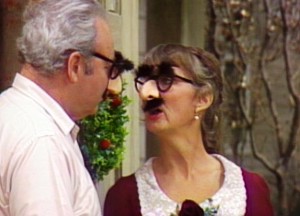
The next role that really brought Garrett back into national prominence didn't come until 1973 when she was cast in the recurring role of Irene Lorenzo, a new neighbor and foil for Carroll O'Connor's Archie Bunker on All in the Family. The role earned her a Golden Globe in 1975 for best supporting actress on television. Vincent Gardenia also was cast to play Irene's husband Frank. Garrett played Irene for 24 episodes from 1973 until 1975 when she joined the cast of another hit comedy, Laverne & Shirley. There, she played the girls' landlady Edna Babish before eventually becoming Laverne's stepmom when she wed her widowed father Frank DeFazio (Phil Foster). She stayed with the show until 1981. She never had another role as a series regular but did appear frequently as a guest, most recently on Grey's Anatomy in 2006. In 2003, she was nominated for an Emmy as guest actress in a comedy for an appearance on Becker.
She appeared on Broadway three more times: in a play, The Supporting Cast, in 1981, in a stage version of Meet Me in St. Louis in 1989 and in the revival of Stephen Sondheim's Follies in 2001, where she got to perform "Broadway Baby" as Hattie Walker.
Her final credit on IMDb is for a 2009 mystery comedy called Dark and Stormy Night starring Jim Beaver, the noble Ellsworth on Deadwood, and currently on Supernatural.
R.I.P. Ms. Garrett.
Tweet
Labels: Awards, blacklist, Cole Porter, Comden and Green, Cyd Charisse, Donen, Frank Loesser, Garland, Gene Kelly, Mary Wickes, Merman, Musicals, Obituary, Rodgers, Sinatra, Sondheim, Television, Theater
TO READ ON, CLICK HERE
Monday, June 04, 2007
Centennial Tributes: Rosalind Russell

By Josh R
The casting of the female lead in His Girl Friday represented a compromise, and one which director Howard Hawks was initially loath to make. Everyone on the filmmaker’s wish list was either uninterested or unavailable — Jean Arthur was the first choice, followed by Katharine Hepburn, Carole Lombard, Claudette Colbert, Irene Dunne and Ginger Rogers. Rosalind Russell would have been well at the bottom of the list — that is, if it had even occurred to Hawks to put her there in the first place. The actress had made a modest name for herself playing elegant ladies and frigid bitches in turgid melodramas — usually in support of another female star. The Women, another film the actress had to fight to be cast in and the first to challenge the industry’s perception of her, was still awaiting release, and there was little indication from her other work that she had the chops to meet the demands of screwball comedy.

Needless to say, Hawks was in a bad temper when filming commenced in the summer of 1939, and regarded his leading lady, who’d been forced upon him by the studio in a last ditch effort to get the film made on schedule, with no small amount of resentment. Picking up on his hostility, Russell took the director aside and told him, “I know you didn’t want me, but we’re stuck with each other.” The tension was alleviated, and Hawks would later insist that no one — not Hepburn, Lombard or any of the others — could have brought as much verve, style and wit to the part as Russell did. Viewing the finished product, no one would challenge that appraisal.
Hawks can hardly be blamed for harboring some early doubts — from the very beginning, Rosalind Russell was an unlikely candidate for stardom. The Connecticut-bred lawyer’s daughter, the product of a scrupulous Catholic upbringing, was a tall, almost ungainly woman with a raspy contralto voice and plain, sensible features. Her no-nonsense appearance, which was smart and well-tailored without being austere, suggested both a practical outlook and a bemused sense of irony. No one would ever mistake her for an ingénue or a sex goddess — which probably suited Russell just fine. Never beautiful in the conventional sense, she could generate more heat with an arched eyebrow and a deadpan retort than any of the glamour girls could with smoldering looks and coy displays of their natural assets. She could be side-splittingly funny in films that tapped into the zanier side of her nature, but made surprisingly few comedies during her four decades as a cinema fixture. It’s a testament to the impact she had in the handful of films that allowed her to cut loose that she is remembered first and foremost as a comedienne.
After making her film debut in 1934’s Evelyn Prentice, the next five years of her career proceeded without incident. Hollywood wasn’t quite sure what it had on its hands, or exactly what to do with her — she didn’t fit comfortably into any easy category, and seemed slightly embarrassed as a result. More often than not, she wound up playing patrician ladies in fussy costumes which tried to minimize her height. Typical of the period was China Seas, where she was cast as a romantic rival to Jean Harlow for the affections of Clark Gable. The cool brunette didn’t stand a chance — Harlow’s curvy, hip-swinging brashness made the lanky interloper seem like even more of a stiff than she actually was.
When the actress graduated to leads, the results were initially less than rewarding. As the title character in Craig’s Wife, she was a domestic dictator and an evil oppressor of men — somewhat surprisingly, this study in
 misogyny was the work of a female director, Dorothy Arzner. From an acting standpoint, Russell failed conspicuously in a role that, as thinly conceived as it was, would seem to call for an element of shamelessness — Joan Crawford, never one to shy away from playing brass-knuckled bitches, did much better by the same material in Harriet Craig 14 years later. To be fair, no one could have brought much in the way of human dimension to the character, a soulless martinet with an only slightly more complex pathology than The Wicked Witch of the West. As someone less interested in the subtleties of film acting, Crawford probably responded to something in the material Russell didn’t — Mommie Dearest’s late-career philosophy might be best described as “when in doubt, bare fangs.” Russell fared somewhat better in her next two films, Night Must Fall and The Citadel — box office hits which helped to solidify her position, but not affording her the opportunity to do much more than adopt a reactive stance while her male co-stars delivered star turns. Roberts Montgomery and Donat were nominated for Oscars, while their leading lady remained largely an afterthought — in both outings, she affected an earnest wholesomeness which gave little indication of an arresting personality.

If her prospects looked dim, the actress remained undaunted — she had some of Hepburn’s can-do Yankee feistiness, and an intelligence to match. She lobbied for the role of Sylvia Fowler, the loose-lipped socialite who views the dissemination of gossip as something akin to a higher calling, in George Cukor’s star-studded screen adaptation of Clare Booth Luce’s The Women. It was apparent that after years of playing it safe and fading into the scenery, she’d learned her lesson — the deliriously uninhibited comic brio that she exhibited in the role gave lie to the presumption that refinement and restraint were her salient characteristics as a performer. With her peerless talent for physical and verbal slapstick, she stole the film right out from under Crawford, Norma Shearer, Paulette Goddard and a gallery of others. It was as if someone had let loose a fox in a henhouse — untrammeled malice has never been more sublimely ridiculous.
Having finally broken out of her shell, she hit her stride. The role of Hildy Johnson in His Girl Friday was originally written for a man, and in its transmogrified incarnation could have easily come across as a shrill, insulting parody of the tough-minded career woman as a masculine (or worse still, asexual) entity, but Russell was much too smart, and far too inventive, to fall into that trap — her Hildy was one of the boys, alright, but more woman
 than ever. For the first time in motion pictures, here was a truly modern woman — not only the professional equal of her male counterparts, but with a quickness and creativity that left them in the dust. The pride of The Morning Star is an ace reporter who can outtalk, outthink and out-maneuver every man in the room, and rather than resent her for it, her colleagues can only peer out from under their porkpie hats and newsman’s visors with a mixture of awe and respect as she runs circles around the rest of them. The actress was a whirling dervish of energy, sprinting through entire pages of dialogue at warp speed without missing a beat, and her inflections throughout were priceless. She threw herself into the part with the same kind of edgy, go-for-broke tenacity that the character exhibited when chasing headlines, and made it clear that, for Hildy Johnson, no other kind of life is possible. She needs the thrill of the chase, and a guy like Walter Burns who can not only keep up with her, but is only too happy to let her run with the wolves. That’s why nice, bland Ralph Bellamy had to be sent packing at the end of the picture — there’s no way he could avoid being blown away by this sonic boom in heels.
Her resounding success in the Hawks entry dramatically altered her career trajectory, and the next five years saw
 her playing a series of variations on the same character. She was very good in Take a Letter, Darling opposite Fred MacMurray — one of the few leading men, other than Cary Grant, with whom she managed a genuine chemistry — but My Sister Eileen was a bigger hit with audiences. Her neophyte journalist braving the wilds of the urban jungle was sort of a country cousin to Hildy Johnson, and showed how fully she’d come into her own in the realm of screwball comedy. If the film itself was an inferior showcase, it nonetheless provided her with a welcome opportunity to hone her talent for slapstick — she earned the first of her four Oscar nominations for her efforts. Her best vehicle of the 1940s, after His Girl Friday, was the comedy-drama Roughly Speaking, which revealed an element of defensiveness as a component of the super-competent, overachieving persona. Wary of being typecast, she shifted her focus to drama, to somewhat disappointing effect. Sister Kenny, concerning the heroics of an Australian bush nurse who pioneers a revolutionary treatment for polio, was a Greer Garson film with crippled children standing in for illegitimate babies and the isolation of radium. She carried the film with dignity, but no amount of solid professionalism could keep it from seeming like a step backward. The marathon theatrics of Mourning Becomes Electra, Eugene O’Neill’s Civil-War-era riff on the precepts of Greek Tragedy, made for a creaky, ponderous affair — the play was not an ideal candidate for cinematic adaptation, especially at a time when its Oedipal undertones had to be tiptoed around in order to pass muster with the censors. Russell was rather badly miscast in a role that required more volatile nervous energy than she could muster — Bette Davis would have been more appropriate — but she made a brave try nonetheless. The Velvet Touch went so far as to cast her as a sweaty murderess; the entire enterprise seemed badly in need of Hitchcock.
The New York stage paved the way for career revitalization, and the actress took Broadway by storm with her star turn in Wonderful Town, Leonard Bernstein’s musical treatment of My Sister Eileen. If her singing skills posed no threat to the likes of Martin and Merman, she could still fire off Comden and Green’s custom-crafted zingers like a champ, and earned a Tony Award for her efforts. Since Hollywood had nothing better
 to offer than a supporting stint as a boozy spinster in the sodden mess of Picnic, she returned to the theater to take on the title role in Auntie Mame, a performance she repeated for the film version. The character of a madcap nonconformist, whose personality is expansive and irrepressible as her hair color is changeable, was a seven-course meal of a part, and the actress made the most of it. Everything about the globe-trotting, gin-swilling, convention-flouting Mame was writ larger than life, and Russell attacked the role with such giddy abandon as to make the entire mixed-up universe, from the Heart of Dixie to the Himalayas, seem like her own personal playground. It was her most unabashedly silly performance, and ultimately her most iconic; by thumbing her nose at conservatism, with behavior as outrageous as her wardrobe, both Mame and the actress playing her inadvertently kicked off the drag queen movement.
If Russell never again soared to Mame or Hildy-like heights, she continued to work steadily, and not without acclaim. The Majority of One cast her as a Jewish widow being romanced by Alec Guinness’ Japanese businessman — it was as bizarre as it sounds. If the actress had gotten by in Wonderful Town, it was clear
 that for the purposes of Gypsy, Styne and Sondheim’s backstage musical about the stage mother to end all others, her singing would have to be dubbed. While her acting as Mama Rose was credible, it was painfully apparent that a key element of the performance was being faked; as Ethel Merman’s participation in the original stage production testified, the role needed a great singer more than it required a great actress. For both of these late-career performances, she was recognized with citations from The Hollywood Foreign Press Association — it’s worth noting that a performer who never won a competitive acting Oscar still holds the record for most Golden Globe victories by an actress (her other three came for Kenny, Mourning and Mame). In a shame-faced apology for its habitual neglectfulness, The Academy presented her with the Jean Hersholt Humanitarian Award in 1973 — Russell pursued an active interest in philanthropy long before it became fashionable for movie stars to do so.
If the remainder of her film work failed to capture the spark of her earlier triumphs, she never lost the affection of her audience. The silly The Trouble with Angels was profitable enough to merit a sequel, Where Angels Go — Trouble Follows. In both films, she returned to her Catholic school roots as a tough-but-tender Mother Superior presiding over the likes of Hayley Mills and Susan Saint James — the material was beneath her, but she played it for what it was worth. Looking back over her career, it’s startling to realize how few of the films that she participated in were genuine classics — and fewer still were those that really allowed her to shine. Nevertheless, the performances for which she is cherished — His Girl Friday, Auntie Mame and The Women — when taken out of context, would individually stand as the highlights of any career. It took only one to encompass all three.
Tweet
Labels: Bellamy, Bette, Cary, Comden and Green, Crawford, Cukor, Gable, Garson, Ginger Rogers, Guinness, Harlow, Hawks, Irene Dunne, Jean Arthur, K. Hepburn, Lombard, MacMurray, O'Neill, Paulette Goddard, Sondheim
TO READ ON, CLICK HERE


