Tuesday, August 16, 2011
My Missing Picture Nominees: Sons and Lovers (1960)

By Edward Copeland
Before I begin discussing the 1960 best picture nominee Sons and Lovers, based on the famed D.H. Lawrence novel and which earned acclaimed Oscar-winning cinematographer Jack Cardiff his only nomination as a director, I'd like to use this occasion to point out yet another reason any true film lover should dump their streaming only Netflix option in favor of DVDs only. Sons and Lovers is one of the few Oscar nominees for best picture that I've never been able to see, but Netflix only carries it on streaming so I've been trying to watch any titles they have only on streaming before I switch to DVDs only. Cardiff filmed Sons and Lovers in luscious black-and-white CinemaScope (actually his d.p., the equally famous and lauded Freddie Francis was the cinematographer on the film). While you will see the opening and closing credits in the intended aspect ratio, the film in between will be cropped and squeezed for no good reason. Other streaming titles are shown in CinmaScope from beginning to end. Another strike against Netflix streaming. You won't get that on the DVD unless it's a DVD that only offers fullscreen.
As you might expect, a film being directed by Jack Cardiff, the brilliant d.p. behind the look of the Michael Powell and Emeric Pressburger classics A Matter of Life and Death aka Stairway to Heaven, Black Narcissus (for which he won the Oscar for cinematography) and The Red Shoes. He also shot Under Capricorn for Hitchcock, The African Queen for Huston, War and Peace for King Vidor (earning another Oscar nomination) and garnered his final cinematography nomination for Joshua Logan's Fanny in 1961. Believe it or not, he even served as d.p. on Rambo: First Blood Part II. The Academy saw fit to give him an honorary Oscar for his long career of exceptional work at the ceremony held in 2001.
Freddie Francis, his d.p. for Sons and Lovers, took home the Oscar for his work on the film. Despite a long list of impressive work, Francis was only nominated for the Oscar one other time — for Glory — and he won. Some of Francis' other films included Scorsese's version of Cape Fear and, his final film, David Lynch's The Straight Story. Also on Cardiff's crew as an assistant director was Peter Yates, who would go on to direct films as diverse as Bullitt and Breaking Away.

I wish I could say that I've read the D.H. Lawrence novel upon which the film is based, but the title itself makes it obvious that the adaptation by Gavin Lambert (who co-wrote Nicholas Ray's films Bigger Than Life and Bitter Victory) and T.E.B. Clarke (Oscar-winning writer of The Lavender Hill Mob) has taken some big liberties from the book. I mean the title indicates multiple sons, but aside from one brief scene that kills off Arthur (Sean Barrett), son of Walter and Gertrude Morel (the great Trevor Howard and Wendy Hiller, by far the film's greatest asset beyond its look and design), a couple of scenes with their son William (William Lucas), who lives in London, the film revolves around their son Paul (Dean Stockwell).
According to summaries of the novel online, Lawrence's book begins with a focus on the turbulent marriage of Walter, a working class miner in Nottingham, England, with a penchant for liquor and Gertrude, who develops unhealthy attachments to her sons. William still moves to London in the book, but is the eldest son and Gertrude's favorite, though he takes ill and dies. Arthur is an afterthought in the book and they also have a sister named Annie who doesn't exist in the film at all. None of the children follow dad into the mines. A near-death experience for Paul (in the novel, not the film) makes Gertrude transfer her obsession to him. Aspiring to be an artist, he gets a chance to move to London when a patron (Ernest Thesiger, who played Dr. Pretorious in 1935's Bride of Frankenstein) sees promise in Paul's work, but Paul abandons his chance to leave when he witness an incident of his drunken father mistreating his mother and stays, fearful of what his lout of a dad could do to his mom.
His mother also subtly and not so subtly interferes with Paul's romances, first with the overly pious Miriam (Heather Sears), who teases the poor lad unmercifully. and later with the married but separated suffragette Clara (Mary Ure) he meets when he takes a job at a sewing factory. (His boss is played by Donald Pleasence). While Miriam runs frigid, Clara burns hot and Paul eats her up, much to the disdain of Clara's cheating husband and his possessive mother.
Howard was nominated as best actor, though he's really supporting and deserved a nomination there. Ure was nominated as supporting actress. Hiller didn't get remembered at all, which is a shame. Given the five films up for best picture in 1960, they all were going to finish a distant second to Billy Wilder's The Apartment. John Wayne's starring in and directing The Alamo automatically lands in fifth. The middle three are tightly bunched, but I believe I'd rank Elmer Gantry second, then The Sundowners, and place Sons and Lovers fourth.
What finally brings Sons and Lovers down that low, despite its gorgeous look and design and mostly superb acting, is Dean Stockwell, who sticks out like a dandelion in a bouquet of roses. Amidst all this British authenticity, including filming on many locations that D.H. Lawrence actually traversed, Stockwell just doesn't belong. His accent isn't horrible, but he's so recognizable as an American (he was born in Hollywood and began acting as a child in the 1940s after all), you know that he wasn't spawned by Trevor Howard and Wendy Hiller. Supposedly, one of the producers, American Jerry Wald, insisted on casting an American in hopes of better U.S. box office. Stockwell can be a great actor but when you think of all the marvelous actors in the right age range circulating in the U.K at that time, what a boneheaded move. Imagine if this film had starred an O'Toole or a Finney or a Caine or a Richard Harris or an Oliver Reed or an Alan Bates or a Laurence Harvey. It could have saved the movie.
Tweet
Labels: 60s, Archers, Books, Caine, Dean Stockwell, Fiction, Finney, Hitchcock, Huston, Lynch, N. Ray, Netflix, O'Toole, Oscars, Pleasence, Scorsese, T. Howard, W. Hiller, Wayne, Wilder
TO READ ON, CLICK HERE


Tuesday, February 02, 2010
“A parrot bit me.”

By Ivan G. Shreve, Jr.
Sixty years ago on this date, the Grand Prize winner of the 1949 Cannes Film Festival had its American premiere in New York City — and I mention this only because there may be one or two people confused as to why Carol Reed’s The Third Man (1949) is being commemorated in 2010 as opposed to 2009. Since its introduction to American audiences, the film has become a yardstick by which classic suspense thrillers are measured, telling an engrossing tale of crime and corruption in post-war Vienna as concocted in a novella by author Graham Greene, who also wrote the screenplay for the film.
Novelist Holly Martins (Joseph Cotten), a writer of pulp fiction Westerns, arrives in Vienna at the request of an old friend named Harry Lime (Orson Welles), who has offered Holly a job in his “business,” as Holly is a bit “down on his uppers.” No sooner has he arrived in the city when he learns from a porter (Paul Hörbiger) in Harry’s apartment building that Lime is dead (killed when he was hit by a truck driven by his chauffeur); Holly has barely enough time to witness the body of his friend being buried in a nearby cemetery. The witnesses to Harry’s demise are two of his friends/associates — "Baron" Kurtz (Ernst Deutsch) and Popescu (Siegfried Breuer) — and Harry’s personal physician, Dr. Winkel (Erich Ponto), also is apparently involved … having conveniently been passing by when Harry had his fatal accident.
The whole incident smells a bit fishy to Martins … and he’s not the only one with suspicions. Major Callaway (Trevor Howard) has been investigating the case, because he knows more about Lime than his buddy Holly — that Lime is one of the most notorious racketeers in Vienna, up to his neck in black market activities. Holly refuses to believe this, and vows to stick around until he’s cracked the case; he talks with Harry’s friends, doctor … and even Harry’s lover, a theatrical performer named Anna Schmidt (Alida Valli). Their stories are riddled with inconsistencies — and Holly is particularly wary when the porter tells him that a mysterious “third man” was at the scene of Harry’s mishap.
Things start to go from bad to worse: Anna is taken in when it is learned that her passport is a forgery, and Holly becomes the No. 1 suspect when the porter turns up murdered. Callaway finally lays all his cards out on the table, and shows Martins solid evidence that Lime was involved in a scheme to steal penicillin from the military hospitals, then diluting it and making a killing in the black market. He presents Holly with sobering pictures of children who were treated for meningitis with Harry’s cut-rate medicine, and Martins becomes physically ill at both the photos and the knowledge he now has that his chum is, in essence, a murderer. After learning the truth about Harry, Holly returns to Anna’s lodgings and tells her what he’s learned from Callaway — but since she’s still upset by her loss she dismisses what he has to say. On his way back to the hotel, he calls out an individual who’s been “shadowing” him, and demands that he show himself. This is done with the simple flick of a light switch from an apartment overhead…and Holly is stunned to see that the figure is Harry Lime!
Holly reports what he has seen to Callaway, who orders that the coffin buried in Harry’s “grave” be dug up — and it is revealed that the body inside is that of Joseph Harbin, one of Lime’s “partners” in the penicillin racket (he worked as a hospital orderly, which gave him access to the medicine). Holly at first agrees to be a decoy in flushing Lime out of his hiding place (the police discover that Lime has taken up temporary residence in the sewers of Vienna), but Anna begs him to reconsider — it takes a visit to a children’s hospital ward (populated with Harry’s “victims”) and a promise from Callaway that Anna’s passport problems will disappear before Holly goes through with the plan … and Harry Lime meets his demise at the end of a suspenseful chase climax through the sewers, courtesy of a bullet from his best friend’s gun.
The very first time I saw The Third Man was in 1985, when the professor in a film class I was taking showed scenes from the movie to illustrate some of its breathtaking visuals (courtesy of Robert Krasker, who won an Academy Award for best black-and-white cinematography for 1950) — like the way director Reed presented some scenes at a slight tilt to emphasize the dizzying, disorienting effect Vienna had on Man’s protagonist. At the time, I had just started collecting movies on VHS and I was fortunate to find the movie cheaply on videocassette because the film had fallen into the public domain. (The film later had its copyright protection restored in 1996.) The version I had on VHS was the U.S. version, which featured Cotten’s character narrating at the beginning; this was done because the U.S. producer, David O. Selznick, wanted to present Holly Martins in a more positive light (and eventually edited out an additional 11 minutes from the U.K. version in order to accomplish this). The original U.K. version featured an unknown narrator (later identified as director Reed) whose opening remarks reveal him to be in the same “business” as Harry Lime; this complete print is the one now available on DVD and shown regularly on TCM.
Since my first encounter with Man 25 years ago, I can confidently say that I manage to revisit this wonderful film every year — even though I know the plot and most of the dialogue by heart. It is a prime example, according to director/film critic Peter Bogdanovich, of what he calls the “non-auteur” film: that the success of Man comes from the involvement of several different sources — the crisp, economical direction of Carol Reed; the complex (and oftentimes very witty) screenplay from Graham Greene; the star wattage of actors Cotten, Welles, Howard and Valli, performing at the peak of their powers; and the supervision of both Selznick (who was universally reviled by both the cast and crew) and Alexander Korda. A notable contribution to the film was the zither music of Anton Karas, whose jaunty "Third Man Theme" became an international hit upon the movie’s release. (To this day, my father will refer to the film as The Third Man Theme, and all attempts to get him to eliminate the unnecessary last word have proved futile.)
It was thought for many years that Welles — also a writer, director and producer in addition to his thespian skills — may have had a hand in partly directing Man; it’s kind of hard not to watch the movie and detect the influences of Welles productions like Citizen Kane (1941), The Stranger (1946) and The Lady from Shanghai (1947), but Welles was insistent that the direction was all Reed’s, labeling him “a hell of a director” — and a man who brought such classics to the screen as The Stars Look Down (1940), Night Train to Munich (1940), Odd Man Out (1947) and The Fallen Idol (1948) certainly didn’t need Orson to show him the ropes. (Reed’s star has since fallen among cinephiles because many of the movies he made at the end of his career are not considered his best — even though they ironically made more money that his “masterpieces.” I have a soft spot for The Man Between [1953], a Cold War-thriller set in Berlin and very reminiscent in both plot and character of Man.)
Welles did make a couple of contributions to the dialogue, including the mention of his “stomach troubles” (which was improvised) and one of the most memorable observations in the history of cinematic dialogue:
"Don't be so gloomy. After all, it's not that awful. Like the fella says, in Italy for 30 years under the Borgias they had warfare, terror, murder, and bloodshed, but they produced Michelangelo, Leonardo da Vinci, and the Renaissance. In Switzerland they had brotherly love — they had 500 years of democracy and peace, and what did that produce? The cuckoo clock. So long, Holly…"
Third Man was one of the first movies to teach me that while movies could look sensational in black-and-white, the outside world was often not the case. Holly Martins does the right thing by ratting out Lime in Man — despite his friend Harry’s charming, roguish personality he is also a criminal, and his business practices stand to hurt more innocent individuals if he’s allowed to remain free. Yet Lime has a point when he remarks to Holly (as the two men are looking down at the ground from their view on-board a Ferris wheel): “Would you really feel any pity if one of those dots stopped moving forever? If I offered you 20,000 pounds for every dot that stopped, would you really, old man, tell me to keep my money, or would you calculate how many dots you could afford to spare? Free of income tax, old man. Free of income tax — the only way you can save money nowadays.” The ambiguity of an individual’s actions — presented against the background of a city so war-torn that its new mission statement has almost become “survival of the fittest” — is hammered home at the movie’s end when Holly has Callaway stop the car so he can talk to Anna (they’ve just buried Harry a second time). Anna walks right by Holly without so much as a by-your-leave … and our “hero” is left standing there, cigarette in hand and completely flummoxed as to why he didn’t get the girl — with the words of his former friend ringing in his ears: “The world doesn't make any heroes outside of your stories.”
Ivan G. Shreve, Jr. blogs at Thrilling Days of Yesteryear and also has written an essay on the radio series, The Lives of Harry Lime, created in the wake of the success of The Third Man — but it’s at his old Salon Blogs address, so you’ll have to click here.
Tweet
Labels: 40s, 50s, Bogdanovich, Carol Reed, Joseph Cotten, Movie Tributes, Selznick, T. Howard, Welles
TO READ ON, CLICK HERE
Tuesday, March 25, 2008
Centennial Tributes: David Lean


By Peter Nellhaus
In honor of David Lean’s 100th birthday, I had finally gotten around to seeing Ryan’s Daughter. I had put off seeing this film because of the largely negative response from the critics I paid attention to at the time of release. Being better acquainted with Lean’s films now, I thought that I would be more receptive to the film than I would have been in 1970. The answer is no. In fact there were moments when I struggled to stay awake during the first half of this more than three hour epic. I had originally started to write something rather arch about Ryan’s Daughter, but thought more and more about how this misconceived film fit within the rest of Lean’s career.
Looking back on Lean’s filmography, I was struck by how many films deal with war or romance. In Which We Serve and Brief Encounter not only are the titles for two of Lean’s earlier films, but could also act as titles for his latter films as well. The more interesting part of Ryan’s Daughter is actually the subplot about “the troubles” — British occupation of Ireland during World War I, the conflicting senses of loyalty concerning the Germans and the paramilitary efforts of the IRA. It is the romantic element of Ryan’s Daughter that fails in part because Sarah Miles was incapable of conveying erotic longing, and Christopher Jones' lack of acting ability was made even more obvious in 70mm. If there is a reason to see Ryan’s Daughter, and I recommend it only to completists, it is to see Robert Mitchum in an uncharacteristic role as the cerebral schoolteacher who initially wins Sarah Miles' heart, Leo McKern as Miles’ father, caught between the demands of his community and his role as a father, Trevor Howard as the village priest and John Mills as the deformed mute who looks for friendship where ever it may be offered. In a way, Mills' performance may be something of his tribute to Charles Laughton’s performance in The Hunchback of Notre Dame. Mills and Laughton starred together in Hobson’s Choice, Lean’s last film in black and white.
There were times when I wish that Ryan’s Daughter had been shot in black and white. Yes, there are the gorgeous shots of the waves beating against the rocks, and the clouds Lean waited days for to shoot, back in the days before CGI would do what nature wouldn’t or couldn’t. There are also too many shots of small characters in vast landscapes. What David Lean seemed to forget was that he was not filming Lawrence of Arabia and that the character of Rosy Ryan was not T.E. Lawrence, or even Yuri Zhivago’s Lara. Too often, Ryan’s Daughter appears to have been overproduced simply to justify the budget that was at Lean’s disposal.
My own favorite Lean films are Great Expectations, still one of the most watchable film adaptations of Charles Dickens, and Brief Encounter, a story of unfulfilled love that generates more heat than its description would indicate. Of Lean’s later films, I did like A Passage to India. Perhaps because after almost 14 years I started to miss David Lean without knowing exactly why, or simply because Lean was able to create a film combining the epic with the personal in just the right proportion, but A Passage to India succeeded with me in a way that his films from Bridge on the River Kwai had not. It is not coincidental that Lean also edited A Passage to India. In his final film, Lean combined what had initially distinguished him in the British film industry with his career as the director of epics shot in remote locations. A reworking of Madame Bovary got lost in the bloated, boring Ryan’s Daughter. With A Passage to India, David Lean regained control of the best parts of his films.
Peter Nellhaus' writings on film can be found at his blog Coffee Coffee and More Coffee.
Tweet
Labels: Dickens, Laughton, Lean, Mitchum, T. Howard
TO READ ON, CLICK HERE
Saturday, December 30, 2006
Centennial Tributes: Carol Reed

By Edward Copeland
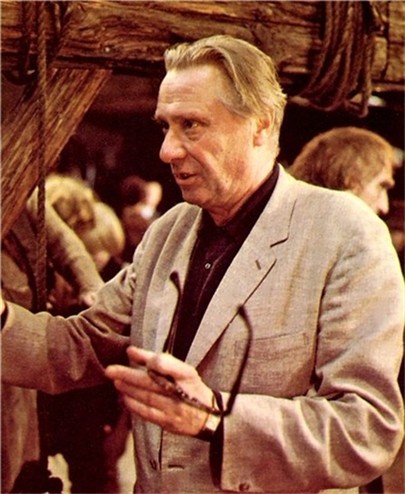
In an introduction on the great Criterion Collection DVD of The Third Man, Peter Bogdanovich speculates that Carol Reed is largely forgotten now because his greatest works came early in his career and were eclipsed by his later, lesser efforts such as Trapeze and The Agony and the Ecstasy and the movie he won the Oscar for, Oliver!, which while fun (sorry Josh R) doesn't come close to equaling his early efforts. I don't necessarily agree — because The Third Man still seems to tower among many movies made today, even if younger viewers are unfamiliar with The Fallen Idol or Odd Man Out. Still if the only movie that Reed, who was born 100 years ago today, ever made had been The Third Man, he would still be deserving of a place among the ranks of film's greatest directors.
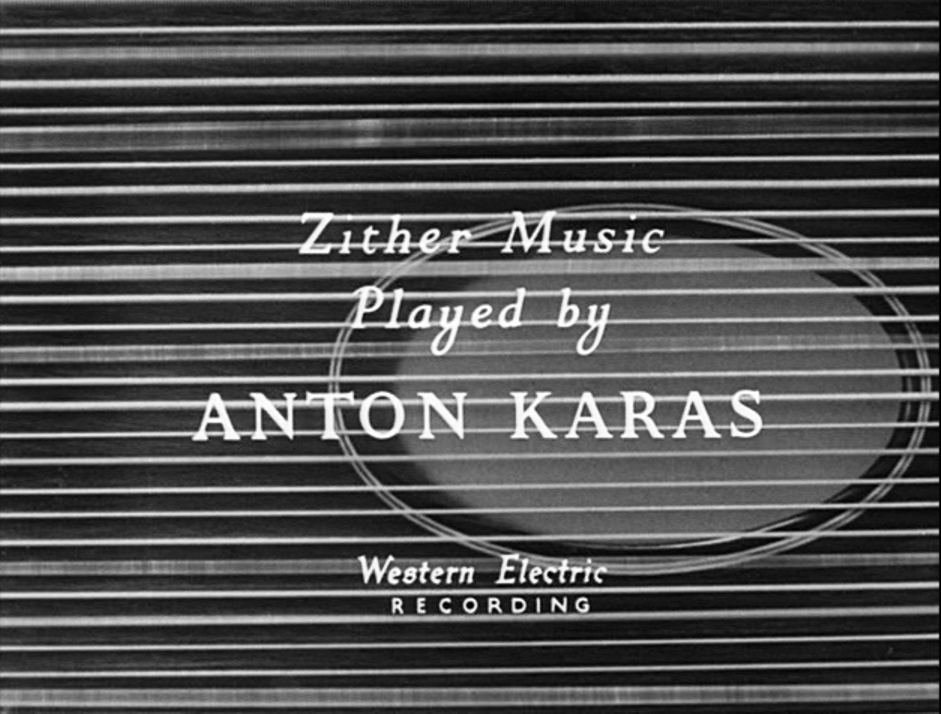
Re-watching The Third Man recently, it once again captivated me from the moment the great zither music by Anton Karas begins to play over the credits. With the presence of Orson Welles and Joseph Cotten and great black-and-white cinematography (by Robert Krasker, not Gregg Toland), the movie almost plays as if the gang from Citizen Kane has teamed up
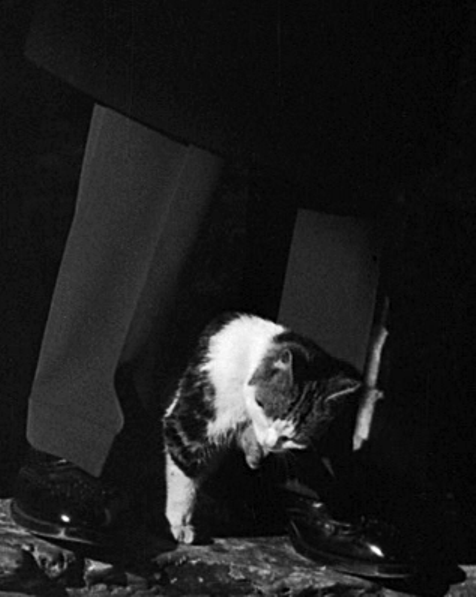 again. If that weren't enough, it also has a great script by novelist Graham Greene (and Trevor Howard is fun as well). If you haven't seen The Third Man (and shame on you if you call yourself a film buff and you haven't), watching the Criterion DVD really is the way to go, not only for a crisp print but to be able to compare the different versions offered for British and U.S. audiences (though only the different openings are included — we don't see what 17 minutes David O. Selznick cut for American audiences). With its great scenes of Vienna, sly performances and perhaps the greatest entrance of any character in movie history, The Third Man stays near the top of all films ever made, even nearly 60 years after its release.

While The Third Man remains the greatest collaboration between Graham Greene and Carol Reed, it wasn't the first — that came with 1948's The Fallen Idol. Often mischaracterized as a mystery or a thriller, it's a more humanistic tale of what one would do for a friend and when the truth is better than a lie or vice-versa. A charming child actor named Bobby Henrey stars as Phillipe, the son of a French ambassador to England who has developed an deep attachment to the family's butler Baines (a great Ralph Richardson) due to his parents' frequent absences. Baines' kindness toward the child is not equaled by his shrew of a wife, the household's head housekeeper (Sonia Dresdel), who is such an unlikable character she makes Judith Anderson's Mrs. Danvers in Hitchcock's Rebecca look like Mrs. Doubtfire. Baines isn't much fonder of his wife than the boy, keeping a mistress (Michele Morgan) on the side that he hopes to leave her for — not that Mrs. Baines wants to let that happen. When Mrs. Baines dies accidentally, Phillipe is convinced that Baines murdered her and does everything he can to try to protect his friend — only his lies just serve to get the butler deeper in trouble. The Fallen Idol creates quite a different mood than The Third Man or Odd Man Out, but it is still quite good.

Before The Fallen Idol and The Third Man came another great black-and-white feature from Reed with Odd Man Out in 1947. To think that Reed produced these three films in consecutive years astounds me and is an incredible achievement to this very day. James Mason gave one of his very best performances as Johnny McQueen, an Irish nationalist fighting for freedom from Britain who attempts to evade authorities after he's wounded in a botched robbery attempt. It actually offers even more suspense than The Third Man and its subject matter had to have been seen as daring in England in its time. In the Bogdanovich intro on the Criterion DVD of The Third Man he repeats the oft-told Orson Welles line that no great film performance was ever given in color. While I disagree with that statement, I can't help but wonder if it applies specifically to Reed as a filmmaker. Though I haven't seen all of his films — and his filmography is surprisingly slim when compared with someone such as Otto Preminger — it certainly is true that no film he made in color comes close to matching the greatest of his black-and-white efforts.
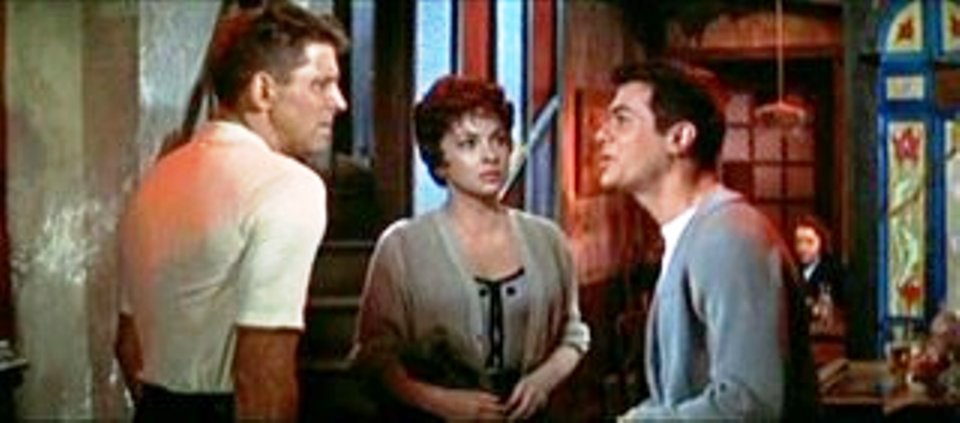
No film makes a better case for this that his 1956 effort Trapeze starring Burt Lancaster, Tony Curtis and Gina Lollobrigida. This triangle set amidst the soaring artists of a circus surpasses hokey and comes perilously close to being plain awful. Lancaster plays a former trapeze star, reduced to being a rigger after an injury, who finds life in his work again through the young prodigy Curtis. Lollobrigida threatens to come between them both personally and professionally but, let's face it — the real romance here is between Burt and Tony with nearly as much gay subtext as Curtis had with Laurence Olivier in Spartacus. As a film, it's pretty dreadful but has a good live-action film ever been made that was set in a circus?


Of course, Trapeze turns out to be a real fun ride compared to The Agony and the Ecstasy, though at least they got the first part of the title right. Come to think of it — has any really good film been made about a true-life artist either? If so, this account of Michelangelo (the ever-stiff Charlton Heston) trying to paint the Sistine Chapel for Pope Julius II (the most British pontiff of Italian lineage in the history of the papacy as played by Rex Harrison) certainly is not that film. It begins with a nearly 15-minute, dry recitation of Michelangelo's artistic works up until that point — and it's all downhill from there. A running gag in the film is Julius constantly asking Michelangelo, "When will it end?" to which the artist replies, "When it is finished?" and Lord knows I felt the same way trying to get through this snoozer of a film, despite its colorful cinematography. Of course, as history it's fairly suspect as well. Granted that it was 1965 and Heston would have never played Michelangelo as the homosexual that history seems to have concluded he was, the film does have to insert some female love interests for him, lest people watching the movie get the right idea.

Now while I don't worship Oliver! the way Josh R does nor do I hold it in the disdain that many worst picture survey participants expressed last year, this certainly wasn't a great film or the one that should have brought Reed an Oscar. It does have great performances from young Jack Wild, Oliver Reed, Shani Wallis and, most especially, Ron Moody as Fagin, and many of the musical numbers are well done, but Oliver! is way too damn long. I imagine a great deal of the hatred exhibited earlier this year had to do with Reed winning best director in 1968 over Stanley Kubrick for 2001: A Space Odyssey, but I always try to blame the Academy for Oscar's mistakes instead of the winner. For me, the greatest crime Oliver! commits is its excessive length. When little Oliver (Mark Lester) delivers the classic line, "Please sir — may I have some more" I have to believe that someone mistook his request for additional gruel with a desire for more footage and he should have been refused if that had been his wish.

However, when you're talking about Carol Reed, all roads lead back to The Third Man in the end. Nothing else he made matters as long as it exists. It's his legacy and the most important reason he should be remembered today on what would have been his 100th birthday. Though The Third Man was released in England in 1949, it was released for Oscar consideration in 1950 — and what a year and what competition it faced. Joseph L. Mankiewicz won for the great All About Eve and Billy Wilder was nominated for directing the even better Sunset Blvd. and he had to contend with John Huston for The Asphalt Jungle as well, so Reed's direction of this masterpiece never really stood a chance, though the nominations it didn't get remain an outrage. No supporting nomination for Welles (though I'd still have voted for George Sanders' Addison De Witt). At least Robert Krasker won for his cinematography. The fact The Third Man lost editing to King Solomon's Mines is downright silly. Graham Greene's great screenplay was completely ignored. Of course, the greatest outrage is its omission from the best picture ranks when Born Yesterday, Father of the Bride and King Solomon's Mines made the cut. Then again, I think Harry Lime and the gang had the last laugh — who really wants to watch those movies again after they've seen them once? In Harry's mind, all the Swiss could take credit for is the cuckoo clock but if Reed's legacy consisted solely of The Third Man, that would be more than enough for which to be grateful.
Tweet
Labels: Bogdanovich, Carol Reed, Heston, Huston, Joseph Cotten, Kubrick, Lancaster, Mankiewicz, Mason, Olivier, Sanders, Selznick, T. Howard, Tony Curtis, Welles, Wilder
TO READ ON, CLICK HERE
Saturday, April 08, 2006
Lean was so much better when he was lean

By Edward Copeland
The legend has it that David Lean was so scarred by Pauline Kael's brutal take on his 1970 movie Ryan's Daughter that it kept him out of the director's chair for more than a decade, until he returned with 1984's A Passage to India. Alas, Kael's review was not included in her collection For Keeps, so I've never read it in all its glory and her only comment in 5001 Nights at the Movies is that it is "Gush made respectable by millions of dollars tastefully wasted." I don't know if the legend is true, but having recently watched Ryan's Daughter for the first time, I have to think that Kael did Lean and audiences a favor because as he became epic obsessed, his greatness diminished, especially when compared to his earlier, smaller and brilliant films.
Something happens when great filmmakers get the bloat bug and it's a shame that more can't go back to small after they've gone gargantuan (Peter Jackson, I'm looking in your general direction). Don't get me wrong — I love Lawrence of Arabia — but for me, that's the only one of his big pictures that really works (though A Passage to India is passable enough). Even Lawrence lags in the second half, but Bridge on the River Kwai doesn't hold up well and I found Doctor Zhivago damn near interminable aside from Rod Steiger's great performance.
However, I'm here to discuss Ryan's Daughter which is the biggest epic crime committed by Lean — forcing a simple (though dull) tale of a love triangle into a three-hour format because by 1970, that's the only thing he knew how to do. There also is a side diversion into early IRA stuff, but it seems present only to pad out the running time which was padded as it was. Robert Mitchum suffers through a less-than-convincing Irish accent as his new bride (Sarah Miles) suddenly decides to take up with a British soldier, prompting a Scarlet Letter-ish outcry from the townfolk, who also blame her for ratting out an IRA soldier.

As one would expect, the film is pretty — including many shots of raindrops falling off leaves during a love scene that Terrence Malick would love — but pretty images alone do not a good movie make. The real embarrassment of the film is the Oscar-winning performance by John Mills as the village idiot which may well be the worst Oscar-winning performance I've ever seen — and that says a lot. Hidden somewhat beneath makeup, Mills' character basically has two expressions: fear and glee, though I guess you could argue that is one more expression than Charlize Theron could muster under her Monster makeup, thought at least Theron had the help of being able to speak. This all seems so tragic to me when you look back at Lean's early filmography, which holds up so much better than what he made once the epic bug bit him.
1942: Co-directed with Noel Coward, In Which We Serve is a dramatic and touching story of a British naval ship with some haunting images that I don't dare spoil for those who haven't seen it.
1945: Lean produced the fluffy Blithe Spirit, which is worth watching if only for Margaret Rutherford's absolutely brilliant comic performance.
That same year, Lean directed the absolutely sublime romantic classic Brief Encounter whose influence has resonated through the ages in forms as diverse as the play turned movie Same Time, Next Year and the schlock novel turned movie The Bridges of Madison County. It also features great performances by Trevor Howard and the now nearly forgotten Celia Johnson.
1946: Lean made the first of his two great Dickens' adaptations, Great Expectations, and for my money it remains the best film version of a Charles Dickens novel ever put on screen. It also contains a John Mills performance worth praising as Pip. (Mills also gave a memorable early performance in In Which We Serve).
1948: Lean scored another win with Dickens, this time with Oliver Twist. Despite the usual criticism of the Fagin character that accompanies all versions of this tale, Alec Guinness is positively brilliant in the role.
Admittedly, I haven't seen his works between 1949 and 1954, but in 1955 he made the bittersweet Summertime with Katharine Hepburn as a spinster finding romance in Venice — and after that, it was epics all the way and I think, aside from Lawrence of Arabia, film lovers are the ones who suffered the most by his conversion to the HUGE. I picked on Peter Jackson earlier about this, but I think it could be applied to Martin Scorsese and others as well. Imagine if Scorsese stepped back from his epic phase and went back to a smaller type of film that made his reputation in the first place. I don't know if The Departed will be that film — but I can hope.
As far as Ryan's Daughter goes, if you haven't seen it, despite the deluxe 2-DVD treatment it has recently received, save your time.
Tweet
Labels: 70s, Dickens, Guinness, K. Hepburn, Kael, Lean, Malick, Mitchum, Peter Jackson, Scorsese, T. Howard
TO READ ON, CLICK HERE


