Wednesday, June 29, 2011
Centennial Tributes: Bernard Herrmann Part I
”As a composer I might class myself as a Neo-Romantic, inasmuch as I have always regarded music as a highly personal and emotional form of expression. I like to write music which takes its inspiration from poetry, art and nature. I do not care for purely decorative music. Although I am in sympathy with modern idioms, I abhor music which attempts nothing more than the illustration of a stylistic fad. And in using modern techniques, I have tried at all times to subjugate them to a larger idea or a grander human feeling.”
Bernard Herrmann in Bernard Herrmann: Hollywood’s Music-Dramatist by Edward Johnson
By Edward Copeland
Our centennial tributes tend to be of actor, actresses, directors and writers. We were honored when lyricist Bill Russell wrote a tribute to composer Frank Loesser, but he was a songwriter, providing both music and lyrics, who penned many memorable songs for stage and screen. We've never attempted to salute a composer known for his instrumental scores, particularly ones he wrote for movies, but Bernard Herrmann born 100 years ago today (exactly one year younger than Loesser), didn't like to be pigeonholed as a film composer since his musical work spanned opera, symphonies, concerts, radio and television in addition to some of the most memorable film scores of all time. That's why instead of just starting this post with a photo of the man and some words, I figured it's more fitting to use clips or links to clips to demonstrate his works such as his score that accompanied the Saul Bass title sequence for Alfred Hitchcock's Vertigo, an example of one of his very best. Movie titles and still photographs don't do Bernard Herrmann justice, that's why I'm going to write less than usual in this tribute and let his music do the talking. However, the man was so prolific, I've had to divide the post in half so it doesn't grow so long anyway that it knocks other posts off the front page. While there will be some biography, mainly it will be about his music and I'm going to try to be chronological and, in a couple of occasions, show his influence. We even have a clip of the master musician discussing his craft relating to his scoring to a particular film. If you are reading this at work, I hope you have headphones.
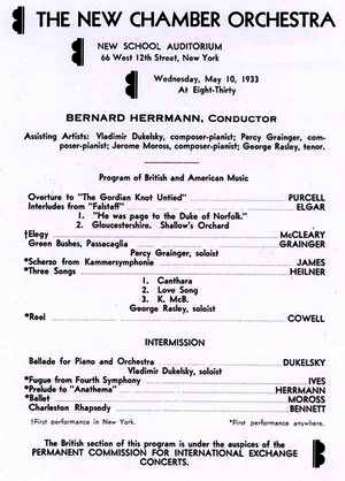
His father encouraged his interest in music and he took up the violin, winning a $100 prize for one of his own compositions at the age of 13. Herrmann's interest in composition became more serious sometime around 1927 while he attended DeWitt Clinton High School and studied with Gustav Heine. His first notable work is considered to be a tone poem called "The Forest" he wrote in January 1929. He enrolled at New York University (while still in high school) and studied composition with Philip James and conducting with Albert Stoessel. Stoessel later headed the opera and orchestra at Juilliard and Herrmann landed a fellowship there in 1930 where he studied conducting and composition with Bernard Wagenaar. He officially finished high school in 1931 around the time he formed his own orchestra, The New York Chamber Orchestra. This was before he was 20. He left Juilliard in 1932 but without a degree. That fall, he attended lectures in advanced composition and orchestration at NYU by Percy Grainger. Herrmann also worked as a music editor and arranger at the Harms music publishing company around this period. That same fall, some dancers he knew from Juilliard asked him to arrange ballet music for a musical revue called +New Americana, which inadvertently led to his professional composing, conducting, and Broadway debuts when he went on to direct the orchestra during his arrangement of The Shakers and his own piece, "Amour à la Militaire," when it opened Oct. 5, 1932. It ran 77 performances.*
By 1934, he was a staff conductor with CBS radio. He seriously began his prolific composing work during this period, writing many scores to accompany CBS radio programs including "The City of Brass" which accompanied David Ross' narration of one of the tales from One Thousand and One Nights or The Arabian Nights. In 1935, he composed the orchestral piece the Currier and Ives Suite. It was described as a short, five-movement piece on the Film Score website which has been running a series all year on Herrmann's centennial. The site notes that its composition occurred while he was employed by CBS because one of the pages of the composition was on CBS paper. Other than that, it says the origin of the piece is largely a mystery. There is a YouTube clip set against classic Currier and Ives drawings that has the orchestral piece.
Herrmann was named chief conductor of the CBS Symphony Orchestra in 1943 (a title he held until the orchestra disbanded in 1951 as TV began to displace radio), where it was said he introduced American audiences to more new musical works than any conductor in history. He particularly championed the American composer Charles Ives. Even before getting that post, Herrmann's output beyond the network and for mediums other than radio or orchestra bloomed. During the 1937-38 period, Herrmann got his feet wet for the first time in composing opera with a 45-minute cantata of Moby Dick. It didn't receive a world premiere until 1940 with The New York Philharmonic under the direction of Sir John Barbirolli. The cantata had never received a live performance in the United States since until April of this year when John Kendall Bailey conducted a 40-voice men's chorus and four soloists to perform it with the American Philharmonic-Sonoma County. Below are excerpts from the score, though it doesn't indicate from what recording it is taken and though it includes stills from John Huston's film of Moby Dick, note that Herrmann did not score that film.

While still just a staff conductor at CBS, the musical prodigy Herrmann would meet another young wunderkind making waves in New York named Orson Welles. He composed and arranged scores for Welles' Mercury Theater broadcasts, including the infamous 1938 War of the Worlds . While working at CBS, Welles lured Herrmann to Hollywood with him and when Welles made his astounding debut as the actor, writer and director of Citizen Kane in 1941, Herrmann had an equally impressive first year as a film composer. Not only did he make an impressive first showing with Citizen Kane and Welles' 1942 followup The Magnificent Ambersons, in between he composed the score for director William Dieterle's 1941 film The Devil and Daniel Webster aka All That Money Can Buy. In 1941, both the scores for Kane and Daniel Webster earned Herrmann Oscar nominations. His Daniel Webster score won (and there were 20 nominees). Though some of his greatest work still was to come, many for Hitchcock. He would receive another nomination in 1946 for director John Cromwell's Anna and the King of Siam but would not receive another nomination until he received two posthumous nominations in 1976. As is unfortunately the case with many YouTube clips, the embedding has been disabled, click here and listen to his lovely piece as the reporter reads Thatcher's diary leading into the flashback to Kane's childhood. Also, two pieces from Ambersons: Herrmann's subtle score running beneath Welles' narration of George's comeuppance and a much bouncier, holiday-theme Herrmann piece accompanying the snowride scene. I couldn't find a sample for The Devil and Daniel Webster/All That Money Can Buy.
In 1943, Herrmann composed the score for Jane Eyre directed by Robert Stevenson but involving many Mercury Theater players including Welles starring as Rochester, Agnes Moorehead as Mrs. Reed and John Houseman co-writing the script. Joan Fontaine starred in the title role. This is Herrmann's main title theme. He didn't score another film for two years when he did director John Brahm's 1945 psychological thriller Hangover Square, which I've never seen but certainly sounds interesting. It stars Laird Cregar as a composer suffering lapses in his memory who thinks he may have killed someone and seeks help from his doctor (George Sanders). Even though the composer is engaged, he somehow finds himself involved with a music hall dancer (Linda Darnell) and his temporary memory losses are threatening the concerto he has a deadline to finish. The following year, he composed the score for Anna and King of Siam, which earned him that third Oscar nomination.
In 1947, Herrmann penned the score for The Ghost and Mrs. Muir directed by Joseph L. Mankiewicz, a film that's very popular on YouTube, only for some reason people like to use scenes and stills from the movie and place modern songs over them. The next year, Herrmann made his first foray into composing for television, making music for many installments of Studio One which went by about a half-dozen different titles during its run. That kept him busy until 1951 when he debuted his first full-fledged opera Wuthering Heights. In the clip below, Yves Saelens sings "Now art thou dear, my golden June" (Edgar Linton's aria) in a concert performance of the opera at the Festival de Radio France et Montpellier 2010. Alain Altinoglu conducts the Orchestre National de Montpellier.
Directed by Robert Wise; Piece: Prelude/Outer Space/Radar
On Dangerous Ground (1952)
Directed by Nicholas Ray (Ida Lupino uncredited)
The Snows of Kiliminjaro (1952)
Directed by Henry King (Roy Ward Baker uncredited)
White Witch Doctor (1953) directed by Henry Hathaway
Now, I'm not going to list EVERY film or television show Herrmann scored, because it would grow too long. It's still going to be so long, that's why I've had to divide it into two posts so everything doesn't get knocked off the page. I'm tempted to leave out lesser titles or even bigger names if there isn't a music sample I can't find. Sometimes though, I'll find some other compelling reason to include a title figure anyone can click on his credits themselves.
Shower of Stars TV series (1954) Episode: "A Christmas Carol"
In 1955 when Burt Lancaster directed the first of the only two films he ever would helm, The Kentuckian, and he chose Herrmann for the score. Of course, that year was auspicious for another reason: It marked the first teaming of one of the most important director-composer partnerships in film history: Herrmann and Alfred Hitchcock. What brought The Master of Suspense and Herrmann together for the first time actually wasn't one of Hitchcock's tense masterpieces but his dark comedy The Trouble With Harry about the small Vermont town with the problem of a body that just won't stay put. It also marked the film debut of Shirley MacLaine.
Directed by Nunnally Johnson; Pieces: Prelude, The Children's Hour
So this is where we will leave part I. Click here just in case Part II still doesn't show on the main page.
*Much of the information in this section comes from the Herrmann biography found on Artists Direct.
Tweet
Labels: Agnes M., Books, Curtiz, Frank Loesser, Gregory Peck, Herrmann, Hitchcock, Huston, Lancaster, Lupino, MacLaine, Mankiewicz, Music, N. Ray, Oscars, Sanders, Television, Theater, Welles, Wise
TO READ ON, CLICK HERE


Saturday, May 14, 2011
Make Believe

By Eddie Selover
The landmark musicals of theater history haven’t fared very well on film. Usually, they’ve had their scores trashed (such as Lady in the Dark and Pal Joey), suffered from big-movie-star miscasting (such as Guys and Dolls, Gypsy and Chicago) or been presented intact but with such fussy over-fidelity that they’re dead on the screen (such as South Pacific and My Fair Lady).
So it’s something of a miracle that 75 years ago today, the first great musical, maybe the greatest stage musical of all — Show Boat, by Jerome Kern and Oscar Hammerstein — reached movie theaters with its beautiful score intact, with the best and most legendary cast members playing their original roles, and filmed with cinematic intelligence by a great director. And most miraculously of all, the movie Show Boat came from the cheapest, blandest and most mediocre studio in Hollywood history — Universal Pictures.
Universal had tried before in 1929. They had bought the film rights to Edna Ferber’s 1926 novel, which had been a big best seller, and were filming a silent version when lightning struck twice. First, Ferber sold the stage rights to Florenz Ziegfeld and the resulting musical became Broadway’s biggest hit and a groundbreaking leap forward in terms of seriousness of story and theme. Second, the movies were swept by the craze for talking pictures. So here was Universal, having just finished making a silent version of a book for a public that wanted to see a famous musical. The solution was to add a talking prologue, with songs performed by a few original cast members, like a variety show, and shoehorn a couple of songs by other composers into the movie randomly. Though it was a financial success, the result was widely regarded as a hodgepodge and an artistic failure, as it is today.

I’d be hard pressed to think of another time in the history of movies that something like this happened, but Carl Laemmle, the head of Universal, decided to try again and do it right. Only seven years after the first film, he hired Oscar Hammerstein, who had written Show Boat’s libretto, to write a screenplay with story and songs true to the original. The score was largely retained; a couple of fine new Hammerstein/Kern songs were added (in fact the two went on adding and subtracting songs to Show Boat into the 1940s). Paul Robeson and Helen Morgan were signed to repeat their stage performances, which was very brave of the studio — Robeson was a pariah due to his left wing politics and refusal to kowtow to anyone; Morgan was on a career slide due to alcoholism, and Hollywood had long since washed its hands of her. The decision to include them shows how serious Laemmle was about rectifying his earlier error. And so Show Boat offers the opportunity to see two of the most legendary performances in the history of American musical theater in one film.
Laemmle also put his best director on the project. James Whale is famous for a quartet of Universal monster movies (Frankenstein, Bride of Frankenstein, The Old Dark House and The Invisible Man), so much so that horror has taken over his resume. But what makes his horror films among the best, if not the best, is the
 kinetic aliveness of his direction (which sometimes meant that his shots don’t match; the film’s only flaw is that it’s choppy in places). Show Boat could have been a static record of a famous stage production, but in Whale’s hands, it’s a movie. There’s so much going on in every frame that it almost feels like 3-D, and you’re always aware of the characters watching each other and reacting to each other. When Helen Morgan sings her great torch song “Bill,” with its famous lyric by P.G. Wodehouse, chorus girls, janitors and washerwomen slowly stop their work and gather at the edges of the room; one discreetly wipes away a tear with her apron. When Paul Robeson sits on a dock and sings “Ol' Man River,” maybe the most famous performance of the most famous song in theater history, Whale’s camera circles him ecstatically, finally ending on a sustained closeup that you hope will never end. Sadly, it does: someone foolishly intercut scenes of Robeson acting out the lyric (toting barges, lifting bales, getting a little drunk and landing in jail). But then we go back to Robeson singing, and it’s one of the most beautiful, stirring sights anyone ever saw.
The leads are great as well. It can’t be the easiest thing in the world to play Magnolia Hawkes and Gaylord Ravenal, Southern belle and riverboat gambler, and not look just a little bit ridiculous. And singing, yet. I’m not a big fan of operetta, with its stilted and formal performance style, but Irene Dunne and Allan Jones are the two best performers who ever attempted it. Dunne is particularly skillful, convincingly aging from innocent late teens to worldly wise 50s (she was about 38) without hitting a single false note. She does a crazy, eye-rolling shuffle to “Can’t Help Lovin' Dat Man” and performs “Gallivantin' Around” in blackface, and manages to keep her dignity as an actress and keep you focused on Magnolia, not on Irene Dunne. And it must be said that she never looked more girlish or more radiantly beautiful than in this film.

If Jones is remembered at all today, it’s as the only bearable male lead in the Marx Brothers’ film career (in A Night at the Opera and A Day at the Races). In Show Boat, he has a tricky role, as a riverboat dandy who’s dashing and charming but also weak and irresponsible. He’s a gambler who loses spectacularly, and losing doesn’t bring out the best in him. He’s much softer than Magnolia, who turns out to be the strong and resilient one. Late in the movie, he takes a menial position just to be around his grown daughter, who doesn’t know him. You accept this melodramatic, masochistic turn of events largely because of the gentleness and simplicity Jones brings to it. His daughter is his legacy; she’s all he has. He makes you understand that Ravenal is a sensitive man who doesn’t like himself very much and clings to a dignity he doesn’t really feel; it’s a terrific, subtle performance.

But everybody in Show Boat is great. As Magnolia’s parents Captain Andy and Parthenia, Charles Winninger and Helen Westley bring out all the comedy and pathos in their parts without overdoing it. Not easy: in the MGM remake from 1951, it’s hard to even look at Joe E. Brown and Agnes Moorehead thrashing around in the same roles. Winninger is particularly outstanding in a scene near the end where he saves his daughter’s singing career by coaching her from the footlights, and his emotion is so full that he can only express it by leading the entire audience in a sing-along reprise. All through the movie, song is a vehicle for emotion rather than an excuse to wow you with a big production number. “Make Believe,” the gorgeous love song that brings Magnolia and Ravenal together, also is a brilliant foreshadowing of their self-delusion and ultimate missed connection.

Maybe the most remarkable thing about Show Boat is the relationships between the black and white characters. In no other '30s movie, and maybe no other movie before the 1970s, do blacks and whites mingle so freely and with so much ease. Though the movie shows you a world in which African Americans are subservient, poor and ignorant, it’s not trafficking in stereotypes or endorsing prejudice. Far from it. The most sympathetic character is Julie (Morgan), who has mixed blood and loses her job and her husband after being hounded by the law. The movie, like the show, is suffused with the idea that racism is evil, ugly, and ruinous. The characters, living in the post-Civil War South, can’t change the world around them but nonetheless treat each other like human beings. When Irene Dunne does her shuffle and her blackface number, it isn’t condescending — Magnolia has been brought up and nurtured by African Americans; she’s one of them.
Quite a progressive movie for 1936, and for a minor studio in some financial trouble. Laemmle had a lot riding on Show Boat. Like Ravenal, he was a gambler. And he lost: the movie was a hit, but due to the time and care he’d invested, it was so expensive that it failed to turn a profit. As a result, the receivers moved in and he was ousted from the studio he had founded. But again, like Ravenal, he left quite a legacy. Show Boat is many things… an irreplaceable record of a key moment in theatrical history, a high point in classical Hollywood filmmaking, a moving bit of make believe, and an eloquent understated plea for tolerance and decency. And for all its antiquated technique and performing style, maybe the finest movie musical ever made.
Tweet
Labels: 30s, Agnes M., Hammerstein, Irene Dunne, Marx Brothers, Movie Tributes, Musicals, Theater, Whale
TO READ ON, CLICK HERE
Sunday, May 01, 2011
The Magician & The Media Baron

Kate Cameron, New York Daily News (1941)
“Perhaps the one American talking picture that seems to be as fresh now as the day it opened.
It may seem even fresher.”
Pauline Kael, The New Yorker (1971)
"Staggering and belongs at once among the greatest screen achievements."
William Boehnel, New World Telegram (1941)
"The boldest free-hand stroke in major screen production since Griffith and Bitzer were running wild
to unshackle the camera."
Otis Ferguson, The New Republic (1941)
“Probably the one film that has started the largest number of filmmakers on their careers.”
François Truffaut

By John Cochrane
What can you say about Citizen Kane (1941) that hasn’t already been said many times before? Orson Welles’ landmark first feature — which received its American premiere 70 years ago today — has routinely been called by general consensus "The Greatest Movie Ever Made" by countless filmmakers, critics and movie buffs — topping lists such as AFI’s Greatest Films Of The Century, Cahiers du Cinema’s 100 Greatest Films Ever Made and every Sight & Sound Critics and Directors poll since 1962. Despite almost universal acclaim, even from the beginning, the movie was blacklisted on its initial release — and almost literally destroyed by a nervous industry that resented its precocious and talented creator and didn’t want to offend the then-still powerful publisher on which it was largely based. The film miraculously survived though, and many critics say that if D.W. Griffith’s The Birth of a Nation (1915) was a watershed moment for the silent period, Citizen Kane was a brilliant summation of the sound era up to that point in time — forever changing how movies could be photographed and edited, and how stories could be told.

Citizen Kane is a fictional biography of an enigmatic newspaper tycoon named Charles Foster Kane — a character largely inspired by William Randolph Hearst, but also borrowing details from real life figures such as Samuel Insull, Harold Fowler McCormick, Howard Hughes and, some would argue, even Orson Welles himself. The film begins with Kane’s death as an old man, and is made up mostly of flashbacks — which are shown in a circular, rather than linear fashion. We watch an almost completed newsreel of his life — which deftly gives a quick summary of the story we’re about to see. We then listen to
 interviews or diary entries from five different people — Kane’s guardian, his business manager, his closest friend, his second wife and his butler — who all tell overlapping anecdotes and opinions of him, in an attempt to fill in the gaps of who Charles Foster Kane really was. Kane inherited an enormous mining fortune from his mother — who sent him away from home as a child to be raised and groomed to be one of the world’s richest and most influential men. He took over a foundering newspaper at 25; created a publishing empire based on sensational journalism; was derailed from becoming governor of New York due to an extramarital affair; failed to mold his mistress-turned-second wife into an opera star and died alone when she left him. Kane’s last word was “Rosebud” — which has become the most famous single word in the history of cinema — and the quest of News on The March reporter Mr. Thompson is to determine what Rosebud is. He never does, though the audience learns what it means in the closing shots of the film.
Citizen Kane is remembered as Orson Welles’ masterpiece, and no one is more responsible for its greatness than Welles himself — who was heavily involved at practically all levels of the production. But the picture also was a coming together of a group of gifted craftsmen and actors, all working together at the top of their game. The first thing that comes to mind when most people think of Citizen Kane, is Gregg Toland’s amazing cinematography. By 1940, Toland already was one of the industry’s top cameramen — having worked with Hollywood heavyweights John Ford and William Wyler. He lobbied hard to be on Welles’ first picture, and the two made a terrific team. Welles later recalled how he believed that a film director was responsible for lighting a set — as a theatrical director would be. For the first few days of shooting, Toland would quietly shadow Welles — fixing his ideas so that they would work and telling everyone else to keep their mouths shut. When a crew member informed an embarrassed Welles that setting the lights was the cinematographer’s job, Toland was frustrated that his cover had been blown. He explained to Orson, “The only way you learn anything new is from someone who doesn’t know what can’t be done.”

Welles and Toland shot the film in deep focus — an extremely difficult process even today — which keeps the entire visual picture in absolute clarity, just like the human eye. (Toland had previously experimented with the process while making Ford’s The Long Voyage Home in 1940.) Working with special effects by Vernon L. Walker and optical printer effects by Linwood Dunn, Welles and Toland created impressive sets and crowd scenes out of miniatures, dissolves and creative shadows and lighting — most noticeably in photographing Kane’s vast, almost gothic estate of Xanadu — his campaign for governor and Susan Alexander’s opera house performances. Sometimes Welles and Toland double exposed the film to create two simultaneous images in focus — as in when Kane discovers Susan after she’s tried to commit suicide by an overdose of pills. Sometimes they simply spliced two images together, or put the camera in an odd place to get an unusual shot, such as cutting a hole in the floor to get an incredibly low shot of Kane and Leland after Kane loses the election making the characters appear bigger than life. Before Citizen Kane, you rarely saw ceilings in films. Toland and Welles used low cloth ceilings throughout the picture (which looked real in black and white) and concealed microphones to record the sound. Soon afterward, many other American filmmakers began to use this technique as well.

In the News on the March sequence — which wickedly satirizes Time magazine’s then-popular The March of Time newsreels — Welles and Toland dragged the film stock on the floor to make it look old and worn and used more camera effects to seemingly place Kane in historical places with famous figures. Orson once said, “A long playing full shot is what always separates the men from the boys. Anybody can make a picture with a pair of scissors and a two inch lens.” In that respect, Citizen Kane also has a number of long scenes that are played with very few cuts. In the sequence in which Kane’s mother signs away guardianship of him to Mr. Thatcher, the camera starts at a window that looks out at Charles playing in the snow, and then backs up over seemingly invisible furniture that is quietly moved into place beneath the moving camera. As Mary Kane sits down at a table to sign the document, a still-wobbling hat inadvertently shows how the shot was achieved. The scene then continues in one take — until Mrs. Kane returns to the window to call for her son — and the camera follows the Kanes and Mr. Thatcher outside, in the second of three shots for the entire sequence. Welles praised his cinematographer, saying that he would constantly ask for miracles and Gregg would perform them without fanfare, like it was no big deal. Orson would show his gratitude by sharing his director’s title card with Toland — an almost unheard of gesture in motion pictures. (Ford did the same thing on The Long Voyage Home, the previous year.) “He was the greatest cameraman who ever lived,” Welles would say. “He deserved it, didn’t he?”
Another key collaborator on Kane was Herman J. Mankiewicz, who co-wrote the script. A veteran screenwriter since the silent era, Mankiewicz worked — often uncredited — on dozens of Hollywood pictures such as The Wizard of Oz (1939), The Pride of the Yankees (1942) and comedies by the Marx Brothers. He also was part of the social circle of William Randolph Hearst and Marion Davies until he was banned from their parties due to his heavy alcoholism and gambling. Mankiewicz was nursing a broken leg in the hospital in 1939 when he met Welles, who was a big fan of Mank’s talent and sharp, cynical humor. After many brainstorming sessions together, Citizen Kane — under the working title The American — was born.
The actual credit for the screenplay has been the subject of debate for decades, with some people such as Pauline Kael and John Houseman suggesting that Mankiewicz was Kane’s sole screenwriter, with Welles usurping a co-writing credit. But these suggestions largely have been discredited by other vocal critics such as Robert Carringer, Jonathan Rosenbaum and filmmaker/writer Peter Bogdanovich. Various Welles’ collaborators on the film also vouched for his screenplay input — including Welles’ own secretary Katherine Trosper, who typed his manuscripts and notes. Welles’ own plausible explanation to Bogdanovich was that he and Mankiewicz discussed the story and characters for a long time and then, in the interest of efficiency, separated to write their own versions. When it came time to make the picture, Orson simply took what he liked from both scripts and improvised and rewrote as needed during the filming process — methods he used on practically every film he ever made — causing Mankiewicz to complain vocally about his many changes.


“Rosebud” was Mankiewicz’s invention. Telling a story from different viewpoints — an idea that was explored more fully by Akira Kurosawa in his great film Rashomon (1950) — was largely Welles’ idea. The breakfast montage between Kane and his first wife showing the disintegration of their marriage also was Welles. Bernstein’s speech about noticing the girl on the ferry for a split second and never forgetting her, was all Mank. It was Welles’ favorite moment in the picture. Despite accusations that likely damaged Welles’ career and that some argue brought a case brought before the Screenwriters Guild, Orson loved Mankiewicz. When the screenplay matter was settled with credit bestowed on both of them, Welles gave Mank top billing and continued to praise him for years afterward, calling his contribution to Citizen Kane “enormous.”

A third essential contribution was from composer Bernard Herrmann, a veteran of Welles’ radio days who was working on his first picture. Herrmann would go on to become synonymous with Alfred Hitchcock, but his score for Citizen Kane is wonderful and varied — sometimes mysterious, grim, tragic and mournful, at others, joyous, energetic or even romantic. Herrmann even created the opera pieces that Susan Alexander sings in her theatrical debut. The music consistently punctuates Kane’s pictures and words perfectly, heightening the emotional impact of the story. Even though Citizen Kane is in many ways a dark film, Herrmann’s score seems to celebrate its artistic quality and achievement and, by the movie’s end, you feel exhilarated. In at least one instance, Welles said that 50 percent of the film’s success was due to Bernard Herrmann. Kane also was a showcase for editor and future Oscar-winning director Robert Wise, who worked closely with Welles on the film’s perfectly cut flash-forward sequences and beautiful dissolves.

The fact that Citizen Kane largely is thought of as a technical masterpiece probably unfairly overshadows the many wonderful performances in the film. Welles used many of his Mercury Theater players in the film, with the idea that he wanted to present fresh faces that never appeared in movies before. He had an ability to bring out the best in his actors — encouraging their creativity, and making them feel like they could accomplish anything. The cast is terrific and their wonderful moments include Joseph Cotten as Kane’s friend and drama critic Jedediah Leland — absent-mindedly tearing up his program to shreds as he watches Susan Alexander perform on stage; Ruth Warrick as Kane’s first wife Emily Norton, arguing with her husband over breakfast; Everett Sloane as Kane’s loyal business manager Mr. Bernstein talking about the girl on the ferry who made a lifelong impression; Agnes Moorehead as Kane’s mother, Mary, calling her son to meet his new guardian and revealing that he’s to leave home and George Coulouris as Kane’s guardian and banker Walter Parks Thatcher, arguing with Kane about using his newspapers to attack companies with which Kane personally has stock in.

Best of all are Dorothy Comingore as Kane’s second wife, Susan Alexander, and Welles himself in the title role. Some people may argue that Charlie Kane isn’t a likable character, but Welles does make him sympathetic — particularly in his scenes with Comingore, which are among the most moving in the picture. Closeups reveal Kane’s insecurity and when he meets Susan Alexander for the first time, you can see how much he values being in the presence of someone who doesn’t realize his stature and likes him for who he is. A comment later in the same scene reveals a subtle feeling of wistfulness for his mother (who at this
 point in the story has died a long time ago). When Susan tries to kill herself with an overdose of pills, Kane looks genuinely fearful for her well-being and tries to cover up the embarrassment of her suicide attempt to the estate’s staff. When Susan finally leaves him, Charles Foster Kane looks sad and lonely. He is a defeated man, close to tears — walking through his castle in a daze, with a snow globe in his pocket — after tearing Susan’s room apart in a rage. As his wife, Dorothy Comingore gives Susan an often tacky and loud quality, but her quiet moments as an older alcoholic reflecting on her ex-husband are beautiful. Looking at him when she awakens in bed from her overdose, she appears like a frightened and vulnerable child. She is apologetic, but unable to endure the harsh notices from her singing career any longer. “The audience doesn’t want you,” she says. “That’s when you’ve got to fight them,” a visibly shaken Kane tells her. “You won’t have to fight them anymore. It’s their loss.”
Orson Welles was able to keep the subject matter of Citizen Kane secret for a long time, thanks to a closed set, very few rushes being seen and by carefully controlling the press. When word got out that Charles Foster Kane closely resembled William Randolph Hearst, Hollywood erupted in turmoil. It didn’t matter that there were many differences between Welles’ fictional character and the actual publisher. (McCormick built the opera house for his wife, not Hearst, for example.) But there were too many similarities, which deep down Welles and Mankiewicz wanted to exploit on some level to attract attention for their film. Hearst may have been 78 years old at the time, but he was still feisty and had a loyal staff that was ready to punish Welles, RKO and even the whole film industry in print for what they perceived to be a harsh portrayal of their employer and his mistress, Marion Davies, who was well-liked in Hollywood. Davies was in fact considered a talented comedienne — though Hearst inadvertently hampered her career by using his influence to miscast her as a starlet in romantic epics. Welles for the record personally liked and admired her, and he would later agree that Hearst had a right to be upset for how she was unfairly caricatured.
Led by Louis B. Mayer, the other Hollywood studios offered to reimburse RKO for all expenses if they burned the film’s negative and all prints. The film escaped that fate by the skin of its teeth but Hearst newspapers still managed to blacklist RKO's movies for two weeks. That ban was lifted, but any mention of Citizen Kane either in articles or advertising still was strictly forbidden. The film also was denied exhibition by most major movie chains — largely owned by the movie studios at that time — as a safety precaution to avoid repercussions from Hearst’s empire, which was more than ready to expose the private, dirty laundry of any Hollywood insider that it didn’t like. Despite rave reviews and good business in big cities — mostly from independent movie theaters that weren’t afraid to show the film — Citizen Kane died in the heartland of America and lost money on its initial run.
Going into the Academy Awards, Kane had nine nominations including best picture, best director, best actor, best black-and-white cinematography and best music score of a dramatic picture, but it only won one Oscar for best original screenplay, which most people acknowledged was really for well-liked Hollywood pro Mankiewicz and not Orson Welles. Nominated editor Robert Wise recalled that every time Citizen Kane was mentioned during the ceremony, the booing became louder. The big winner that year was How Green Was My Valley (1941), a beautiful elegiac story of a Welsh coal mining family by legendary director and industry favorite John Ford — whose classic western Stagecoach (1939) Welles had screened almost 40 times in preparation as a textbook for making his own film. Valley has an unfair reputation today as the film that beat Citizen Kane, but the movie is one of Ford’s masterworks — the finest movie to ever win best picture, according to Bogdanovich — though he was quick to add that Kane was the movie of the decade.
After its disappointing performance at the Oscars, RKO retired the film from distribution, keeping it out of circulation in America until 1956 — five years after Hearst’s death. During this time, the movie’s reputation as an unseen masterpiece began to take shape. Citizen Kane belatedly received its first release in Europe in 1946 after World War II, where it was immediately embraced by the French. The founding members of the New Wave would immediately hail Welles as one of the great American film auteurs, with Jean Luc Godard later exclaiming “Everyone will always owe him everything.”

So what did Orson Welles ever do after Citizen Kane? It was an unfair question that bothered Welles for the rest of his life. Orson was lured to Hollywood in 1939, as a 24-year-old prodigy who seemed to be able to do it all. He had created groundbreaking theatrical productions in New York — including radical re-workings of Shakespeare’s Macbeth (staged in Harlem with an all African-American cast) and Julius Caesar (updating the play with a modern Fascist Rome as its setting). He also had a vastly influential radio career with his company the Mercury Theater, whose countless programs culminated with the notorious broadcast of H.G. Wells' War of the Worlds in 1938, sending much of the country into hysterics with the idea that aliens were landing in New Jersey. Desperate to bring potential hits and prominence to their movie studio, RKO offered Orson a two-picture deal — with complete creative control as writer, director, producer and star. It even included final cut — a deal that even today few Hollywood filmmakers receive and many would kill for. To give this to an untested, brash 24-year-old rubbed many studio system veterans the wrong way and the town quietly watched with anticipation, waiting for Welles to be taken down. When Kane didn’t live up to box office expectations and only won one Oscar, many in the industry felt a sense of smug satisfaction.

Jonathan Rosenbaum suggests the theory that depending on whether you view Kane as a supreme example of the studio system or as an independent feature made in Hollywood, Orson Welles is either a failed artistic genius who burned bridges, couldn’t complete films and never lived up to his potential or he is a brilliant independent filmmaker who made the most of his opportunity to make one film in Hollywood with a good budget, top talent and complete creative freedom. Welles’ history and legacy is complicated, and there are a lot of conflicting facts and opinions, but Orson Welles was a lot more than just a one trick pony and his standing as a one of the cinema’s greatest directors has only grown since his death in 1985. It’s true that he never had final cut on any of the subsequent motion pictures he would make in Hollywood. His independent features from the '50s through the '70s also would be delayed and hampered by legal issues and a lack of funds which Welles would often raise himself through his many acting jobs, the most famous of these being Orson’s appearance as Harry Lime in Carol Reed’s immortal film noir The Third Man (1949) — arguably the greatest extended movie cameo in history.
Welles was a true renaissance man whose talents also included being an accomplished magician and painter. He was a maverick who never would have really thrived in the strict and careful confines of the Hollywood studio system. He also was a contradiction, exuding bigger than life confidence, but also deeply hurt by much of the criticism leveled at him over the years. He strongly disliked talking about his movies as art, but took his work very seriously and would freely admit that he was not a popular artist. Despite a number of setbacks and unfinished projects, Orson Welles would go on to complete 12 more films in his career, including at least three more masterpieces — The Magnificent Ambersons (1942), Touch of Evil (1958) and Chimes at Midnight (1965).
The Magnificent Ambersons — a darkly beautiful and disturbing film that depicts the decline of a prominent family, as America ends one era and enters into the age of the automobile — may have even been a better film than Citizen Kane, according to Orson himself
 and others who saw the original version. But the film was butchered and re-edited by the studio after a disastrous preview during Welles' absence on another project in Brazil, something that Kane never had to endure. Roughly an hour of Ambersons was removed, a happier ending shot by others was tacked on and the discarded footage destroyed. Welles’ cut (with its devastating finale) remains the Holy Grail of lost cinema. Chimes at Midnight (also known as Falstaff) draws from parts of five Shakespeare plays to create a new work about one of the Bard’s most beloved characters. Chimes has been widely unavailable in the United States for decades, but it was Welles’ personal choice for his best film — an opinion that a number of Welles historians and critics might agree with. Two Welles films — Touch of Evil and The Lady from Shanghai (1948) — also are considered classic films noir, a genre almost unthinkable without the visual influence of Citizen Kane. Welles never stopped being an artist and he never repeated himself. His flair for striking visuals and inventive editing always were a constant in his work. If you love the art of cinema, anything he directed is worth seeing.
As the life of William Randolph Hearst faded into history, he became largely remembered through the character and movie that he and his company tried to suppress. Welles himself resented being largely remembered only for Citizen Kane, but the picture’s quality and history captured the public imagination. The legend of a brilliant 25-year-old shaking up Hollywood and redefining the art of filmmaking to everyone’s astonishment was too much to resist. Pauline Kael called the film a shallow masterpiece, but that’s not really true. Everyone remembers Rosebud. (If you don’t know what it is, you deserve to find out for yourself.) What the picture really seems to say is that it is impossible to completely know
 someone. People are too complicated and mysterious and you can never truly know the secrets of their heart. Sometimes you might not even truly know the secrets of your own heart. We are many people in different situations — as the mirror sequence showing multiple Charles Foster Kanes walking down the hallway so beautifully exemplifies. As filmmaker Ernest R. Dickerson said in Sight & Sound magazine, “One word can't explain a man's life. But the final two words in this film can: "No Trespassing." It’s that mystery, along with the enigmatic genius of Orson Welles that makes Citizen Kane not only a great cinematic work of art, but a terrific entertainment that deserves to be seen and enjoyed.
Tweet
Labels: 40s, Agnes M., Bogdanovich, Carol Reed, Godard, Hitchcock, Howard Hughes, John Ford, Joseph Cotten, Kael, Kurosawa, Marx Brothers, Movie Tributes, Oscars, Shakespeare, Truffaut, Welles, Wise, Wyler
TO READ ON, CLICK HERE
Friday, June 15, 2007
Lowering the bar

By Edward Copeland
I haven't seen Interrupted Melody but based on Caged and Detective Story, I have to ask: Is Eleanor Parker the worst actress ever to receive three Oscar nominations? John Cromwell's 1950 women-in-prison melodrama set the template for oodles of femmes-behind-bars flicks to come, but Parker's awful performance really keeps Caged from being a true guilty pleasure, even with all the talent that surrounds her.

The presence of such pros as Agnes Moorehead, Ellen Corby, Jan Sterling and Jane Darwell only makes Parker's limited acting skills stand out even further, especially when facing off against the indelible creation of Oscar nominee Hope Emerson as the evil prison matron Evelyn Harper, a prison guard so malevolent that she makes Hume Cronyn in Brute Force seem kindly and charitable toward his prisoners. Moorehead turns in a nice, understated turn as the reform-minded warden and most of the other inmates are well played. However, standing above them all (literally and figuratively) is Emerson's Evelyn Harper. The actress looks like a giant and her sharp features at times reminded me of Mark McKinney playing the Chicken Lady on The Kids in the Hall. Emerson's low-hanging, sharp bosoms make such a presence, and not in a lustful way, that I wouldn't have been surprised if at some point she'd ripped off her shirt to reveal she actually was hiding turret guns under there. I caught Caged this week on TCM, which is having a "Screened Out" series this month on gay-themed films, both overt and covert, co-hosted by Roger Fristoe. In his post-Caged talk with Robert Osborne, Fristoe mentioned that the implied lesbianism in Caged received less problems from the censors than the issue of Parker's character's pregnancy. While there certainly are lesbian allusions in the film, I didn't think they were as blatant as even 1929's German silent classic Pandora's Box, which I saw recently. Then again, Emerson's character is supposed to be the main lesbian symbol and, honestly, this crone is so frightening that you don't want to imagine her being intimate with either sex.
Tweet
TO READ ON, CLICK HERE
Friday, December 02, 2005
From the Vault: Citizen Kane

Where does one begin writing about a film like Citizen Kane when so many words have been written about the film over the past 50 years that it seems every possible angle has been explored? Approaching the film with emphasis on its importance and what makes it a landmark probably serves Citizen Kane best on the occasion of its 50th anniversary re-release.
While Orson Welles' masterpiece, so routinely hailed as the greatest motion picture ever made that the phrase seems knee-jerk, shows regularly on TV, nothing equals the cinematic experience, especially when it highlights the brilliant deep focus cinematography of Gregg Toland.
"Memory is the greatest curse ever inflicted on mankind," drama critic Jed Leland (Joseph Cotten) says at one point in the film and this line in many ways reflects what made this movie such a breakthrough. Citizen Kane explores a sort of existential mystery, attempting to encapsulate one man's life by deciphering the meaning of his dying word. Welles proved a wonder in his film debut, playing the title character, producing, directing and co-writing the movie — all at the tender age of 25.
Charles Foster Kane so closely resembled the newspaper magnate William Randolph Hearst that Hearst practically curtailed the film's release in his lifetime. Like Hearst, Kane inherits a fortune, not from a wealthy father but from a supposedly worthless deed left to his mother (Agnes Moorehead) by one of the tenants of her boarding house. A guardian whisks young Kane away to the city, away from his loving mother, and into a lifelong search to replace that absent love. "If I hadn't been rich, I might have been a really great man," Kane says at one of the worst moments of his life and one of the film's greatest contributions comes from its unpredictable narrative structure that explores this.
Kane leaps back and forth in time as a reporter (William Alland) searches through newsreels, diaries and interviews with friends, enemies, ex-wives and employees to try to pin down the secret of Charles Foster Kane. The film's conception remains fresh today as it examines the life of a man who thought "it would be fun to run a newspaper."
This film's legacy extends far beyond its story into the now-commonplace techniques it employs, from the structure which you can spot in films such as Annie Hall to individual shots like the unbroken pan through a rain-soaked skylight that Brian De Palma aped in the dreadful Bonfire of the Vanities. Even TV got into the act when St. Elsewhere ended with a scene reminiscent of the film's opening sequence.
Then there are the touches that can't be equaled such as the series of scenes at a dining room table that reflect in short order the disintegration of a marriage. All told, this is a film that not only has stood the test of time but demands repeat viewings. If you call yourself a movie fan and have not seen this film, your education is incomplete. Don't miss this chance.
Tweet
Labels: 40s, Agnes M., De Palma, Joseph Cotten, Movie Tributes, Television, Welles
TO READ ON, CLICK HERE


