Tuesday, December 20, 2011
The World Dearly Loves a Cage

By VenetianBlond
Directed by Hal Ashby, one of the real wild men of Hollywood, Harold and Maude is a puzzler of a film. Perhaps that’s not quite right, because Ashby is well in control of it, and it appears to be exactly what it’s meant to be. What’s puzzling is the wide reaction by audiences not only at its release but also over time. On the occasion of its 40th anniversary, Harold and Maude is still, depending on who you ask, an uproarious comedy, a dark comedy, too twisted to be entertaining, emotionally frozen or bursting with life.

Harold (Bud Cort) is a baby-faced, knobby-kneed, 20-year-old man living a ridiculously luxurious life with his mother. Although she has big hopes for his future, he spends his time staging elaborate suicides for his mother (Vivian Pickles) to discover. She’s seen it all and refuses to react to him. Rather, she decides Harold needs to get married, so she brings over a number of computer dates for him to choose from. He pulls them into his morbid pranks to great effect. He also likes to attend strangers’ funerals where he continues to run into the same older lady. This older lady is Maude, who represents life for Harold’s representation of death. She’s an artist, she models nude, rescues potted trees from the city and replants them in the forest, (“They’re public property.” “Exactly!”) and she dresses up in costumes, depending on her mood. Played by Ruth Gordon, she’s one of Nathan Rubin’s “manic pixie dream girls” even if she’s one week away from her 80th birthday. Harold and Maude develop a deep friendship, and later a sexual relationship. Maude guides Harold through the process of opening up to life and experiencing it fully. Harold decides that he will get married after all — to Maude. However, she already has decided that 80 years is just about right for a life, and opts out from the rest of it. Harold is devastated, but stages his final tableaux — driving his car off a cliff. The final shot, however, is Harold on top of the ridge, playing his banjo, clicking his heels, demonstrating he’s learned Maude’s lessons well.

The funniest subplot is Harold’s mother’s attempt to give him some purpose in life by encouraging him to join the Army. His uncle (Charles Tyner) is a gung ho lifer who has rigged a saluting empty sleeve in place of his lost arm. Harold and Maude stage a counterargument to his uncle’s continued warmongering. Out in a public place, Harold takes his uncle’s blustery statements to their morbid conclusion, wondering how wonderful it would be to squeeze out a man’s life with one’s bare hands, when Maude appears in an old time “Salvation Army” costume carrying a “Peace” sign. To his uncle’s horror, Harold attacks her, screaming, “Parasite!” and appears to kill her. It’s over the top, but that’s exactly how the film plays. How Harold stages his suicides is never explained; it certainly looks like he’s hanging from that rope, but he’s alive. We don’t know how Maude manages to steal cars so easily, but she does. There is one explanation for Maude’s outlook on life in a brief shot of numbers tattooed on her arm. It pulls the viewer back from whimsy in an instant, but is not out of place from other serious aspects of the film.

Morbid fairy tale or buddy film, romantic comedy or creepy cautionary tale, Harold and Maude touches a very specific sensibility. To me, it shows the development of a deep and profound connection between two widely divergent people. Hal Ashby would go on to more consistently acclaimed greatness with 1979's Being There in which he more fully realizes both films' theses — “Life is a state of mind.”
Tweet
Labels: 70s, Ashby, Bud Cort, Movie Tributes, Ruth Gordon
TO READ ON, CLICK HERE


Tuesday, September 28, 2010
Houston, we have a problem
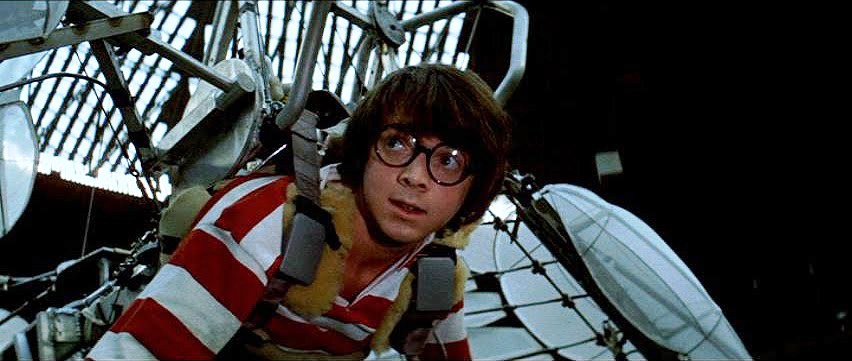
By Edward Copeland
Problem probably isn't the correct word to use here, but hey, I had to go for the play on the phrase since thanks to TCM I finally saw Robert Altman's Brewster McCloud. One word sticks in my brain after viewing his followup film to MASH: bizarre, bizarre, bizarre. It isn't unwatchable bizarre in the way Quintet is, but Brewster McCloud most decidedly spins a strange tale. It does though go a long way in explaining how Altman's reputation as an iconoclast got cast in cement in Hollywood. It took balls to follow up a critical and box office hit such as MASH with a loony lark like Brewster McCloud.
Bud Cort, who made his debut in MASH, stars as the title character, a young man who lives in a room inside the Houston Astrodome. We don't immediately know what his plan is, but we do know that people he comes in contact with keep turning up strangled to death, all marked mysteriously with bird shit.

The film begins with, and is frequently interrupted by, another MASH cast member, Rene Auberjonois, as "The Lecturer," who tells us facts about the history of birds in addition to making strange bird noises and movements. MASH co-stars populate the film including Sally Kellerman as Brewster's friend and protector, Michael Murphy as a San Francisco police detective brought in to help with the murder investigation, John Schuck as a Houston patrolman and G. Wood as a Houston police captain. It also introduces us to future Altman regular Shelley Duvall, features Altman repertory player Bert Remsen, William Windom, Jennifer Salt, a young Stacy Keach hidden behind old age makeup and Margaret Hamilton who even gets to die wearing ruby red slippers. It's got a helluva ensemble for such a weird and wacky tale. It's pretty amazing that Altman already had earned so much faith from so many actors to get them to take a chance on a film whose plot couldn't be called half-baked on a good day.
The movie opens as if to make certain we know it's not to be taken seriously as Leo, the sturdy old MGM lion, fails to emit his usual roar but instead comes forth with Auberjonois' voice saying he doesn't know what the next line is. The next thing we know, we are on the field of the Astrodome where Hamilton is leading a chorus in The Star-Spangled Banner as the credits roll. Someone messes up, so Hamilton insists they start over, only not only does the chorus start over, so do the credits. There even is a credit reading "Title song by Francis Scott Key."
When we meet Brewster, radio reports already speculate about a previous murder as he drives a rich old man (the one played by Keach, who wasn't even 30 years old) under all that makeup) who is going around town terrorizing various people and collecting money from them. It's pure lunacy, but it is funny. When an accident spills the cash from Keach's hands and Cort tries to collect it, the old man pulls a gun and accuses him of trying to steal it. He drops it and as the wind blows the bills to and fro, we see the film's first dropping of bird shit as it strikes Keach's old man. It's the film's equivalent of the mark of death. It also reminded me of all those dog shit jokes nearly a quarter-century later in Ready to Wear, which may be a more conventional movie than Brewster McCloud but also a worse one and definitely a less interesting one. Coincidentally or not, both films contain murder mysteries that hardly seem to matter.
My favorite performance of the film belongs to Murphy as Lt. Shaft (before a more famous Shaft played by Richard Roundtree entered movie lore) as he investigates the murders. He works as the movie's straight man and it makes him all the funnier, especially since it's a mystery that neither the movie nor the characters in it seem particularly interested in solving. Still, Murphy treats it seriously, as if his duty compels him to solve the killings. He's even interested in identifying the type of bird the shit is coming from and if it's the same one.
Reviewing Brewster McCloud does not prove an easy task for a critic. It's not as if I fear spoilers, because there's nothing crucial to ruin since the movie charts such a strange course in which twists don't matter. It's just too odd to analyze. It's not a good movie. I don't think I'd ever want to watch it again, but yet I wouldn't want to discourage Altman completists from seeking it out. Unfortunately, that's difficult to do. Warner Archives has made the film available for DVD purchase, but not for rental. I'm lucky I caught it on TCM because I imagine my reaction would be harsher if I'd spent $30 for this film, sight unseen, just because I'd never had the chance to see it before. Warner really should make rental copies available of its library as well if they are making DVD copies to order.
If you get the chance and you love Altman, Brewster McCloud probably is worth watching, if only so you can say that you've seen it, but I'd think twice before buying it blindly unless you have lots of disposable income.
Tweet
TO READ ON, CLICK HERE
Tuesday, March 09, 2010
Old Altmans never die (or fade away)
visions of the things to be
the pains that are withheld for me
I realize and I can see...
That suicide is painless
It brings on many changes
and I can take or leave it if I please.

By Edward Copeland
It began life as a novel by Richard Hooker, then Robert Altman transferred MASH into a movie and made his reputation. Later, Larry Gelbart transformed that film into a television comedy and made it a landmark series, adding the asterisks to the title M*A*S*H. Altman's film had its New York premiere in January 1970, but back in those days of slow, platform releases, there was no one day when it spread to the rest of the U.S. at once. The best I can find is that it was in March, so I pick today to mark the movie's 40th anniversary.
all our little joys relate
without that ever-present hate
but now I know that it's too late, and...
That suicide is painless
It brings on many changes
and I can take or leave it if I please.
When Johnny Mandel's theme played week after week on the CBS series for 11 seasons, I often wondered what it would have been like if they'd kept Altman's son's Mike's lyrics for "Suicide Is Painless" as well. The sitcom may have taken MASH as its essential template, but they had to draw the line somewhere. (Even an iconoclastic risk taker such as Altman had to let some things from the novel go that early in his career, so we weren't treated to scenes of Elliott Gould as Trapper John dressed as Christ, flying around Korea on a cross suspended from a helicopter and signing autographs to raise money for Ho-Jon's college fund.)
Still, Altman's movie certainly broke ground as far as war movies were concerned and definitely formed the
 initial portrait of what a Robert Altman film usually was like: large casts, overlapping dialogue using unusual recording techniques, largely plotless and when they worked, as they did with MASH, great films that changed the medium and that couldn't be mistaken as the work of another director. Watching MASH again for this piece, with its dizzying overheads of helicopters bringing the wounded to the 4077th, I thought of a comparison to another Altman opening for the very first time that came 23 years later: Short Cuts. Only in that instance, the helicopters weren't bearing the injured, they were spraying the injured with pesticide as part of California's battle with the Mediterranean fruit fly.
I'm gonna lose it anyway
The losing card I'll someday lay
so this is all I have to say.
That suicide is painless
It brings on many changes
and I can take or leave it if I please.

People who know the 4077th only from the TV series will certainly recognize the essential elements in the Altman movie, but they also will discover quite a few differences that follow the novel more closely. Only one cast member from the movie became a regular on the series and that was Gary Burghoff repeating his role as Radar. While the series began basically as Hawkeye (the great Donald Sutherland in the film) and Trapper
 against the world, the movie had a third surgeon: Duke, played by Tom Skerritt. While many of the MASH characters share names with the M*A*S*H characters, in many areas they bear little resemblance. Hawkeye is a married man in the movie, not that it prevents his playing around, not Alan Alda's single lothario from the series. Robert Duvall's Frank Burns lives light years away from the buffoonish character Larry Linville grew tired of playing on TV. He's a strictly religious, nondrinker who is teaching Ho-Jon to learn English through the Bible. ("Were you on this religious kick at home or did you crack up over here?" Sutherland's Hawkeye asks Frank as he prays beside his cot.) That doesn't prevent Frank from falling prey his lust for Maj. Margaret "Hot Lips" Houlihan (Sally Kellerman). However, in the movie, Burns gets carted away early in a strait-jacket after a single prank.
And lay it down before I'm beat
and to another give my seat
for that's the only painless feat.
That suicide is painless
It brings on many changes
and I can take or leave it if I please.
MASH is neither a conventional comedy nor a conventional war film and, since this a Robert Altman movie, you shouldn't expect a conventional climax either. Besides, in a film that is essentially untethered from any
 plot, how could there be? So, the big finish for the film's third act is anything but obvious: It's a football game (Shades of the Marx Brothers' Horse Feathers). The 4077th gets challenged to a game by the commander of the 325th Evac. As General Hammond (G. Wood) tells Col. Henry Blake (Roger Bowen) in proposing the game, football is one of the "best gimmicks to keep the American way of life going in Asia." Wood did re-create his role as Hammond in a couple of guest appearances in the early seasons of the TV series. In an eerie coincidence, when McLean Stevenson, the sitcom's memorable Henry Blake died, the following day Bowen died. It almost was like Bowen knew that his death would get little notice unless he piggybacked on Stevenson's as the other Henry Blake. Hammond, of course, has his own ringer, so Trapper and Hawkeye set out to obtain one for their team, a neurosurgeon named Dr. Jones who was better known in his college football days as Spearchucker
 Jones (the film debut of Fred Williamson). They try to brush off the racist nickname by having some ask him why he's called Spearchucker and having him answer that he used to throw the javelin. While I worship Altman, one thing I never quite understood was his insistence that the TV show was racist, specifically against the Koreans, but if anyone can notice any appreciable difference betweeen the film and TV show on that count, I'd love to hear the argument. One of the biggest cheerleaders for the game is Hot Lips and if I have a problem with the film, it's the quick and inexplicable conversion of the Margaret Houlihan character. She's introduced as a no-nonsense, by-the-book Army major, constantly being humiliated by the pranksters of The Swamp (and a wonderful Oscar-
 nominated performance from Kellerman). When Hawkeye first meets her, always out to put the make on some new female flesh, he gives it to her for putting him off his lust and that she's just a regular Army clown and he's going back to his tent to drink scotch. Houlihan vents her outrage to the film's Father Mulcahy (Rene Auberjonois), known here as Dago Red, asking how someone so crass as Hawkeye could reach a position of responsibility in the Army. "He was drafted," the priest replies. When the gang exposes her shower and nudity to the camp, she has a breakdown to Henry, insisting that, "This is not a hospital, it's an insane asylum!" Then, before you know it, she's fooling around with Duke and playing cheerleader. It's odd, but it's still a minor criticism in an otherwise great film. (I'm just thinking off the top of my head, but has any great movie been turned into an almost equally great television show the way MASH was?)
It doesn't hurt when it begins
But as it works its way on in
The pain grows stronger...watch it grin, but...
That suicide is painless
It brings on many changes
and I can take or leave it if I please.
As I mentioned before, MASH is the first example of the Robert Altman ensemble that he'd become famous for and many of the actors who would become part of the unofficial Altman repertory company would make appearances here. Elliott Gould would follow his great work as Trapper John with similarly solid work in Altman's The Long Goodbye and California Split and would appear as himself in Nashville and The Player.
 Skerritt returned to Altman for Thieves Like Us. Kellerman returned for Brewster McCloud and Ready to Wear and as herself in The Player. Duvall first appeared in Altman's Countdown and then reunited with him on The Gingerbread Man. Rene Auberjonois rejoined the director for Brewster McCloud, McCabe & Mrs. Miller and Images. David Arkin also appeared in The Long Goodbye, Nashville and Popeye. Last, but certainly not least, MASH marked the appearance of Michael Murphy who may have been the most regular of Altman regulars, appearing in McCabe & Mrs. Miller, Nashville, Brewster McCloud, Kansas City, Countdown, That Cold Day in the Park, Tanner '88, Tanner on Tanner, The Caine Mutiny Court-Martial and even episodes of TV's Combat, Kraft Suspense Theater and the 1964 TV movie Nightmare in Chicago. It also marked the film debut of Bud Cort who returned in Brewster McCloud. Surprisingly, the actor who gave the best performance in MASH never worked with Altman again. I always go back and forth as to whether or not Donald Sutherland's Hawkeye Pierce is lead or supporting but in either case, it is brilliant and yet another example of the outrage that this man has never received an Oscar nomination for anything. His little whistle as Hawkeye alone is a thing of wonder.
to answer questions that are key
'is it to be or not to be'
and I replied 'oh why ask me?'
'Cause suicide is painless
it brings on many changes
and I can take or leave it if I please.
...and you can do the same thing if you choose.

Alright, about that song. The painless it refers to is not just the idea that suicide is free from hurt but refers to a very specific character in MASH: Painless Pole the dentist, portrayed by another Altman regular, John
 Schuck. Painless has a reputation not only as a Don Juan but as being particularly well endowed, so much so that when it's his turn in the shower, people take turns gazing upon his impressive manhood. The song opens the film but it is reprised again later when Painless, after a bout of impotence, becomes convinced that he may carry some latent homosexuality and even though he's never had any form of gay sex, he figures it's just a matter of time so he goes to Hawkeye for help for a way out. A last supper is arranged, where Painless will take the Black Capsule and commit suicide. Of course, Hawkeye has no intention of helping Painless to kill himself but instead enlists Lt. Dish (Jo Ann Pflug) to sleep with the unconscious Painless and restore his confidence. It works. There even is an instrumental, heavenly choir version of "Suicide Is Painless" to accompany the scene.
Since MASH may well be the among the most plotless of Robert Altman's works (at least of the successful ones), I figured my appreciation of the film should be equally aimless, but I still had a few more things to say
 and I've run out of stanzas to the song, so I'll just go with them. I love Altman's use of sound, already coming to life here, but particularly in the fun loudspeaker announcements. My personal favorite: the announcement that the American Medical Association had classified marijuana as a dangerous drug, despite previous studies that had found it no more harmful than alcohol. Also, it's worth noting that MASH did garner many Oscar nominations but in a tumultuous year such as 1970, there was no way that the stodgy Academy would go with the subversive Korean War comedy that everyone knew was really about Vietnam. (The Oscar went with the rah-rah jingoism of Patton.) MASH did manage to win adapted screenplay, which was particularly sweet, because its writer was Ring Lardner Jr., one of the most infamous victims of the Hollywood blacklist. Though Robert Altman had made features prior to MASH, truly this is the film that started the Altman canon and career and began to create the legend the late director became.
Tweet
Labels: 70s, Alda, Altman, blacklist, Bud Cort, D. Sutherland, Duvall, Gelbart, Marx Brothers, Movie Tributes, Television
TO READ ON, CLICK HERE


