Saturday, July 31, 2010
From the Vault: Ghost World

By Edward Copeland
Movies can succeed by taking you to places you've never known or showing you worlds you know too well. The latter is the land where Ghost World resides.
Ghost World spins the tale of Enid (Thora Birch), a high school graduate (assuming she makes up a failed art class in summer school) who pursues her angst enthusiastically, dwelling almost exclusively in a land of deadpan irony with her best friend Rebecca (Scarlett Johansson).
Enid cloaks herself in wardrobes and hairstyles designed to provoke, daring the world to mock her while she sneers at everything and everyone she encounters. Birch, so good as a different type of alienated teen in American Beauty, nails Enid, capturing her wit and her pathos. Birch seems likely to escape the child actor's curse as she moves into adult roles.
Faithfully adapted by Daniel Clowes and director Terry Zwigoff from Clowes' great comic book, how well Ghost World works depends almost entirely on the degree with which you recognize its characters.
The movie's biggest departure from the comic book is the character of Seymour, a middle-age bachelor and audiophile who begins an unlikely friendship with Enid. Steve Buscemi plays Seymour and it's his best role in quite some time. He slips so easily into Seymour's skin, you'd think a tailor had sewn the character to him.
Zwigoff makes his fiction directing debut with Ghost World, his first feature since making 1995's best film, the documentary Crumb. Zwigoff's pacing lags occasionally, but it seems right for a film about a character as directionless as Enid.
Still, Ghost World entertains consistently, using its sarcasm to hide its more downbeat turns. Again, if this universe seems familiar, you have to know those moments are inevitable.
Ghost World won't please everyone and will leave some viewers cold. However, for those who recognize friends and acquaintances in its vivid character sketches, the movie provides a nostalgic tonic of warmth.
Tweet
Labels: 00s, Buscemi, Johansson, Terry Zwigoff
TO READ ON, CLICK HERE


Thursday, May 24, 2007
Portrait of a movie as a near-miss
By Edward Copeland
With the exception of the dark-spirited fun that is Bad Santa, all of Terry Zwigoff's films as director since the great documentary Crumb have revolved around art to some extent.
Reuniting with Daniel Clowes, the author of the comic and screenplay for Ghost World, Zwigoff released Art School Confidential last year, to mostly mixed reviews. While it doesn't come close to his last three films, there certainly is more there than most gave the film credit for.
Max Minghella stars as Jerome, a freshman at a somewhat prestigious arts college who hasn't found time for romance or a way to truly satisfy his artistic yearnings, being that much of his time has been spent on the wrong end of bullies' fists. Strathmore Academy offers him a chance at a new start on all levels through a beautiful young woman (Sophia Myles) and a professor who acts as a somewhat loopy artistic mentor (John Malkovich).
Much of the comedy, while familiar, works thanks to the stellar supporting cast which in addition to Malkovich includes Ethan Suplee, Joel David Moore, Jim Broadbent and Steve Buscemi. The jabs at college and the art world have been done many times and better, but they still land on their targets more often than they miss. However, then comes the serial killer subplot.
I'd read most of the criticisms of the movie relating to this story strand, so I was prepared for it. Still, the reason the killer plot doesn't work is less because it seems out of place it's that once it develops, it's pretty clear where it's headed and what the film has in mind as an ultimate statement and that also has been done much better elsewhere (From The King of Comedy to To Die For and others too numerous to mention).
As a result, I got impatient because I was so far ahead of the film and I think that is what ultimately sinks it. Still, there are enough engaging moments and funny moments to save it from being a complete misfire.
Tweet
TO READ ON, CLICK HERE
With the exception of the dark-spirited fun that is Bad Santa, all of Terry Zwigoff's films as director since the great documentary Crumb have revolved around art to some extent.
Reuniting with Daniel Clowes, the author of the comic and screenplay for Ghost World, Zwigoff released Art School Confidential last year, to mostly mixed reviews. While it doesn't come close to his last three films, there certainly is more there than most gave the film credit for.
Max Minghella stars as Jerome, a freshman at a somewhat prestigious arts college who hasn't found time for romance or a way to truly satisfy his artistic yearnings, being that much of his time has been spent on the wrong end of bullies' fists. Strathmore Academy offers him a chance at a new start on all levels through a beautiful young woman (Sophia Myles) and a professor who acts as a somewhat loopy artistic mentor (John Malkovich).
Much of the comedy, while familiar, works thanks to the stellar supporting cast which in addition to Malkovich includes Ethan Suplee, Joel David Moore, Jim Broadbent and Steve Buscemi. The jabs at college and the art world have been done many times and better, but they still land on their targets more often than they miss. However, then comes the serial killer subplot.
I'd read most of the criticisms of the movie relating to this story strand, so I was prepared for it. Still, the reason the killer plot doesn't work is less because it seems out of place it's that once it develops, it's pretty clear where it's headed and what the film has in mind as an ultimate statement and that also has been done much better elsewhere (From The King of Comedy to To Die For and others too numerous to mention).
As a result, I got impatient because I was so far ahead of the film and I think that is what ultimately sinks it. Still, there are enough engaging moments and funny moments to save it from being a complete misfire.
Tweet
Labels: 00s, Broadbent, Buscemi, Malkovich, Terry Zwigoff
TO READ ON, CLICK HERE
Saturday, September 16, 2006
From the Vault: Crumb

Year after year, like clockwork, the annual announcement of the Oscar nominations brings the expected ritual of bellyaching about omissions. In the past decade, critics directed their most consistent shouts at the documentary branch which repeatedly overlooked films they'd actually seen and praised but didn't make the nomination cut. In the 1994 contest, most of the whining commenced on behalf of the impressive sports documentary Hoop Dreams, but there was a better documentary that similarly got the shaft: Crumb, which takes a look at the family and life of underground comic artist Robert Crumb, creator of Fritz the Cat and the "Keep on Truckin'" guy of the late 1960s and early 1970s. Crumb's revenge on the Academy may take the form of box office as it now has received wide theatrical release this year. Gaining an audience for this remarkable film is a much greater reward.
It's also indicative of how, as Hollywood's formula machine churns out more predictable, escapist fare, it has almost become the exclusive responsibility of documentarians to produce real-life stories with the ability to surprise.
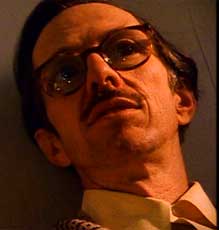
David Lynch is one of the producers of Crumb, produced and directed by Terry Zwigoff, and it's easy to see the appeal of this subject matter to that unique filmmaker. The documentary doesn't just plunge into the sometimes racist and nearly always misogynistic work of the eccentric Crumb, but it also focuses on the environment that produced such a mind and shows us his brothers, also artistically inclined but lacking R.'s knack for turning his dysfunction into a career. What makes Crumb so fascinating is that it's more than just a portrait of the artist as a sick man, it's a look at family as well as the pomposity of so-called experts who pontificate about the meaning, both good and ill, in Crumb's work while Crumb stands next to them, shrugging, smiling and arching his eyebrows in humorous exasperation.
The opening shot perfectly illustrates what lies ahead as Crumb sits, rocking on the floor of his house listening to music, one of the few times, he later explains, that he feels any love for humanity. When you first hear R. Crumb's voice, it almost resembles Dustin Hoffman as Rain Man, but R. exhibits more savant than autistic.
The film chronicles Crumb's life and career as the artist and his second wife, Aline, pack up their Winters, Calif., home to move to France, which Crumb describes as "slightly less evil" than the United States, though he insists that's not why he's leaving. It's his disgust with advertising and a lack of intellectual curiosity on the part of Americans.
During the course of the film, Crumb returns to his mother's home where his older brother, Charles, dependent on antidepressants to combat suicidal tendencies, still resides with their mother. Even in Charles' chemically altered state, the hero worship that R. holds for his older brother still shows.
R. Crumb escaped the house, made a name for himself, married and had children, but he's still clearly envious of his troubled brother, something which Charles attributes to Crumb being "so detached from humanity."
What impresses most about Zwigoff's film is that even if you go into it knowing next to nothing about R. Crumb, as I did, you leave feeling you are intimate with the man and all aspects of his life. While his work easily riles a lot of people, the film clearly shows why he's worth studying and, more impressively, raises the idea that art doesn't always come from the purest of intentions.
Tweet
Labels: 90s, Documentary, Dustin Hoffman, Lynch, Oscars, Terry Zwigoff
TO READ ON, CLICK HERE


